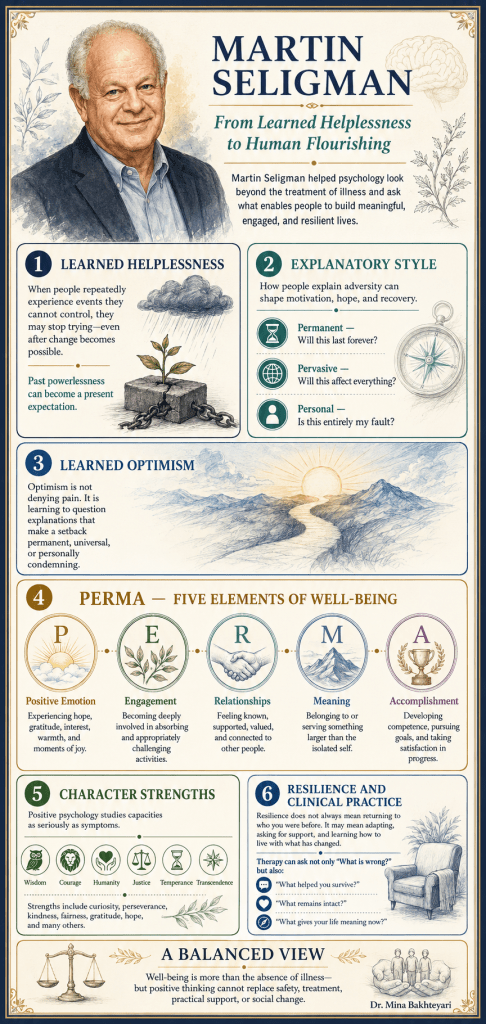
For much of its history, psychology became involved in people’s lives after something had gone wrong. It studied anxiety, depression, trauma, conflict, and psychological disorders, and developed increasingly sophisticated ways of describing and treating them. This work was necessary. However, Martin Seligman began to question whether psychology had allowed human suffering to define too much of its subject matter.
- If therapy reduced a person’s depression, did that necessarily mean the person would feel engaged with life?
- If anxiety became manageable, would meaning, connection, and hope naturally appear?
- If psychological health was more than the absence of symptoms, why had psychology devoted relatively little attention to the conditions that help people flourish?
These questions eventually became central to positive psychology. Although Seligman did not invent the study of happiness, resilience, or human strength, he helped bring these subjects into the center of contemporary psychological research. His work encouraged psychologists to examine not only what weakens people, but also what enables them to recover, participate in life, form meaningful relationships, and continue moving forward when life becomes difficult.
What makes Seligman’s contribution especially interesting is that it began with happiness and with helplessness.
Before Positive Psychology: The Discovery of Learned Helplessness
Early in his career, Seligman became known for his research on learned helplessness. The idea emerged from experimental studies examining what happens when an organism is repeatedly exposed to an unpleasant situation it cannot control. It was not simply that uncontrollable experiences caused distress. It was that their effects could continue even after circumstances changed. When escape later became possible, the organism might no longer try to escape. Previous experience had taught it that action was ineffective.
The physical barrier had disappeared, but the expectation of powerlessness remained; this finding offered a compelling way to think about certain features of depression. Moreover, people who have repeatedly experienced failure, rejection, abuse, humiliation, or uncontrollable loss may gradually stop believing that their actions can change anything.
They appear passive, unmotivated, or resistant, while internally they have reached a different conclusion (effort does not matter); from this perspective, helplessness is not necessarily a lack of ability; it can be something learned through experience.
- A person may remain in an unhealthy relationship because previous attempts to protect herself led nowhere.
- Another may stop applying for jobs after repeated rejection.
- A child who is continually criticised may eventually avoid challenges altogether, not because the child lacks intelligence, but because trying has become emotionally dangerous.
In conclusion, even when new opportunities appear, the person may respond according to an older reality. This is one reason helplessness can be difficult to recognise. From the outside, it looks like inaction. From the inside, it often feels like realism.
The Importance of Perceived Control
Seligman’s early work drew attention to the psychological importance of control. Human beings do not need complete control over life; such control is impossible, but they do need some sense that their choices and responses have consequences.
When people experience themselves as not influencing important outcomes, motivation begins to weaken, and they become less curious, less persistent, and less willing to take emotional risks. Over time, helplessness can affect behaviour, memory, attention, and expectations about the future.
However, the theory was never simply about difficult events. Two people may experience similar failures and respond very differently. One sees failure as evidence that nothing will ever improve. The other sees it as painful but temporary. The event matters, but so does the meaning assigned to it. This led Seligman toward the study of explanatory style.
Explanatory Style: How People Interpret Adversity
Explanatory style refers to the habitual way a person explains why events happen. According to that concept, Seligman and his colleagues focused particularly on three dimensions: permanence, pervasiveness, and personalisation.
A person with a pessimistic explanatory style may interpret a setback as:
- Permanent: This will always be this way.
- Pervasive: This affects everything in my life.
- Entirely personal: It happened because something is fundamentally wrong with me.
Consider someone whose relationship has ended. She might think, No one will ever stay with me. Every relationship I have will fail. I am simply unlovable. A single loss has become permanent, global, and deeply personal.
Another person may experience the same heartbreak but understand it differently. His thoughts are that included; this relationship ended because we could not resolve certain problems. I am suffering now, but this feeling will not last forever. The loss does not determine the value of the rest of my life. The second interpretation does not deny pain. It gives pain boundaries.
This distinction is important because healthy optimism is often misunderstood as positive thinking. Seligman was not suggesting that people should replace every unpleasant thought with a cheerful one. Realistic optimism does not require a person to pretend that circumstances are better than they are. It involves resisting the tendency to make suffering larger, more permanent, or more personally condemning than the evidence supports.
In clinical work, this difference matters enormously. A client does not need to be persuaded that everything will be fine. Often, the more useful task is to examine whether the present difficulty has become fused with an absolute conclusion about the self or the future. Something painful happened is not the same as My life will always be painful.
- I was rejected is not the same as I am unworthy of love.
- I could not control that situation is not the same as I have no influence over what happens next.
Psychology Had Learned to Treat Illness—but Not Always to Build Health
Seligman’s later work developed from a simple but far-reaching observation: removing suffering and creating well-being are related, but they are not identical.
A person may no longer meet the criteria for major depressive disorder and still feel empty. Panic attacks may stop, yet the person may remain isolated and directionless. Therapy may reduce symptoms without helping someone discover what gives life personal significance.
Seligman argued that psychology should study the positive dimensions of human functioning with the same seriousness it had applied to mental illness. This included well-being, hope, resilience, character, creativity, meaningful activity, and the conditions that support strong relationships and communities.
Positive psychology emerged from this shift in attention, and positive psychology asks a more complete question: alongside understanding what causes distress, what helps people live well?
Positive psychology emerged from this shift in attention. Its purpose was not to replace the study of suffering. Nor was it meant to suggest that people can overcome trauma, poverty, discrimination, illness, or grief merely by adopting a better attitude. At its best, positive psychology asks a more complete question: alongside understanding what causes distress, what helps human beings live well?
From Happiness to Well-Being
Seligman’s earlier writing placed considerable emphasis on authentic happiness. Over time, however, he became dissatisfied with happiness as the central goal. Happiness is difficult to define and is often reduced to a pleasant emotional state. However, a meaningful life is not always pleasant. Raising a child, caring for an ill parent, completing demanding work, or standing by an important moral commitment may involve frustration, exhaustion, and grief. People may willingly accept these experiences because the activity matters to them.
This led Seligman to develop his theory of well-being, commonly represented by the acronym PERMA, which is the short form of these words:
- Positive Emotion
- Engagement
- Relationships
- Meaning
- Accomplishment
They are distinct elements that can contribute to a life that feels worthwhile.
Positive Emotion
Positive emotion includes pleasure, gratitude, hope, affection, calmness, interest, and joy. These experiences matter, but Seligman did not argue that people should remain positive at all times. A psychologically healthy life includes painful emotions. Grief reflects attachment, anger may signal a violation, fear can protect us from danger, guilt may draw attention to behaviour that needs repair. Attempts to eliminate every uncomfortable feeling can make people less flexible, not more resilient.
Positive emotions are valuable, in part, because they widen psychological space. In moments of fear or despair, attention narrows on the threat.
Experiences such as warmth, humour, interest, and gratitude can make other possibilities visible again; the goal is not emotional perfection. It is the ability to experience moments of goodness without believing that pain must disappear first.
Engagement
Engagement describes deep involvement in an activity. It is closely related to the idea of flow: a state in which attention becomes fully absorbed, self-consciousness decreases, and the person is challenged without being overwhelmed. Engagement may occur while writing, teaching, creating art, solving a problem, practising a skill, playing music, or having a demanding conversation. What produces engagement differs between individuals. The important feature is that the person is not merely passing time but participating fully.
This aspect of well-being is particularly relevant in an age of constant distraction. In other words, people can remain busy all day without feeling genuinely involved in anything; engagement requires more than activity. It involves the meeting point between attention, ability, and meaningful challenge.
Relationships
Seligman stated that relationships are essential to well-being. From his perspective, human flourishing is rarely an entirely private achievement. People need to feel known, valued, supported, and able to contribute to the lives of others.
What appears to be loneliness is not always a lack of company; sometimes it is the absence of a relationship in which a person can be psychologically present without performing. Hence, Relationships do not need to be perfect or numerous, and one emotionally safe connection matters more than a large social network.
In addition, the relational element of PERMA also prevents positive psychology from becoming an individualistic project of self-improvement. A person’s emotional life cannot be separated from the environment in which that life unfolds. The quality of families, workplaces, schools, communities, and social institutions shapes well-being.
Meaning
Meaning involves belonging to or serving something larger than the isolated self. In other words, it is found through family, spirituality, community, professional responsibility, creativity, social contribution, or commitment to a cause.
Meaning is not the same as pleasure. In fact, some of the most meaningful parts of life require sacrifice. A psychologist may feel emotionally tired after a difficult session while still knowing that the work matters. A parent may experience years of worry and effort alongside a deep sense of purpose. Someone caring for a loved one may feel grief and meaning at the same time. Meaning does not remove suffering. It changes the place suffering occupies within the person’s life.
Accomplishment
Most people need to feel that they can do something well. Finishing a difficult task, becoming better at a skill, or noticing that months of effort have finally led somewhere can bring genuine satisfaction. There is nothing unhealthy about wanting to succeed.
The problem begins when achievement becomes the only way a person knows how to feel good enough. Some people move from one goal to the next without ever really enjoying what they have done. Success brings relief for a short time, but soon another target takes its place. They are not only working toward something they want; they are also running from the fear that, without achievement, they may not be worth very much.
A healthier relationship with accomplishment feels different. A person can work hard and take pride in the result, but can also rest without feeling guilty or useless. In therapy, this often leads to a more revealing question than “What have you achieved?” We might ask, “Who do you feel you are when you are not achieving anything?”
Character Strengths
Another major development in positive psychology was the systematic study of character strengths. Working with Christopher Peterson and other researchers, Seligman contributed to a classification of strengths that included qualities such as curiosity, courage, kindness, fairness, gratitude, humour, perseverance, and social intelligence. The intention was to create a language for describing what is strong in a person, not only what is disordered.
Clinical assessment often begins with difficulties: What symptoms are present? What has gone wrong? Which criteria are met? These questions are necessary, but they provide an incomplete picture. Two people with the same diagnosis may possess very different capacities, values, relationships, and sources of resilience.
A strengths-based approach brings different questions into the room. How did this person manage to keep going? What parts of her remained alive, even during the worst periods? When does she feel most like herself? She may already be drawing on important strengths without recognising them as such.
A woman who has always been told that she is too sensitive may, in fact, notice emotional details that others miss. Someone described as stubborn may have relied on that same determination to survive years of difficulty. A child raised in a chaotic home may become unusually skilled at reading people’s moods. Later in life, however, this skill can turn into constant watchfulness, anxiety, and a habit of caring for everyone except herself.
This does not mean that every painful adaptation should be celebrated. What protected someone in the past may now be limiting her life. Still, it helps to recognise what was intelligent or resourceful within that response. Change often becomes easier when the person is understood with respect rather than treated as a collection of problems.
Resilience Is Not the Absence of Pain
Seligman’s ideas have strongly influenced contemporary approaches to resilience. However, resilience is sometimes described too simply, as though resilient people recover quickly and remain positive under pressure.
In real life, resilience does not always look strong or inspiring. Someone can be going through a difficult period and still feel angry, confused, tired, or discouraged. They may need therapy, medication, practical support, or time away from their usual responsibilities. Needing help does not make them any less resilient.
Nor does resilience always mean becoming the person you were before the experience. Sometimes life has changed too much for that. It may simply mean asking for support, accepting new limits, and gradually learning how to live with what has happened. People do not always bounce back. Sometimes they move forward with the experience still very much a part of them.
The Limits and Misuse of Positive Psychology
Seligman’s work has had an enormous influence, but positive psychology has also attracted justified criticism. Its ideas can become harmful when they are reduced to slogans about choosing happiness or maintaining a positive mindset. Such messages can place responsibility for suffering entirely on the individual while ignoring trauma, inequality, illness, financial insecurity, discrimination, or unsafe relationships.
Gratitude should never be used to make someone tolerate abuse, and optimism is no substitute for being safe. Finding meaning in hardship does not make injustice acceptable. When a person is living in genuinely harmful circumstances, encouraging positive thinking may do very little, or even leave them feeling blamed for their pain. What they need first may be protection, practical support, access to resources, and a real change in their circumstances.
There is also a risk of turning well-being into another performance standard. People may begin to judge themselves for not feeling grateful enough, productive enough, or emotionally positive enough. Positive psychology then becomes another source of inadequacy. A mature reading of Seligman requires more nuance. Human well-being is not created by denying the negative. It develops through the ability to hold difficulty and possibility in the same psychological space.
Seligman’s Place in Psychotherapy
Unlike Aaron Beck or Marsha Linehan, Seligman is not known for developing one specific form of therapy. His contribution was broader: he encouraged psychologists to ask different questions about what people need—not only to recover from distress, but also to build a life that feels meaningful and worth living.
Therapy informed by his work does not stop at symptom reduction. Once a client has greater stability, the focus can expand:
- What kind of life is now possible?
- Which relationships deserve investment?
- Where does the client experience engagement?
- What values or responsibilities create meaning?
- Which strengths have been hidden beneath years of shame?
- What would accomplishment look like if it were no longer driven by fear?
These questions should not be introduced too early or used to bypass suffering. A grieving person may first need room to grieve. Someone living in danger needs safety before flourishing can become a realistic therapeutic aim. Timing matters.
However, eventually, many clients reach a point where understanding the past is no longer enough. They want to know how to inhabit the future.
A More Complete Picture of Psychological Health
Perhaps Seligman’s most enduring contribution is the insistence that mental health cannot be defined only by what is absent.
A person that have fewer symptoms and still lacks a life that feels personally meaningful. Another person may live with continuing psychological difficulty while maintaining love, purpose, engagement, and dignity. Human well-being does not fit neatly on a scale that runs from illness to health.
Seligman helped psychology recognise a second dimension: the development of what is valuable in life.
His work began with the discovery that people can learn helplessness. It later turned toward a more hopeful possibility, that people can also develop agency, recognise strengths, revise pessimistic expectations, and build lives containing meaning and connection.
Not every loss leads to growth, and suffering does not always leave behind a valuable lesson. Some experiences simply hurt, and some situations are deeply unfair. People should never feel pressured to find something positive in their pain, especially before that pain has been recognised and understood. A quieter kind of insight in Seligman’s work offers hope: what happened to a person shapes them, but it does not tell the whole story of who they are. Therapy can help ease suffering and help someone reconnect with relationships, interests, purpose, and the parts of life that once felt beyond reach.
The purpose is not to be happy all the time. It is to create a life in which joy, sorrow, effort, relationship, purpose, and uncertainty can all exist—and in which the person still has reasons to continue.
Dr Mina Bakhteyari
 Dr Mina Bakhterari Haftlangi
Leave a comment