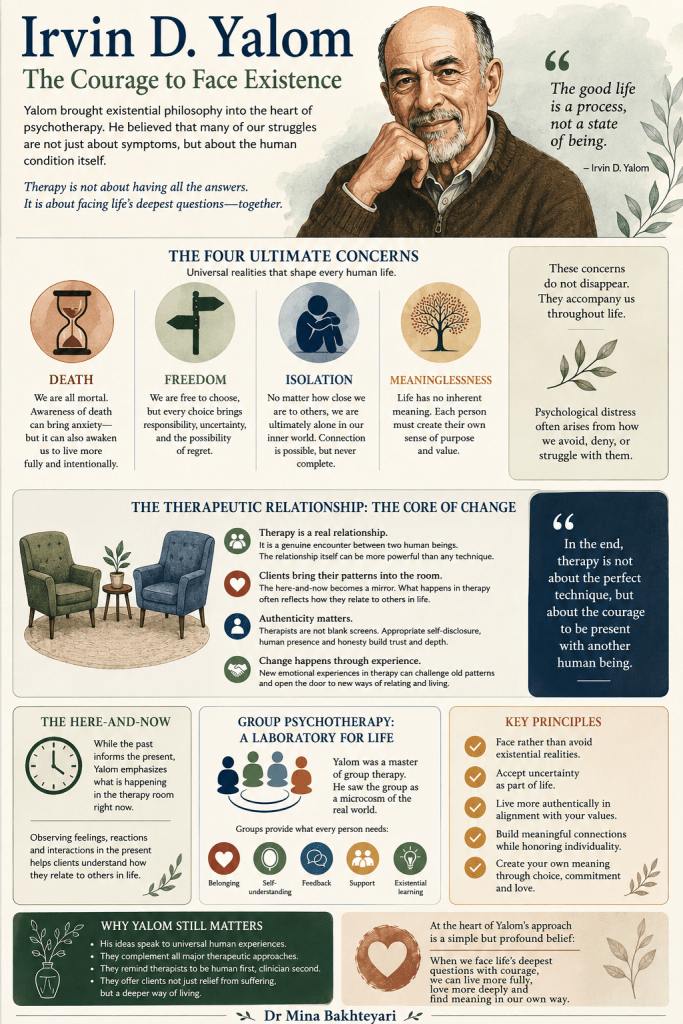
Why does therapy begin with Being Human? When Symptoms Are Not the Whole Story?
There is a moment in almost every therapist’s career when diagnoses begin to feel smaller than the people sitting across from them. Two clients may meet the criteria for the same disorder, yet their suffering can be entirely different. In other words, one person is overwhelmed by grief after losing a partner, another feels trapped in a successful career that no longer has meaning, and a third cannot explain why life feels empty despite having everything they once wanted. The diagnosis helps organize the clinical picture, but it rarely explains what the person is actually living through.
Irvin Yalom spent much of his career paying attention to that difference and never dismissed diagnosis or psychological science. Instead, he believed that something essential could be lost if therapy focused only on symptoms. Behind anxiety, depression, relationship difficulties, or chronic dissatisfaction, he often saw people struggling with questions that belong to every human life. How do we cope with the knowledge that life is finite? What does it mean to make choices when no one can guarantee they are the right ones? How do we remain connected to others while knowing that parts of our inner world will always remain private? Moreover, perhaps the most difficult question of all is how do we create a meaningful life when certainty is impossible?
These were not philosophical puzzles for Yalom. They appeared in his consulting room every day. A patient might come because panic attacks had become unbearable, but over time, the conversation would reveal a growing fear of aging. Another might describe years of conflict in intimate relationships, only to discover a profound fear of emotional closeness. Someone else might insist that work was the problem, when underneath was the unsettling feeling that success had never answered the question of why they were working so hard in the first place.
For Yalom, symptoms often pointed beyond themselves. They were important, but they were also part of a much larger story. This way of thinking made his work feel different from many traditional approaches to psychotherapy. Instead of asking, How can we eliminate this symptom?, he often became curious about what the symptom was protecting the person from confronting.
For example, anxiety is not simply anxiety, but sometimes it reflects the discomfort of realizing that life was changing, not just conceptually. Another example, depression was not always only a mood disorder, but it emerged after years of living according to expectations that no longer felt authentic. Moreover, even loneliness could become more than social isolation and expose the uncomfortable truth that no relationship can completely erase a person’s sense of separateness.
That perspective did not make suffering less painful. If anything, it acknowledged how complicated emotional life really is. Yalom believed that psychotherapy should not rush to simplify experiences that are inherently complex. Some forms of distress cannot be understood without looking at the larger context of being human.
In addition, his work continues to resonate across different schools of psychotherapy; whether a clinician primarily practices cognitive behavioral therapy, schema therapy, psychodynamic therapy, ACT, or emotion-focused therapy, the questions Yalom raised rarely disappear. Furthermore, techniques differ, but every therapist eventually meets clients whose greatest struggles cannot be explained by cognitive distortions alone or by childhood experiences alone. At some point, people begin asking questions about purpose, responsibility, love, freedom, regret, and mortality. Those conversations require more than technique. They require genuine human presence.
Yalom writting was clinician, and he had spent decades listening carefully to people trying to make sense of their lives, and his confidence came not from certainty but from curiosity, and his writings are enduring. During his research, again and again, he returned to the same belief that this definition holds: before individuals are patients, therapists, researchers, or teachers, they are human beings facing many of the same realities.
That idea sounds simple, but it quietly changes the entire therapeutic relationship. The therapist is no longer someone standing outside the client’s experience, armed only with expertise. Both people in the room know what it means to lose someone they love, understand uncertainty, will grow older and are trying, in their own ways, to live meaningful lives despite knowing that life offers no permanent guarantees.
For Yalom, this shared humanity was never a weakness in psychotherapy. It was where the real work began.
The Four Existential Concerns: The Questions We Never Fully Escape
If there is one idea that sits at the heart of Yalom’s work, it is this: beneath our individual stories lie a handful of universal concerns. They do not belong to people with mental illness, nor are they limited to those who seek therapy. They are simply part of being human.
Yalom described these concerns as the ultimate concerns of existence. They are not problems that can be solved once and for all. Instead, they remain in the background of life, becoming more noticeable during periods of change, loss, illness, success, or transition. Most of the time, we are busy enough not to think about them directly. Then something happens, a diagnosis, the end of a relationship, the birth of a child, retirement, the death of a parent, and questions we have managed to avoid suddenly feel impossible to ignore.
According to Yalom, much of psychological distress can be understood as the ways people respond to these realities rather than the realities themselves.
Death: Living While Knowing Life Will End
Death was the existential concern that Yalom returned to most often, yet he rarely spoke about it in dramatic terms. He was less interested in death itself than in how the awareness of mortality quietly shapes everyday life.
Most people do not wake up each morning thinking about death. However, in subtle ways, the awareness of it influences the choices they make, the risks they avoid, and the relationships they invest in. Most of the time, it stays quietly in the background. However, sometimes it moves sharply into focus-after the loss of a loved one, a serious illness, or simply the realization that time seems to pass faster with each passing year. In therapy, this fear rarely presents itself openly.
Instead, it often shows up in disguise: one client may struggle with constant anxiety about their health, another throws themselves into work, unable to slow down because they fear wasting time. Someone else feels an increasing sense of panic as birthdays become harder to celebrate. They may never speak about death directly, yet it remains a powerful force shaping their emotional world.
Yalom stated that avoiding thoughts of mortality does not make the fear disappear. He observed that the more people try to suppress it, the stronger it becomes.
At the same time, he observed something surprising: when people begin to accept the reality that life is finite, they often start living more intentionally. Knowing that time is limited can bring clarity to what truly matters. Conversations become more genuine, relationships deepen, and everyday moments take on greater meaning. Paradoxically, accepting mortality may deepen one’s engagement with life.
Freedom: The Weight of Choosing
Most people think of freedom as something desirable and celebrate independence, personal choice, and the ability to shape their own future; in Yalom’s perspective, that is more complicated. In other words, freedom means responsibility, and every meaningful choice closes the door on countless alternatives. No one else can ultimately decide how individuals should live, and that realization can be surprisingly uncomfortable.
Many clients arrive in therapy convinced that their circumstances leave them with no options. Sometimes that is true. However, often, what appears to be helplessness is actually the fear of making a choice and living with its consequences.
- Should I leave this relationship?
- Should I change careers?
- Should I forgive?
- Should I become a parent?
No therapist can answer these questions for another person. At best, therapy creates enough space for people to hear their own answers more clearly.
Uncertainty is the price of freedom with very few guarantees in life; waiting for complete certainty often becomes another way of avoiding responsibility. In addition, growth begins when people recognize that they cannot control every outcome, but they can choose how they respond.
Isolation: The Distance Between People
During times, human beings need connection and decades of psychological research have shown that relationships influence both mental and physical health. Nevertheless, even the closest relationships have limits. No matter how deeply someone loves another person, no one can fully experience their thoughts, memories, or emotions exactly as they do.
Yalom called this existential isolation, and that is different from loneliness. A person can feel profoundly lonely in a crowded room, yet another may spend days alone without feeling isolated at all. Existential isolation refers to something deeper—the recognition that every individual ultimately experiences life from within their own consciousness. At first glance, that idea sounds bleak. Yalom did not see it that way.
He believed that accepting this reality allows relationships to become more genuine. Instead of expecting another person to erase loneliness, we begin to appreciate the extraordinary fact that two separate individuals can still understand one another remarkably well.
Although therapy itself reflects this balance, the therapist and the client can never be in each other’s place. That means that, although in the therapy process and through careful listening, empathy, and emotional honesty, they create moments in which one person genuinely feels understood, those moments do not eliminate existential isolation; they make it easier to bear.
Meaning: The Question That Never Quite Goes Away
Existential concern has become more visible in recent decades than the search for meaning. Many clients are not asking, how can I stop feeling anxious? Instead, they quietly wonder, Why does any of this matter?
This kind of question can pop up in someone after achieving everything they once believed would make them happy, while others experience this question after retirement, divorce, children leaving home, or the loss of someone central to their identity.
Yalom argued that people gradually create, through the way they live, the relationships they build, the work they choose, and the values they practice, the meaning of their life. In other words, it is not something waiting to be discovered like a hidden object or a universal formulated that gives one person’s life purpose but may leave another completely unmoved. This is why existential therapy avoids prescribing meaning. The therapist cannot hand a client a purpose in the same way they might teach a coping skill. Instead, therapy becomes a place where people examine whether the life they are living reflects the life they genuinely wish to live.
That process is significantly uncomfortable most of the time. It requires grieving over years spent pursuing goals that belonged to someone else, it involves accepting that certainty will never arrive, and it means beginning again later in life than expected.
Yalom claimed that these four concerns could not be eliminated because they accompany every stage of life and are woven into the human condition itself. He was fascinated by the existence of these realities and by the countless ways people respond to them. Some avoid them through perfectionism, achievement, or constant distraction. Others become trapped by fear. Still others discover that facing these questions, difficult as they are, can become the beginning of a more authentic life.
For Yalom, psychotherapy was never about helping people escape the realities of existence. It was about helping them face those realities with greater openness, honesty, and courage.
The Relationship Comes Before the Technique
Asking of an experienced therapists what they remember most vividly after twenty or thirty years of practice, and few will begin by talking about techniques. They remember people.
The woman who spent months insisting she was “fine” before quietly admitting she had not felt close to anyone in years. The man who arrived wanting help for panic attacks but gradually realized he had organized his entire life around avoiding disappointment. The young student who came because of Anxiety and eventually found herself grieving a childhood she had never allowed herself to mourn.
These are the moments that tend to stay with clinicians. Not because a particular intervention worked perfectly, but because something shifted between two people sitting in the same room.
Yalom understood this long before research on the therapeutic alliance became one of the strongest findings in psychotherapy. He certainly valued theory, and he never argued that techniques were unimportant. However, he questioned the assumption that techniques, by themselves, create change. His question was surprisingly simple.
What happens between the therapist and the client while those techniques are being used?
That question eventually became one of the foundations of his clinical work. It is easy to imagine therapy as something that a therapist does to another person. The therapist analyzes, interprets, teaches, or challenges. However, anyone who has practiced psychotherapy knows the experience is rarely that straightforward.
Cognitive restructuring affects clients in different ways; some clients respond immediately to it, but others understand every worksheet they complete and still leave each session feeling exactly as they did before. Occasionally, a single conversation changes something that months of carefully planned interventions never touched.
Those moments are difficult to explain if we think of therapy only as a collection of methods. Yalom suggested looking somewhere else. Instead of asking Which intervention should I use next? he encouraged therapists to notice what was happening in the relationship itself. Was the client beginning to trust? Were they hiding something because they expected criticism? Had they started trying to please the therapist instead of speaking honestly? Was the therapist becoming impatient without realizing it?
These questions may sound ordinary, but they often reveal far more than another symptom checklist. One of Yalom’s most distinctive ideas was that the therapeutic relationship is never neutral. Clients do not leave their relational patterns outside the consulting room. They bring them into every session, usually without realizing it. The client who constantly apologizes. The client who waits for rejection before becoming emotionally invested. The client who avoids disagreement at all costs. The client who believes they must appear interesting enough to deserve another appointment. These are not interruptions to therapy.
They are therapy, instead of discussing relationships in the abstract, the therapist begins observing them as they unfold in real time. The consulting room becomes a place where familiar patterns can finally be seen instead of simply repeated.
This is one reason Yalom placed so much emphasis on what he called the here-and-now. While a person’s history certainly matters, he believed that paying attention to what is happening between therapist and client often provides the clearest window into how that person experiences relationships everywhere else. Imagine a client who repeatedly says, You are probably bored listening to me. A therapist could reassure them immediately. Or the therapist might gently ask, I am interested in what made you think that just now.
That small moment opens an entirely different conversation; perhaps the client has spent years assuming that their needs are too much for other people. Perhaps they learned early in life that attention disappears unless they remain entertaining, helpful, or easy to manage. Without realizing it, they begin expecting the therapist to react exactly as everyone else has. When those expectations are explored rather than confirmed, something important can happen. The client is no longer talking about relationships. They are experiencing one.
Yalom often described therapy as a living encounter rather than an intellectual exercise. He believes that insight matters, but alone rarely changes deeply established ways of relating to others. Most people, before going to therapy understanding far more about themselves than their daily lives would suggest. They know they worry too much, avoid conflict, and that perfectionism exhausts them. Also, they know that knowing is rarely the difficult part; living differently is.
Moreover, Yalom believed that emotional experiences inside therapy carry a unique kind of influence, and clients discover that they can disagree with the therapist without being rejected, express sadness without being judged, or admit fear without being humiliated; they are not simply collecting new information. They are having an experience that begins to compete with older expectations. The relationship itself is another piece of evidence that shows relating is possible.
None of this means the therapist becomes a friend or abandons professional boundaries. Yalom valued boundaries deeply. What he questioned was emotional distance.
In addition, he never believed that therapists needed to hide behind a carefully constructed professional mask. Authenticity, when guided by clinical judgment, could strengthen therapy rather than weaken it. Clients often recognize immediately when a therapist is genuinely present, and they notice just as quickly when someone is relying entirely on technique.
Perhaps that is why Yalom’s work continues to feel remarkably current. Different schools of psychotherapy continue to debate interventions, treatment protocols, and theoretical models. However, beneath those discussions remains a quieter truth that many clinicians eventually discover for themselves.
People rarely remember every interpretation their therapist offered. They remember how they felt in that room. Whether they felt safe enough to speak honestly.
Whether someone stayed curious instead of rushing to explain them. Whether, perhaps for the first time, another person was willing to remain with their pain instead of trying to escape it. For Yalom, that was never a small part of psychotherapy. It was where psychotherapy truly began.
Dr Mina Bakhteyari
 Dr Mina Bakhterari Haftlangi
Leave a comment