Most people move through life with a quiet assumption that they feel self-evident: there is a single “I” sitting somewhere inside the mind, observing, deciding, remembering, and making sense of experience. Rarely question themselves, this assumption is because everyday life seems to confirm it. Thoughts appear connected, decisions feel unified; the person who remembers yesterday appears to be the same person planning tomorrow.
However, one of the most fascinating discoveries in twentieth-century psychology began to crack that certainty. The work of Roger Sperry suggested that the unity we experience may be less straightforward than it appears. His research did not simply reveal something about the brain. It forced psychologists to reconsider one of the oldest questions in human history: How does a coherent self-emerge from a nervous system made up of many different parts?
For clinicians, the question remains surprisingly relevant. After all, therapy is often filled with people who seem divided against themselves, and one part wants to change, another part resists; One part understands, another part remains emotionally unconvinced; one part knows the danger has passed, another continues to behave as though the threat is still present. Long before concepts such as parts work, emotional processing, and neural integration became common in psychotherapy, Sperry’s findings were already pointing toward a similar reality.
When the Brain Revealed Its Hidden Divisions
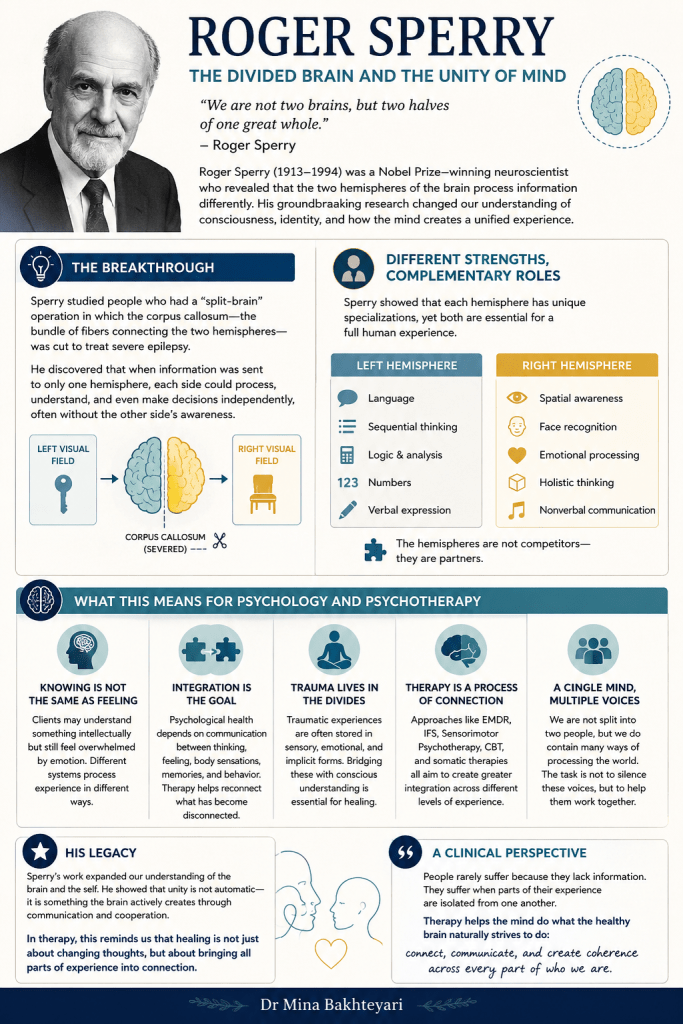
Sperry became widely known through his research with individuals whose corpus callosum—the large bundle of fibers connecting the two hemispheres of the brain—had been surgically severed as a treatment for severe epilepsy. The expectation was largely medical. The consequences turned out to be psychological.
In addition, when information was presented to only one hemisphere, patients sometimes behaved as though distinct systems of awareness were operating simultaneously; one side could recognise information that the other could not report verbally. Actions and explanations occasionally appeared disconnected, and the findings were startling because they challenged a deeply rooted assumption: that consciousness is necessarily singular. Sperry was not claiming that people literally possessed two separate personalities, and his work was far more nuanced than the popular “left-brain versus right-brain” mythology that later emerged.
Instead, he demonstrated that different forms of processing could coexist within the same person, each contributing something unique to experience; the mind was less centralized than psychologists had assumed.
The Myth of Pure Rationality
Perhaps one reason Sperry’s work continues to resonate is that it arrived during a period when rational thought was often treated as the highest form of human functioning. Logic, language, analysis, and conscious reasoning occupied center stage.
However, human beings rarely live through logic alone. People fall in love before they can explain why, feel grief before they can describe it, and react emotionally to situations they intellectually understand, carry memories that are sensed long before they are verbalized. Sperry’s findings helped illuminate the reality clinicians encounter every day: understanding and experiencing are not always the same thing. A client may recognize that a childhood belief is irrational and still feel controlled by it.
Someone recovering from trauma may fully understand that they are safe while their body continues responding as though danger remains nearby. Insight and transformation often travel at different speeds; this observation remains one of the central challenges of psychotherapy.
Why Therapy Is Rarely About Information
If psychological change depended solely on knowledge, many clients would improve after reading a book; most do not. People frequently arrive at therapy already aware of what they “should” do; the difficulty lies elsewhere. The emotional system may not agree with the cognitive system; the body may not trust what the mind knows, and old patterns may continue operating despite conscious intentions.
Modern psychotherapy increasingly recognizes this complexity. Whether through cognitive approaches, experiential therapies, trauma treatment, attachment-focused work, or somatic interventions, therapists often help clients establish communication between systems that have become disconnected from one another. Different schools describe the process differently, but the underlying challenge is remarkably similar. The goal is not simply to create insight; it is to create integration.
The Legacy Hidden Inside Contemporary Therapy
Few therapists today actively think about split-brain experiments while sitting with clients. Nevertheless, Sperry’s influence quietly survives in many of the assumptions that guide contemporary practice. Trauma clinicians speak about fragmented experiences. Attachment theorists describe disconnections between emotional and reflective functioning.
Moreover, explore interactions between networks involved in emotion, self-awareness, memory, and executive control. Even approaches such as EMDR, Internal Family Systems, Sensorimotor Psychotherapy, and other integrative models often rest upon a shared premise: psychological suffering is frequently maintained when important aspects of experience remain disconnected from one another. The language has evolved, and science has advanced, and the central insight remains recognizable: human beings function best when different parts of their experience can communicate.
Clinical Reflection
Roger Sperry’s most important contribution may not have been to show that the brain has two hemispheres; that fact was already known. His deeper contribution was demonstrating that unity cannot be taken for granted. The feeling of being a whole person is something the brain continuously creates.
In clinical work, this idea appears repeatedly. Individuals suffer when thoughts become isolated from emotions, when memories become isolated from present reality, when self-understanding becomes isolated from self-compassion, when different aspects of experience stop speaking to one another.
Therapy, at its best, is often less about teaching something new than about restoring a conversation that has been interrupted. Perhaps this is why Sperry’s work remains relevant decades later. It reminds us that psychological health is not merely the absence of symptoms, but it is the capacity to hold different parts of us together without losing any of them.
Dr Mina Bakhteyari
 Dr Mina Bakhterari Haftlangi
Leave a comment