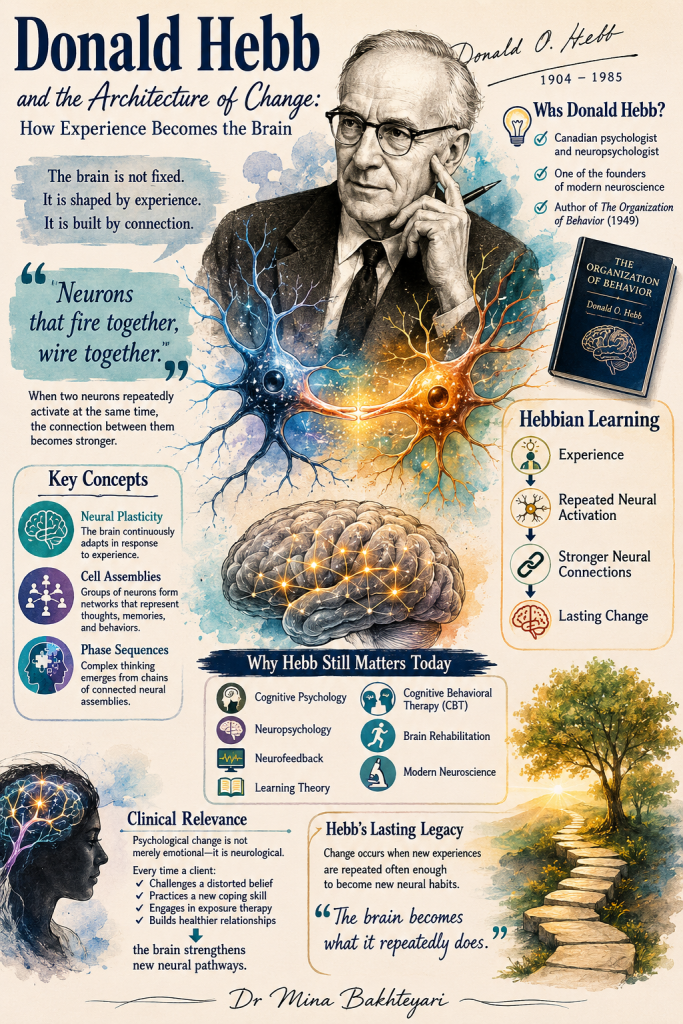
Most psychological theories attempt to explain why people think, feel, and behave as they do. Donald Hebb asked a different question:
How does experience physically become part of who we are?
It is a question that seems obvious today, yet when Hebb began developing his ideas, psychology and neuroscience were still largely separate worlds. Therapists spoke about emotions, learning, personality, and behavior, while neuroscientists focused on neurons and brain structures. Hebb became one of the first thinkers to propose that these were not different stories at all. They were different descriptions of the same process. His work helped establish one of the most influential ideas in modern psychology: human experience changes the brain itself.
Today, this concept is known as neuroplasticity. Long before brain imaging studies demonstrated it visually, Hebb had already begun describing how repeated experiences could reshape neural connections and gradually alter the way a person perceives reality.
The Brain Is Not a Fixed Machine
For much of history, intelligence, personality, and emotional functioning were often viewed as relatively stable traits. People were thought to possess certain capacities, limitations, strengths, and weaknesses that remained largely unchanged throughout life. Hebb challenged this assumption. He proposed that the brain is not simply a biological structure that receives information. Instead, it is an active system that continuously reorganizes itself in response to experience.
Furthermore, every conversation, fear, relationship, success, and disappointment leaves traces within the nervous system. The person that becomes is not solely determined by genetics or circumstance i; it is also shaped by the countless neural pathways strengthened through repetition. This perspective transformed how psychologists understood learning and adaptation. More importantly, it offered a scientific explanation for psychological change itself.
When Repetition Becomes Reality
The idea most commonly associated with Hebb is often summarized in a simple phrase: “Neurons that fire together wire together.”
Although he never expressed it in exactly those words, the phrase captures the essence of his theory. Hebb suggested that when groups of neurons are repeatedly activated together, the connections between them become stronger. Over time, these patterns become more efficient and more likely to occur again.
This principle extends far beyond memory and learning, such as a child repeatedly exposed to criticism may gradually develop neural patterns associated with self-doubt, or an individual who constantly anticipates rejection may strengthen networks related to threat detection.
Someone who repeatedly experiences safety, acceptance, and emotional connection may develop entirely different patterns of expectation. From this perspective, psychological life is not simply happening within the brain. Psychological life is actively shaping the brain.
The Origins of Mental Patterns
Hebb’s most important contributions were the concept of the cell assembly, which he proposed that mental experiences emerge from networks of neurons working together, rather than viewing thoughts as isolated events. These networks become increasingly organized through repeated activation.
Moreover, what is called a memory, belief, fear, or expectation may actually represent the coordinated activity of countless interconnected neural systems. This idea has profound implications for understanding emotional suffering, and a person rarely struggles because of a single event.
More often, they struggle because certain psychological patterns have become deeply established over time. The individual who automatically expects abandonment, failure, criticism, or danger may not be consciously choosing these responses; they may simply be relying on neural pathways that have become highly practiced. In many ways, the mind tends to travel along the routes it knows best.
Donald Hebb’s Legacy in Contemporary Psychotherapy
Although Hebb was not a psychotherapist, his influence can be found throughout modern clinical practice. In addition, contemporary therapies increasingly recognize that lasting psychological change requires more than insight. Understanding a problem intellectually does not necessarily transform the patterns that sustain it. This principle appears across many evidence-based approaches.
Cognitive Behavioral Therapy (CBT)
CBT helps individuals identify and challenge habitual patterns of thinking. From a Hebbian perspective, therapy is not simply replacing one thought with another. It is encouraging repeated activation of new cognitive pathways until they become stronger than older, more automatic ones.
Acceptance and Commitment Therapy (ACT)
ACT encourages individuals to develop a different relationship with difficult thoughts and emotions. Rather than strengthening avoidance networks through repeated struggle, clients learn to practice acceptance, flexibility, and value-based action. Over time, new patterns become increasingly accessible.
Dialectical Behavior Therapy (DBT)
Many DBT skills require deliberate repetition. Emotion regulation, distress tolerance, and mindfulness are not learned through explanation alone. They become effective through practice. This process closely reflects Hebb’s understanding that repeated activation gradually strengthens neural connections.
Mindfulness-Based Interventions
Contemporary neuroscience has consistently demonstrated that mindfulness practice can affect brain function and connectivity; these findings strongly align with Hebb’s original hypothesis that experience modifies neural organization. In other words, each instance of deliberate attention, in a sense, constitutes a minor act of neural training.
Why Change Often Feels Difficult?
One of the most clinically useful implications of Hebb’s work is that it helps explain why change can be slow. People often become frustrated when old habits, fears, or emotional reactions continue to appear despite genuine efforts to change. Hebb’s theory offers a compassionate explanation.
Patterns that have been repeated for years are supported by neural pathways that have been strengthened through thousands of activations. New patterns are initially weaker because they have had less opportunity to develop. This means that setbacks do not necessarily indicate failure.
They may simply reflect the reality that older pathways have been practiced longer. Therapeutic progress often involves creating new routes rather than instantly erasing old ones.
Clinical Insight
Donald Hebb’s greatest contribution may have been his recognition that the brain is continually shaped by lived experience. This insight transformed psychological theory, but it also carries an important therapeutic message. Human beings are not merely the products of their past experiences. They are also the products of the patterns they continue to practice in the present.
Every time a person responds differently to anxiety, challenges a familiar belief, sets a healthy boundary, tolerates discomfort, or engages in a meaningful relationship, new possibilities begin to emerge within the nervous system. Psychotherapy, from this perspective, is not simply a conversation about change.
It is a process through which change becomes biologically possible. More than seventy years after Hebb first introduced his ideas, they continue to echo throughout contemporary psychology, neuroscience, and psychotherapy. His work reminds us that healing is not only psychological. It is also neurological.
Furthermore, perhaps that is why hope remains scientifically reasonable: because the human brain, throughout life, retains the capacity to become something more than it was yesterday.
Dr Mina Bakhteyari
 Dr Mina Bakhterari Haftlangi
Leave a comment