“Why do some people keep trying after repeated failures, while others give up long before their circumstances actually become hopeless?”
Every therapist eventually encounters a puzzling reality. It is occasional that two people experience similar losses, disappointments, or setbacks, but their psychological responses unfold in remarkably different ways. In other words, a person continues searching for solutions despite repeated obstacles; another gradually withdraws, convinced that nothing they do will make a meaningful difference. The external circumstances look similar, but internally, they are living in entirely different worlds.
Julian Rotter spent much of his career trying to understand why. While many psychologists of his generation were focused on unconscious drives or observable behaviors, Rotter became interested in something less visible but perhaps more powerful: the private expectations people develop about how life works.
His work would eventually influence modern psychology through concepts that remain deeply relevant to psychotherapy, resilience, motivation, and mental health. However, Rotter’s most important contribution may not have been a specific theory at all. It was the recognition that human beings are constantly asking a question they may not even realize they are asking: “Do my actions matter?”
The Personal Logic Behind Human Behavior
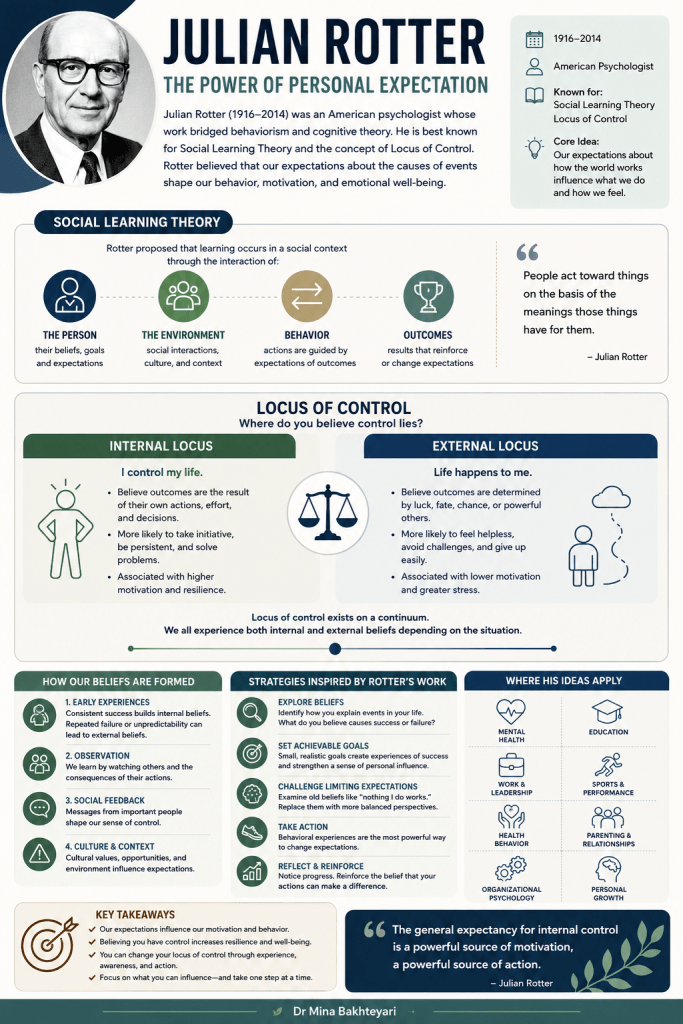
Rotter believed that behavior cannot be fully understood by looking only at external events. People do not simply react to reality. They react to what they expect reality to do next. Before applying for a job, confronting a problem, leaving a difficult relationship, or attempting a new challenge, individuals carry assumptions about the likely outcome of their efforts. Some people expect that persistence will eventually lead somewhere.
there are individuals expect disappointment long before disappointment actually arrives and these expectations become part of a person’s psychological architecture; shape choices, relationships, ambitions, fears, and even identity. From this perspective, behavior is rarely random; it often reflects an internal prediction about whether an action is likely to produce meaningful change.
The Question of Control
Rotter became best known for introducing the concept of Locus of Control, though the idea itself reaches far beyond a personality trait. At its core, locus of control concerns where people locate the causes of what happens in their lives.
Some individuals tend to experience themselves as active participants in shaping outcomes and believe that their decisions, efforts, and behaviors can influence what happens next. Others experience life as something that largely happens to them, Success becomes luck, failure becomes fate, Relationships become matters of chance. The future becomes something to endure rather than something to influence.
Rotter never suggested that one perspective was entirely right and the other entirely wrong. Human beings genuinely encounter circumstances that cannot be controlled.
His insight was subtler; psychological suffering often emerges when people lose sight of the difference between what is beyond their control and what remains within it.
How Helplessness Begins
Many individuals enter therapy believing they have a problem with anxiety, depression, procrastination, or low self-esteem, sometimes those difficulties are present. Nevertheless, underneath them lies a quieter issue. A growing conviction that personal effort no longer matters. This belief rarely appears overnight; It develops gradually through experiences of rejection, criticism, inconsistency, trauma, chronic failure, or environments where actions repeatedly seem disconnected from outcomes.
Eventually, people stop investing energy not because they lack ability, but because they stop expecting their efforts to make a difference.
The psychological withdrawal often arrives before the behavioral withdrawal becomes visible. Rotter understood this process decades before contemporary psychology began exploring learned helplessness, self-efficacy, and many related concepts.
Why Rotter Still Matters in Psychotherapy
Modern psychotherapy frequently involves much more than symptom reduction. At a deeper level, therapy often becomes an attempt to help people reconsider what influence they actually possess.
- A client struggling with depression may slowly rediscover areas of life where action remains possible.
- A client trapped in anxiety may learn that uncertainty does not eliminate personal agency.
- A trauma survivor may begin separating past powerlessness from present possibilities.
These processes appear across different therapeutic approaches; they all touch upon a central theme that Rotter identified many years ago.
Human beings suffer not only because painful events occur, but also because of the conclusions they draw about their ability to respond to those events.
Rotter’s Legacy Beyond Psychology
The influence of Julian Rotter extends far beyond psychotherapy; his ideas have shaped education, health psychology, leadership research, behavioral medicine, organizational psychology, and resilience studies.
Researchers investigate why some individuals take responsibility for change while others surrender to circumstances; they are often exploring questions that Rotter helped bring into psychological science.
His work continues to remind us that people are not merely products of their environments. They are also products of the expectations they carry about their relationship with those environments.
Clinical Reflection
Julian Rotter offered psychology a deceptively simple insight. People do not respond solely to reality itself. They respond to what they believe reality allows them to do. In clinical practice, this principle appears repeatedly. Beneath symptoms, diagnoses, and life histories, there is often a fundamental question about personal influence. When individuals begin to believe that their actions matter again, something important shifts. Motivation returns. Possibilities reappear. New behaviors become imaginable. The external world may not change immediately. Nevertheless, the person’s relationship with that world begins to change. Moreover, sometimes, that is where psychological recovery starts.
Dr. Mina Bakhteyari
 Dr Mina Bakhterari Haftlangi
Leave a comment