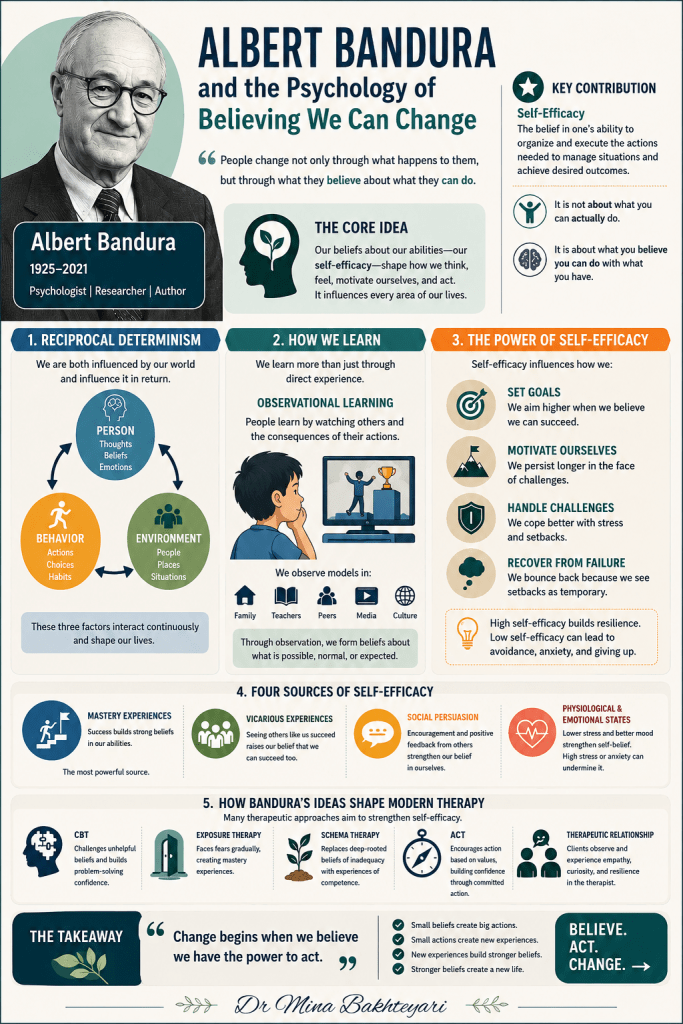
In discussions of the fundamental principles of contemporary psychology, the name of Albert Bandura always stands out because his theory of understanding human behavior has profoundly transformed the field. He does not consider humans mere passive responders to rewards and punishments, but rather has demonstrated that humans are active learners who constantly observe, interpret, and are influenced by their environment.
Even decades later, his ideas are still woven into how therapists work today, such as cognitive-behavioral therapy, coaching and mental health apps, so his influence is everywhere and often without people even realizing it.
A Different Way to Understand Human Behavior
Before Bandura, psychology was largely split between behaviorism (focused on external actions) and psychoanalysis (focused on unconscious drives). Bandura introduced a more balanced view. He argued something quite simple, yet powerful:
We learn not only by doing, but by watching.
That idea, known as observational learning, is something we see every day. People pick up habits, fears, confidence, and even emotional reactions just by observing others, parents, peers, media figures, or even strangers. However, Bandura did not stop there. He added an important layer: What matters is not just what we see, but what we believe about ourselves while we see it.
The Power of Self-Belief
At the heart of Bandura’s work is the concept of self-efficacy, our belief in our ability to manage situations and succeed in specific tasks and that idea sounds simple, but it explains a wide range of human behavior.
Two people can face the same challenge:
- One thinks, “I can oversee this,” and pushes forward.
- The other thinks, “This is too much for me,” and avoids it.
The difference is not intelligence or skill—it is belief.
In therapy, this becomes incredibly important. Many struggles, anxiety, depression, avoidance, and low confidence are closely tied to how people see their own abilities. Changing behavior often starts with changing that internal belief.
Why Bandura Still Matters Today
Bandura’s ideas have aged remarkably well, especially in the modern world. We now live in an environment full of constant observation, social media, online content and virtual communities. People are continually comparing themselves, learning from others, and shaping their behavior based on what they see.
This makes Bandura’s work even more relevant today than when he first introduced it. His theory also fits naturally with modern therapy because:
- It recognizes that people are influenced by their environment.
- It considers thoughts and beliefs, not just behavior.
- It focuses on practical change, not just insight.
In short, it reflects real life. Furthermore, that is exactly why therapists continue to rely on it.
How His Ideas Are Used in Therapy
Bandura’s work is theoretical and translated directly into practical tools that therapists use every day.
1. Learning Through Observation
Therapists often use modeling techniques to help clients practice new behaviors. This might involve:
- Watching someone else successfully cope with fear.
- Practicing role-play scenarios in sessions
- Using videos or guided examples
Seeing a behavior performed successfully makes it feel more achievable. It reduces uncertainty and builds confidence.
2. Building Confidence Step by Step
One of the most effective strategies inspired by Bandura is breaking challenges into manageable pieces. In other words, instead of pushing someone into a difficult situation all at once, therapists help them: Start small; Experience success early; Gradually increase difficulty, and this process builds a sense of capability naturally, rather than forcing it.
3. Strengthening Self-Efficacy
Therapy focuses on helping clients rebuild trust in their own abilities and strengthen Self-Efficacy in several ways:
- Mastery experiences: small wins that prove “I can do this.”
- Encouragement: supportive, realistic feedback
- Observing others: seeing similar people succeed
- Reducing emotional overwhelm, learning to manage anxiety and stress.
Consequently, these experiences reshape how someone sees themselves.
4. Changing Thought Patterns
Bandura’s work influenced cognitive-behavioral approaches, which focus on identifying and shifting unhelpful thinking. For example:
- Replacing “I’ll fail” with “I can try and improve.”
- Challenging assumptions about inability or fear
- Learning to interpret situations more realistically
This does not mean “positive thinking”—it means developing balanced, functional thinking.
5. Using the Social Environment
Another important idea in Bandura’s theory is that behavior does not happen in isolation. Therapists often help clients look at their environment:
- Are there supportive people around them?
- Are there triggers that reinforce negative habits?
- What small changes could make success easier?
Sometimes, changing the environment is just as important as changing thoughts.
A Practical and Empowering Approach
His theory does not just explain behavior—it provides a roadmap for change:
- Learn by observing!
- Build confidence through experience.
- Adjust thoughts and beliefs.
- Shape the environment.
Most importantly, it gives people a sense of control. Instead of feeling stuck or defined by their problems, individuals begin to see that change is possible—and that they play an active role in it.
Clinical Insight
Albert Bandura did not just contribute to psychology—he shifted its direction. By showing that behavior is influenced by observation, belief, and environment all at once, he created a framework that still guides modern therapy today. In a world where people are constantly influenced by what they see, and often struggle with self-doubt, his ideas feel more relevant than ever. At its core, his message is both simple and powerful: What we believe we can do shapes what we actually do; moreover, that belief can be changed.
Dr Mina Bakhteyari
 Dr Mina Bakhterari Haftlangi
Leave a comment