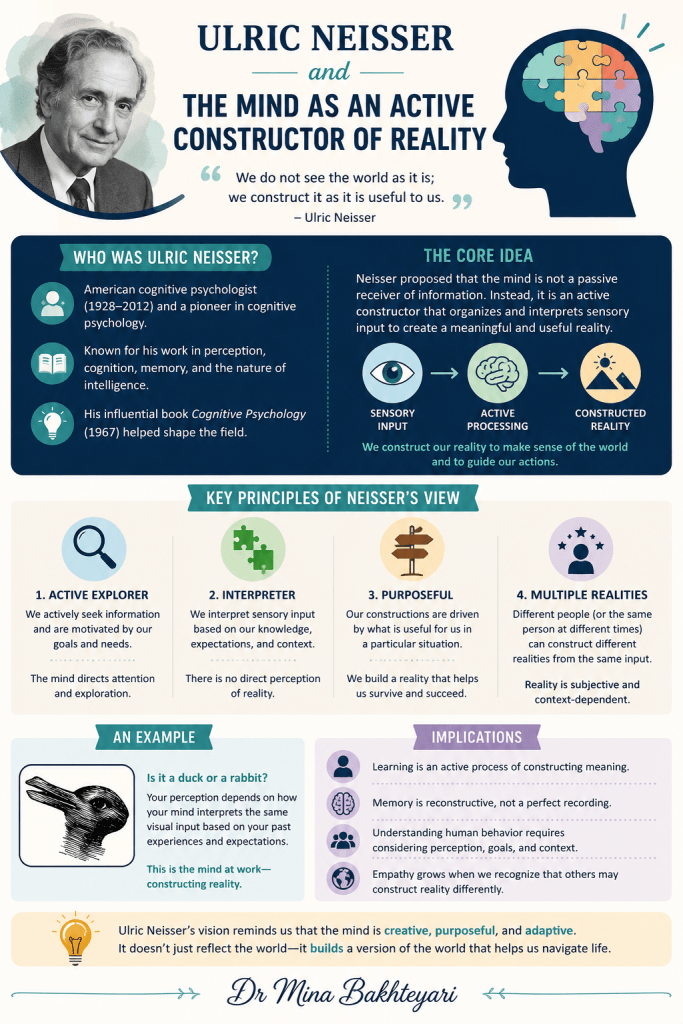
When people speak about memory, attention, perception, or thinking, they often describe these processes as though the mind were a camera recording reality exactly as it appears, and much of modern psychology has gradually moved away from this assumption. Today, therapists, neuroscientists, and cognitive researchers increasingly recognize that human beings do not simply absorb reality; they interpret it.
Few psychologists contributed more to this shift than Ulric Neisser. Although Neisser is widely known as the Father of Cognitive Psychology, his most important contribution may not have been creating a new branch of psychology. Instead, he helped psychology understand something deeper: the mind is not a passive receiver of information but an active participant in constructing experience. This idea continues to shape many contemporary approaches to psychological treatment, often in ways that are not immediately obvious.
Beyond Behavior: Looking Inside the Human Mind
During the early twentieth century, psychology was influenced by behaviorism, and researchers focused primarily on observable behavior because internal mental processes were considered difficult to measure scientifically. Neisser challenged this limitation and argued that if psychology wanted to understand human beings, it could not ignore what occurs between stimulus and response. In other words, thoughts, expectations, interpretations, memories, beliefs, and attention all influence how people experience the world.
His landmark book, Cognitive Psychology (1967), helped establish a scientific framework for studying these internal processes, and Neisser’s work was never simply about cognition as abstract information processing. He was interested in how people actively organize reality itself.
The World We See Is Not the World We Receive
A concept that was Neisser’s central idea is that perception is not a direct copy of external reality. Human beings continuously select, organize, interpret, and reconstruct information based on previous experiences, expectations, goals, and existing mental structures.
In addition, he stated that two individuals can witness the same event and leave with entirely different emotional experiences. Not because one person is lying or is irrational, but because the mind is never merely receiving information. It is actively shaping meaning.
This perspective has enormous implications for psychotherapy. Clinical work reveals that emotional suffering is not created solely by external events. It frequently emerges through the interpretations people build around those events. Furthermore, the same rejection can become evidence of worthlessness for one person, temporary disappointment for another, and motivation for growth for someone else; the event may be similar, but the psychological construction of the event is not.
Schemas: The Invisible Maps Guiding Experience
Neisser introduced the concept of schemas as mental structures that guide attention, interpretation, memory, and perception. In other words, he defined Schemas’ function like internal map. They help individuals predict what is important, what is dangerous, what should be noticed, and what can be ignored. Without schemas, human beings would be overwhelmed by the complexity of daily life. At the same time, schemas can become restrictive. People often begin seeing new experiences through old psychological templates.
Someone who grew up expecting criticism may unconsciously search for signs of rejection. Someone raised in emotionally unpredictable environments may remain hypervigilant for danger long after genuine threats have disappeared. Neisser’s work anticipated many ideas that later became central within contemporary psychotherapy.
Where Neisser Meets Modern Cognitive Therapy
Perhaps the clearest connection within Cognitive Behavioral Therapy (CBT) is built on the understanding that emotional distress is strongly influenced by interpretations rather than events themselves. While Aaron Beck developed the clinical framework of cognitive therapy, Neisser helped create the broader cognitive perspective that made such approaches possible.
Additionally, those perspectives share a similar assumption: that hthat human beings respond not only to reality but also to the meanings they assign to reality. When therapists help clients identify automatic thoughts, challenge assumptions, or develop alternative interpretations, they are working directly with cognitive processes that Neisser spent much of his career studying.
Schema Therapy: Neisser’s Influence in a Deeper Emotional Form
Jeffrey Young’s concept of primary maladaptive schemas reflects the ideas and concepts of his theory that deeply rooted cognitive-emotional structures influence how people interpret relationships, identity, safety, trust, vulnerability, and self-esteem. They shape self-perceptions, and people often pay attention to information that confirms existing schemas while ignoring contradictory evidence.
This process mirrors Neisser’s view that cognition actively guides what enters conscious awareness. From a schema perspective, people are not simply reacting to the present moment. They are often responding to present experiences through psychological maps developed years earlier.
Attention, Trauma, and the Modern Understanding of Hypervigilance
Neisser’s work on attention also remains highly relevant. Contemporary trauma research increasingly demonstrates that trauma changes attentional processes. Many trauma survivors become highly sensitive to threat-related information. Their attention is automatically drawn toward danger, criticism, conflict, unpredictability, or rejection. This is not merely emotional sensitivity. It is also a cognitive phenomenon.
The mind begins to examine the environment differently, modern trauma-focused therapies help clients develop greater flexibility in attentional processing, reduce automatic threat monitoring, and increase engagement with safety, connection, and present-moment experience. These goals reflect the cognitive principles that Neisser helped develop decades ago.
Memory as Reconstruction Rather Than Replay
One of Neisser’s influential insights was the definition of memory. From his perspective, memory has not been understood as a perfect recording system; instead, it involves reconstruction. That means, individuals do not retrieve exact copies of the past, but they rebuild experiences using fragments of stored information, current beliefs, emotional states, expectations, and personal narratives.
This perspective has become increasingly important within trauma therapy, narrative therapy, memory research, and contemporary neuroscience. Clinical work repeatedly demonstrates that the meaning attached to memories often influences emotional suffering more strongly than the factual details alone. Therapeutic change frequently occurs when individuals develop new ways of understanding experiences they have carried for years.
The Hidden Legacy of Ulric Neisser
Neisser’s theory does not appear in psychotherapy textbooks with the same visibility as Freud, Rogers, Beck, or Bowlby, and his influence quietly runs beneath contemporary clinical psychology. Therapists use the cognitive principles that Neisser helped to develop, examining interpretations rather than mere facts; clinicians also assess schemas, attentional biases, memory reconstruction, or perceptual filters, and navigate a therapeutic journey within a realm of thought shaped by Neisser.
His lasting messages are surprisingly relevant, such as his idea about how human beings do not simply encounter reality. They actively participate in creating the psychological reality they experience. Understanding that process remains one of the most important tasks of modern psychotherapy.
Clinical Reflection
The enduring importance of Ulrike Neisser’s work is that psychological suffering often lies not only in the events themselves but also in the cognitive frameworks through which these events are perceived, remembered, and understood. In other words, many psychological symptoms are easier to understand when, instead of asking “What happened?”, the question and attention are focused on how the person organizes events.
The therapeutic process, therefore, is not about changing behavior or reducing symptoms, but it is about helping individuals see, attend and remember differently, and ultimately construct a different relationship with their own experience.
Dr Mina Bakhteyari
 Dr Mina Bakhterari Haftlangi
Leave a comment