Most psychological theories attempt to explain how people learn, develop, adapt, or form relationships. George Miller approached the human mind from a different direction. He became interested in a problem that almost everyone experiences but rarely notices: Why does the mind sometimes reach a point where it can no longer manage the information it is receiving?
Long before smartphones, social media, constant notifications, and modern discussions about cognitive overload, Miller was studying the limitations of mental processing. His work helped reveal an uncomfortable truth about human psychology: The mind is powerful, but it is not limitless. At every moment, people are surrounded by more information than they can consciously process. Thoughts, memories, emotions, conversations, decisions, worries, responsibilities, sensory experiences, and internal dialogues continuously compete for psychological space.
The question Miller asked was not how much information exists. The question was how much information a person can actively work with before the system begins to struggle.
The Mind Was Never Designed to Hold Everything
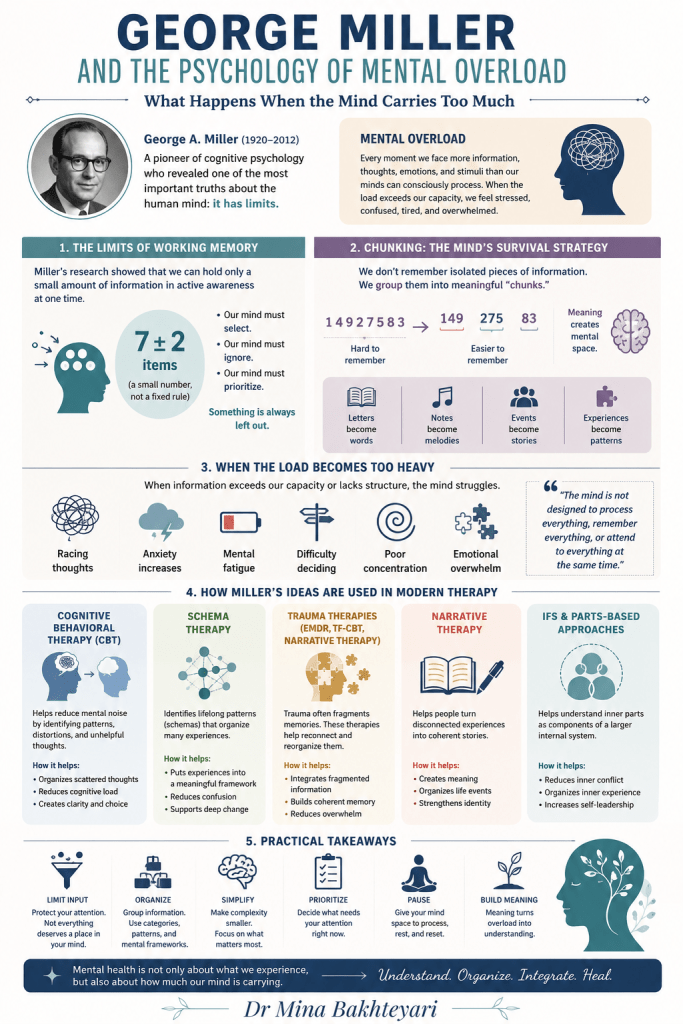
One of Miller’s most influential observations involved the limits of immediate awareness. People imagine that thinking is a smooth and continuous process. In reality, conscious attention is remarkably narrow, and the mind constantly filters, selects, ignores, organizes, and simplifies information simply to remain functional. Miller’s famous research on short-term memory suggested that people can only hold a relatively small amount of information in active awareness at one time.
Although research has refined the exact numbers, the broader principle remains important that human beings operate under cognitive constraints. In additional, the brain is not a warehouse; it is a system of prioritization that, every moment, something must be left out, must be forgotten or be pushed into the background.
Chunking: The Mind’s Natural Survival Strategy
Miller noticed that people become far more effective when information is grouped into meaningful units. Rather than processing isolated pieces of information separately, the mind creates larger psychological patterns.
A person does not remember individual letters when reading. They recognize words, do not remember every separate note in a melody, recognize a song, and they do not remember every individual interaction in a relationship. They develop an overall story about that relationship.
This process, known as chunking, may be one of the most fundamental psychological abilities humans possess. In many ways, psychological health depends upon the ability to organize experience into meaningful structures rather than becoming overwhelmed by disconnected fragments.
Beyond Memory: Miller’s Hidden Contribution to Clinical Psychology
Although Miller is usually introduced as a cognitive psychologist, many of his ideas extend far beyond memory research. Clinical work repeatedly demonstrates that emotional suffering often becomes more intense when experience feels chaotic, confusing, and disorganized. Many clients do not enter therapy because they lack information.
They enter therapy because they are carrying too much information without a coherent way of understanding it. Anxiety often involves dozens of competing predictions. Trauma frequently contains fragmented memories.
Depression may involve years of accumulated disappointment, loss, self-criticism, and hopelessness. Relationship difficulties often include multiple layers of emotional meaning that become difficult to separate. The problem is not always the experience itself. Sometimes the problem is cognitive overload.
Cognitive Behavioral Therapy and the Reduction of Mental Noise
CBT often works by reducing the amount of psychological information competing for attention. When anxious individuals first describe their experience, their thoughts frequently appear tangled and overwhelming. Therapy helps identify recurring themes, distortions, assumptions, and behavioural patterns.
What initially feels like hundreds of separate worries gradually becomes a smaller number of recognizable cognitive processes. From a Millerian perspective, CBT often helps people compress overwhelming mental information into manageable psychological units. The result is not simple symptom relief. The result is greater cognitive efficiency.
Schema Therapy: Organizing a Lifetime of Experiences
Schema Therapy reflects another process that Miller would likely have recognized. Individuals frequently arrive in therapy with years of emotional experiences that feel unrelated. Repeated rejection. Fear of criticism. Difficulty trusting others. Persistent self-doubt Chronic loneliness. These experiences often appear disconnected until a broader schema begins to emerge.
Suddenly, dozens of experiences can be understood through a single organizing pattern. The psychological system becomes easier to understand because the information becomes structured. The mind no longer needs to carry every experience separately.
Trauma Therapy and Fragmented Information
Trauma may represent one of the clearest examples of what happens when experience overwhelms the mind’s ability to organize information. Traumatic memories often remain fragmented across emotions, bodily sensations, images, and isolated recollections. Many modern trauma ther pies attempt to restore integration. EMDR helps connect previously disconnected information. Narrative therapy helps transform fragmented experiences into coherent stories.
Trauma-Focused CBT helps organize overwhelming memories into understandable frameworks. Parts-based approaches, such as IFS, help individuals understand apparently contradictory emotional states as components of a larger internal system. Despite their differences, these approaches share a common goal: Reducing fragmentation and increasing psychologica organization.
Attention, Distraction, and the Modern World
Perhaps Miller’s work has become even more relevant today than when he first introduced it. Modern life continuously demands attention. Emails, messages, advertisements, news feeds, notifications, and endless streams of information compete for limited cognitive resources.
Many people experience chronic mental fatigue not because they are weak or incapable, but because the human mind evolved with boundaries that technology often ignores. Miller’s research reminds us that attention is not an unlimited resource. Every demand placed upon the mind carries a psychological cost.
George Miller’s Enduring Legacy
George Miller did more than study memory. He helped psychology recognize that human beings live under cognitive limits. The mind is not designed to process everything, remember everything, or attend to everything simultaneously. Its strength lies not in unlimited capacity but in its remarkable ability to organize complexity into meaning.
Modern psychotherapy repeatedly depends upon this principle. Whether clinicians are working with anxiety, depression, trauma, personality difficulties, or relationship problems, much of therapy involves helping people transform overwhelming psychological complexity into patterns that can be understood, carried, and eventually changed. Perhaps Miller’s most important lesson is that mental health is not simply about what people experience. It is also about how much experience the mind is trying to carry at once.
Dr Mina Bakhteyari
 Dr Mina Bakhterari Haftlangi
Leave a comment