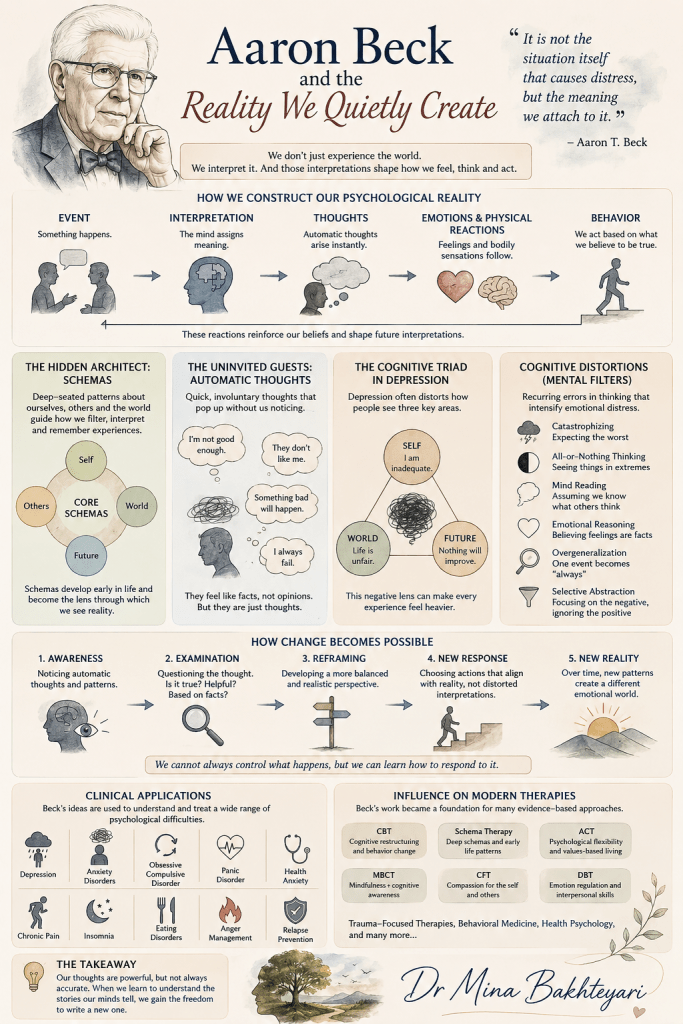
Most people assume they see the world as it is. A difficult conversation feels painful because it was painful. A rejection hurts because rejection hurts. An unexpected silence from someone we care about creates anxiety because uncertainty is naturally uncomfortable.
This explanation feels intuitive. It also feels incomplete. In psychotherapy, clinicians often encounter individuals whose emotional suffering cannot be explained solely by what has happened to them. Two people may experience similar losses, similar disappointments, or similar adversities, yet their psychological outcomes can be strikingly different.
One person gradually recovers. Another remains trapped for years inside the emotional consequences of the same event. The difference is not always found in the event itself. Sometimes it is found in the meaning that develops around it. Long before psychology became interested in concepts such as cognitive processing, information filtering, predictive coding, or psychological flexibility, Aaron Beck was observing something that many clinicians continue to encounter every day in their consulting rooms.
Human beings do not merely experience life. They interpret it. Moreover, those interpretations often become more influential than the events that originally produced them.
When Meaning Becomes Reality
Consider a client who receives constructive feedback at work. The feedback is balanced and reasonable, objectively, but one individual hears: I need to improve. Another hears: I am failing. A third hears: They will eventually realize I am not good enough.
The emotional response emerges not from the feedback itself but from the meaning attached to it. Over time, these meanings accumulate, and they begin to organize and shape expectations. They influence memory and guide attention. Eventually, they become so familiar that they are no longer experienced as interpretations; they feel like reality.
This observation became one of Aaron Beck’s most important contributions to psychology. Not because it explained every form of suffering. However, it revealed a psychological process occurring beneath countless forms of suffering.
The Mind Does Not Simply Record Experience
Philosophers have expressed various opinions about whether humans perceive reality directly or whether the mind itself shapes perception, and Beck has raised a similar question from a clinical perspective and from his own experiences with depressed people, finding that emotional distress often changes the way people process information. He stated that patients remembered failures more clearly than successes, perceived signs of rejection more quickly than signs of acceptance, and predicted disappointment even when evidence indicated otherwise.
The issue that fascinated Beck was that these patterns were not random but rather organized, predictable, and consistent. It was as if people saw life through psychological lenses, silently selecting which aspects of reality were worthy of attention. Modern neuroscience increasingly supports this broader idea, and instead of seeing the brain as a passive camera that records the world exactly as it is, it sees it as a part of the brain that is constantly interpreting, predicting, prioritizing, and organizing information.
In many ways, Aaron Beck was observing this process clinically long before neuroscience possessed the tools to study it directly.
The Private Rules People Live By
As Beck’s understanding evolved, he began looking beyond momentary thoughts. He noticed that many people seemed to carry deeper assumptions about themselves and others. Some individuals appeared to operate from an underlying belief that they were inadequate, while others expected rejection. Some others anticipated failure, while others viewed vulnerability as dangerous.
These assumptions often remain outside of conscious awareness to quietly influence countless decisions, relationships, and emotional responses. Therapists often encounter these patterns in the course of clinical therapy. For example, a client who repeatedly fears abandonment may simply not respond to current relationships.
From his perspective, a client struggling with perfectionism is not merely pursuing excellence, or a client overwhelmed by Anxiety may not only be responding to current stressors. He stated that often, there exists a deeper framework shaping how experience is interpreted before conscious reflection even begins.
According to that, Back referred to these deeper structures as schemas and claimed their importance remains difficult to overstate because they help explain why emotional suffering often persists even when external circumstances improve.
The Thoughts That Arrive Uninvited
Beck’s recognized contribution emerged when he began paying close attention to the rapid internal reactions accompanying emotional distress. In other words, these thoughts appeared quickly, they often felt believable, and rarely announced themselves as assumptions. Instead, they arrived at conclusions: I’m going to fail; Something bad will happen, they do not care about me, I am not capable.
Because these thoughts occur so rapidly, people often respond emotionally before they have the opportunity to evaluate them. Beck called them automatic thoughts. What made this concept powerful was not the discovery that people think negatively. Psychologists already knew that. What Beck highlighted was how these thoughts influence emotion, behaviour, and perception in real time.
Depression Through Beck’s Eyes
While Beck’s ideas eventually influenced many areas of psychology, his early work focused heavily on depression. He observed that depressed individuals frequently interpreted experience through a recurring pattern. They viewed themselves negatively; they viewed their environment negatively. Furthermore, they viewed the future negatively. This pattern later became known as the Cognitive Triad. The significance of the triad lies in the fact that depression appears to affect far more than mood alone. It can reshape how individuals understand themselves, their relationships, their opportunities, and their future possibilities. From this perspective, depression is not simply sadness. It is often a change in how reality is interpreted.
How Beck’s Ideas Changed Psychotherapy
The revolutionary aspect of Beck’s work was not that he encouraged positive thinking. In fact, that is one of the most common misunderstandings of his theory. His goal was never to replace negative thoughts with positive ones. His goal was to help individuals examine whether their interpretations were accurate, balanced, and supported by evidence. This principle eventually became the foundation of Cognitive Therapy and later Cognitive Behavioral Therapy. Clients learned to identify automatic thoughts.
They learned to recognize cognitive distortions such as catastrophizing, all-or-nothing thinking, mind reading, emotional reasoning, and overgeneralization. They learned to evaluate evidence more carefully. Most importantly, they learned that thoughts can be examined rather than automatically obeyed.
Beck’s Influence on Modern Clinical Practice
Today, Aaron Beck’s influence extends far beyond traditional CBT. Schema Therapy expanded many of his ideas regarding enduring psychological patterns. Mindfulness-Based Cognitive Therapy integrated cognitive principles with mindfulness practices to prevent depressive relapse.
Compassion-Focused therapy addresses many of the self-critical cognitive processes Beck described decades earlier. Trauma-focused therapies frequently explore beliefs related to safety, trust, shame, responsibility, power, and vulnerability.
Acceptance and Commitment Therapy differs philosophically from Beck’s approach in several ways, yet it continues to engage with the fundamental question he helped psychology recognize: What happens when people become fused with their thoughts?
Even contemporary interventions targeting Anxiety disorders, obsessive-compulsive disorder, health anxiety, chronic pain, insomnia, eating disorders, and emotional regulation continue to draw from principles that originated in Beck’s work.
A Legacy Beyond Technique
Aaron Beck’s greatest contribution may not be a therapy model. It may be a shift in perspective. He encouraged psychology to look beyond symptoms and ask a deeper question: How is this person making sense of their experience?
That question continues to guide psychotherapy today. Because while life undoubtedly affects people, human beings also participate in constructing the psychological reality through which life is understood.
Furthermore, meaningful change begins when the lens through which those circumstances are viewed becomes more flexible, more balanced, and more open to alternative possibilities.
Dr Mina Bakhteyari
 Dr Mina Bakhterari Haftlangi
Leave a comment