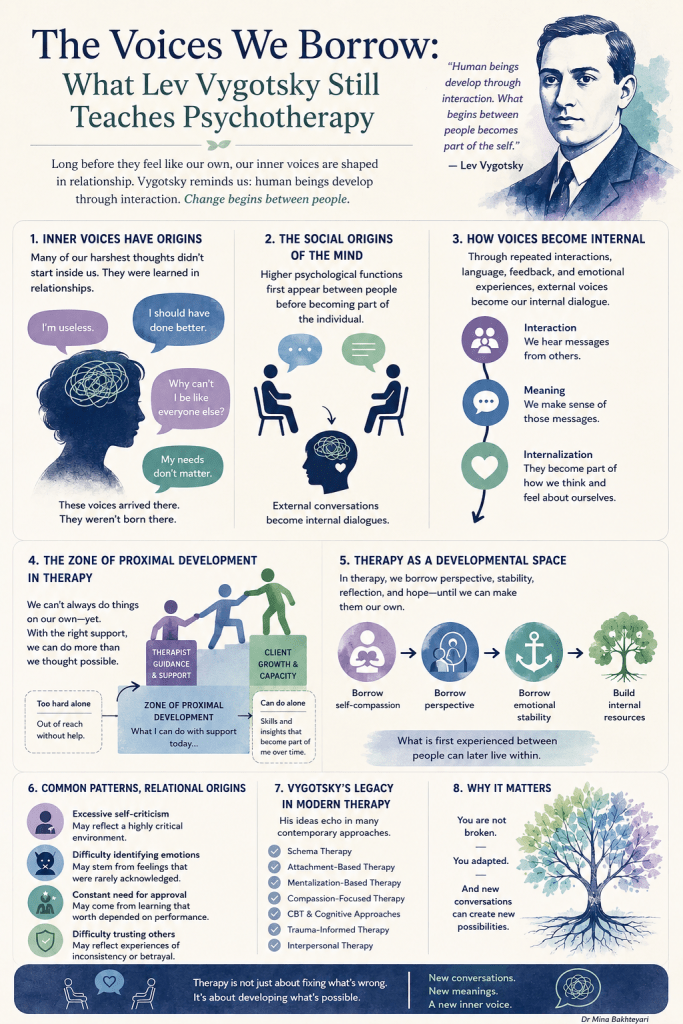
A therapist asks a client a simple question: When you make a mistake, what do you usually say to yourself? The answer often comes quickly. I am useless. I should have done better. Everyone else manages, why can’t I? The client experiences these thoughts as personal truths, and they feel private, internal, and entirely their own. However, psychotherapy repeatedly reveals something interesting, and many of these inner voices did not begin inside the individual.
They arrived there long before people learn to evaluate themselves; they are being evaluated. Long before they learn how to comfort themselves, they are being comforted or not, and before they develop an internal dialogue, they participate in thousands of external conversations that slowly become part of their psychological landscape. Although Lev Vygotsky is usually remembered as a developmental psychologist, his ideas offer a surprisingly useful lens through which to understand what therapists encounter every day in the consulting room.
Vygotsky stated that many psychological processes begin between people before they become part of the individual, and human beings do not simply develop in the presence of others; development itself is fundamentally social. Moreover, this observation seems obvious at first, but its implications are profound, and many adults enter therapy believing their difficulties are purely personal failures. In other words, they criticize themselves for being anxious, emotionally dependent, overly sensitive, perfectionistic, or unable to trust others.
In the therapy process, when their histories are explored more, these patterns appear less like defects and more like adaptations learned within particular relationships.
Furthermore, the excessively self-critical client is carrying the language of a highly critical environment, and an individual who struggles to identify emotions has grown up in a family where feelings were rarely discussed. In addition, the person who constantly seeks approval may have learned early that acceptance depended upon performance rather than authenticity. Symptoms are not isolated psychological events; they are often echoes of past relational experiences that have become internalized over time.
Modern psychotherapy frequently works within this territory, whether it explicitly references Vygotsky or not.
Schema Therapy explores how early interactions become enduring patterns of self-perception.
Attachment-based approaches examine the way relationships shape emotional regulation.
Mentalization-Based Therapy focuses on the development of reflective capacities through interpersonal experience.
Compassion-Focused Therapy often helps clients replace harsh internal dialogues with more supportive ones.
Cognitive therapies frequently involve identifying thoughts that originated long before the client consciously recognized them. What links these approaches is an implicit recognition that psychological life is relational at its roots. Perhaps the most clinically relevant aspect of Vygotsky’s work is the idea that development never occurs entirely alone.
In therapy, people are often asked to do things they cannot yet do independently. Some cannot regulate intense emotions. Others struggle to challenge deeply rooted beliefs about themselves, and some find it difficult to tolerate vulnerability, uncertainty, or self-compassion.
The therapeutic relationship becomes a temporary space where these capacities can be practiced before they are fully owned. A client may initially borrow the therapist’s perspective before developing their own and they may borrow emotional stability before building it internally.
Additionally, they may borrow hope before genuinely feeling hopeful. Over time, what was once supported externally gradually becomes an internal resource and this process reflects something that Vygotsky understood decades ago: growth often begins in a relationship before it becomes part of the self. Seen through this lens, psychotherapy is not merely a process of symptom reduction. It is also a process of psychological development. Individuals are not simply removing problems; they are acquiring new ways of thinking, feeling, understanding, and relating.
Perhaps this is why Vygotsky’s ideas continue to feel unexpectedly contemporary. He reminds us that human beings are shaped by conversations long before they become aware of them and that healing may begin when new conversations become possible.
Dr Mina Bakhteyari
 Dr Mina Bakhterari Haftlangi
Leave a comment