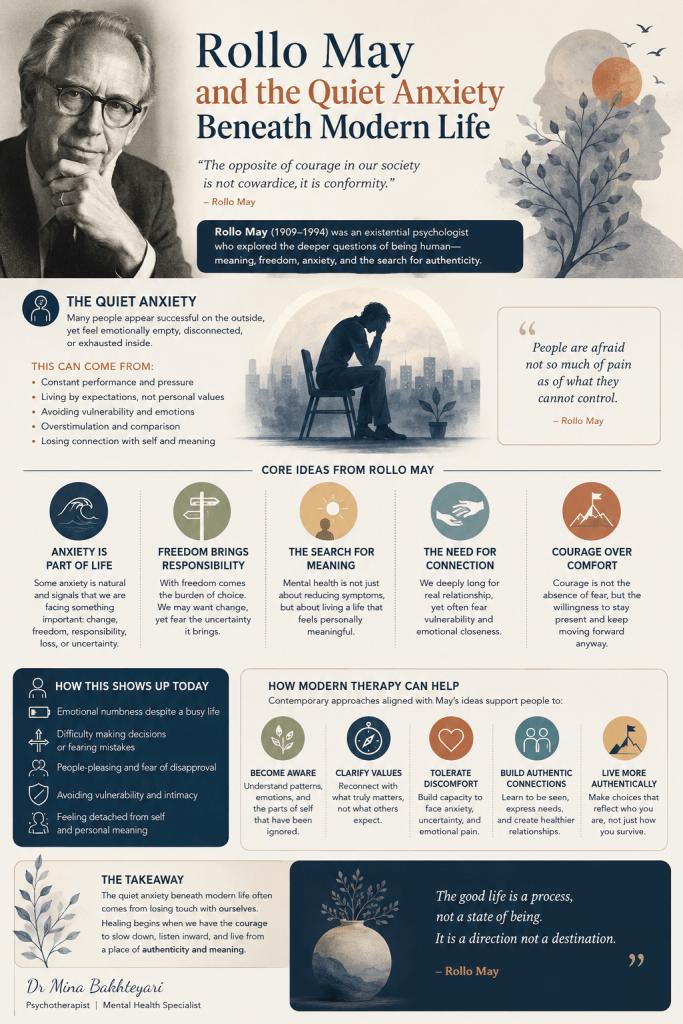
Not every person who comes to therapy is falling apart externally. Some are highly functional; they work, care for their families, answer messages and keep going. However, internally, something feels emotionally distant. Sometimes they describe it as emptiness, sometimes exhaustion or a strange feeling that they have been living for years without feeling fully connected to themselves.
Rollo May spent much of his work trying to understand this side of human suffering. Unlike approaches that focused mainly on symptom control or observable behaviour, May became interested in the emotional experience underneath psychological distress. He believed many struggles develop when people lose contact with meaning, identity, emotional honesty, or genuine connection with others. Decades later, therapy rooms are still filled with many of the same struggles.
Anxiety Is Not Always the Enemy
May did not see anxiety as something completely abnormal. He believed certain forms of anxiety naturally appear during important moments in life:
- falling in love,
- changing careers,
- becoming emotionally vulnerable,
- losing someone important,
- making difficult decisions,
- confronting uncertainty,
- realizing life no longer feels emotionally meaningful.
In clinical work today, this idea still feels relevant, and therapists often notice that people are not only afraid of pain itself. Many are afraid of what emotional honesty may force them to confront: relationships that no longer feel safe, parts of themselves they have ignored, unresolved grief or the realization that they have spent years living according to expectation rather than authenticity.
Modern therapies approach this differently depending on the model, but the underlying process often overlaps. In additional, in other words, in ACT, people learn to stop fighting every uncomfortable feeling; in exposure-based CBT, avoidance gradually becomes less powerful; in Schema Therapy, deeper emotional patterns are explored instead of only surface symptoms; while existential therapy directly explores meaning, freedom, isolation, and identity. In short, it is a different language for a similar human struggle.
Emotional Survival Can Slowly Become Emotional Disconnection
Many people adapt so well to stress that they eventually stop noticing how disconnected they have become emotionally. They function, achieve and continue performing; however, internally, life begins to feel flat.
May wrote about this long before conversations about burnout, emotional exhaustion, or high-functioning anxiety became common. Today, therapists regularly see individuals who have spent years:
- suppressing emotions,
- prioritizing productivity over well-being,
- living through chronic pressure,
- avoiding vulnerability,
- building their identity entirely around achievement and approval.
Eventually, emotional numbness often follows, not because these individuals are weak, but the reson of it is that human beings are not designed to remain psychologically disconnected from themselves indefinitely. Modern psychotherapy increasingly focuses on helping people reconnect with:
- emotional awareness,
- personal meaning,
- physical and emotional presence,
- healthier relationships,
- and a stronger internal sense of identity.
Sometimes treatment is not only about reducing symptoms. Sometimes it is about helping someone feel psychologically alive again.
Why Freedom Feels So Difficult
One of May’s most insightful observations involved freedom, which people often believe automatically feels positive, yet, emotionally, it can feel frightening.
In other words, freedom means choice, choice creates responsibility, responsibility creates uncertainty and in therapy, this conflict appears constantly. A person may want to change while also fearing:
- rejection,
- failure,
- loneliness,
- independence,
- conflict,
- losing the familiarity of old patterns.
One of the cuases that why people remain in painful relationships, silence their needs, or continue living according to roles that no longer fit them emotionally is that. Many contemporary therapies now address this directly; attachment-focused therapies explore fears connected to abandonment and emotional safety, and psychodynamic therapy explores unconscious relational patterns.
Moreover, Schema Therapy works deeply rooted emotional beliefs formed early in life, ACT often helps individuals move toward values-based living despite discomfort or uncertainty and across these approaches, there is a recurring theme: growth usually requires tolerating some degree of emotional risk.
The Fear of Vulnerability
May believed modern life encourages emotional distance while simultaneously leaving people deeply lonely. Furthermore, he stated that the contradiction remains visible today, and people appear socially connected online while privately feeling emotionally unseen. Others become so accustomed to self-protection that closeness itself begins to feel unsafe. Clinically, this appears in many forms:
- fear of intimacy,
- emotional withdrawal,
- chronic self-protection,
- difficulty trusting others,
- perfectionism,
- people-pleasing,
- avoiding emotional dependence entirely.
Therapy often becomes a place where individuals slowly relearn emotional connection without feeling psychologically overwhelmed by it. This process usually happens gradually. People do not suddenly abandon emotional defenses overnight. Most defenses were originally developed for survival, protection, or adaptation. Over time, therapy helps individuals decide which protections are still necessary and which ones are now keeping them emotionally isolated.
Courage in Psychological Healing
May often wrote about courage, though not in a dramatic sense and from his perspective. For, courage involved remaining emotionally present even when life feels uncertain or painful. That idea still sits quietly underneath much of modern psychotherapy, and healing often asks people to:
- tolerate difficult emotions,
- confront avoided experiences,
- grieve honestly,
- establish boundaries,
- rebuild trust,
- speak more authentically,
- create change before feeling fully ready.
Psychological growth rarely arrives with complete certainty first, while more often, people slowly discover that they are capable of carrying uncertainty differently than before.
Why Rollo May Still Feels Relevant
Although psychology has changed enormously since May’s time, many of his ideas continue to appear naturally in contemporary treatment approaches.
His influence can still be felt in:
- existential psychotherapy,
- ACT,
- trauma-informed therapy,
- Schema Therapy,
- attachment-focused work,
- psychodynamic therapy,
- humanistic approaches centered around authenticity and emotional awareness.
What continues to make his work meaningful is that he understood something many people still experience today: Psychological suffering is not always only about symptoms. Sometimes it begins when people become emotionally disconnected from their own lives.
Dr Mina Bakhteyari
 Dr Mina Bakhterari Haftlangi
Leave a comment