When therapy is not only about changing emotions, but about changing the way reality itself is understood
Long before psychotherapy became heavily focused on symptoms, diagnoses, and treatment protocols, Jean Piaget was asking a different question entirely: How does the human mind construct reality?
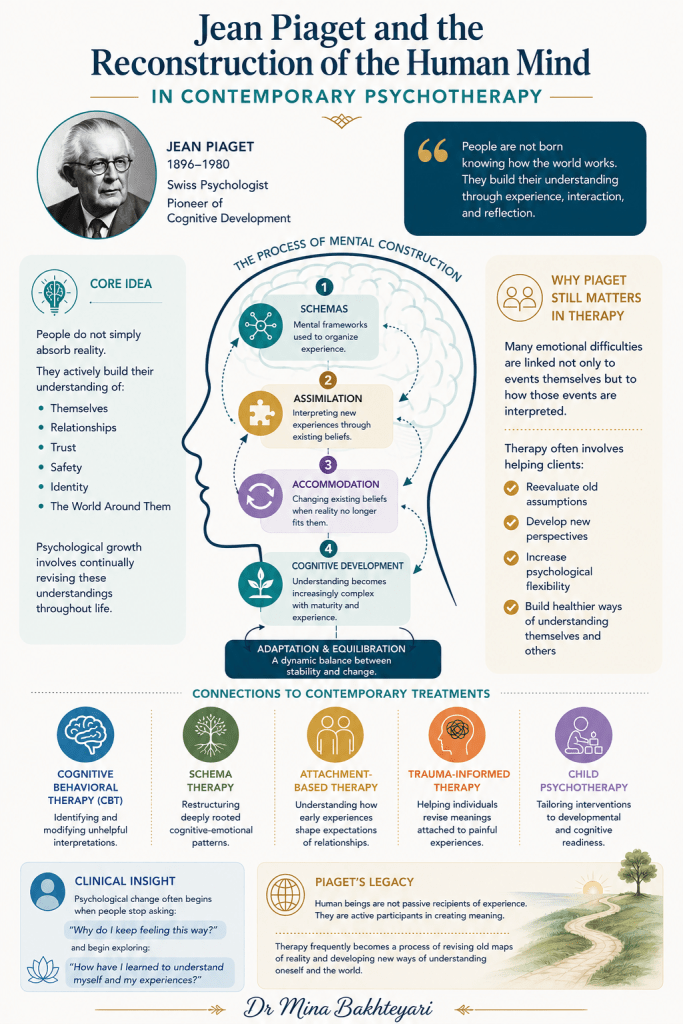
Piaget never believed the mind worked like a space waiting to be filled with information, and he saw people as actively trying to make sense of life from the very beginning. Children, in his view, are not just learning names, rules, or facts, but they slowly create their own understanding of how relationships work, what feels safe or unsafe, whether people can be trusted, and who they are becoming emotionally. That way of thinking still quietly shapes a great deal of psychotherapy today, where in therapy, the real struggle is often much deeper than the symptom itself. Anxiety, shame, depression, or relationship problems usually do not grow in isolation, but they develop inside long-standing ways of seeing the world. Many people carry internal assumptions about themselves and others for years without fully noticing how strongly those assumptions influence their emotions, relationships, reactions, and sense of self.
- how they perceive themselves,
- how they expect others to behave,
- how they interpret emotional pain,
- what they believe is possible within relationships.
For this reason, Piaget’s influence remains highly visible in contemporary:
- cognitive therapies,
- Schema Therapy,
- developmental psychotherapy,
- attachment-based approaches,
- child psychotherapy,
- trauma-informed models,
- and many modern integrative treatments.
Piaget’s Most Important Contribution: The Mind Develops Through Organization
Children were often understood as smaller, less intelligent versions of adults till Piaget challenged this assumption entirely, and he demonstrated that children think in fundamentally different ways at different developmental periods. In other words, their mistakes were not signs of deficiency, but reflections of how their minds were organizing reality at that stage of growth. This idea radically changed psychology. Furthermore, human development was no longer viewed as the simple accumulation of knowledge, but psychological growth became understood as the gradual development of increasingly complex ways of thinking, regulating emotion, understanding perspectives, and interpreting experience.
In addition, this concept remains clinically important today, and many emotional difficulties seen in adulthood are still connected to earlier developmental organizations of meaning. Adults may appear cognitively mature on the surface while emotionally continuing to interpret relationships, safety, abandonment, rejection, or vulnerability through much older psychological structures.
Schemas: The Mind’s Internal Maps of Reality
One of Piaget’s most influential ideas involved schemas, the mental structures people use to organize experience. Furthermore, from his perspective, human beings continuously create internal maps that help them predict, interpret, and navigate the world around them. Modern psychotherapy still relies heavily on this principle, and in contemporary clinical work, particularly within:
- Schema Therapy,
- CBT,
- attachment-focused psychotherapy,
- and trauma treatments,
- therapists frequently observe that people do not simply react to events themselves. They react to the meanings their internal schemas assign to those events.
In the above, a few examples are maintained to clear the issue: the first example is that a person repeatedly exposed to rejection in childhood may interpret minor distance from others as complete abandonment. Second one, Someone raised in a highly critical environment may experience mistakes as evidence of personal worthlessness. The third example is that, a,n individual shaped by chronic shame may struggle to feel emotionally safe even during success, intimacy, or acceptance.
According to that, treatment involves gradually reorganizing the person’s deeper systems of interpretation; this is one of the reasons Piaget’s theoretical legacy remains highly relevant within modern psychotherapy.
Assimilation and Accommodation: How Psychological Change Actually Happens
Piaget proposed two major psychological processes:
- Assimilation occurs when individuals interpret new experiences through existing mental structures.
- Accommodation occurs when those existing structures themselves must change because reality no longer fits them.
This dynamic closely resembles what often happens during meaningful psychotherapy.
Many individuals initially try to fit new emotional experiences into old psychological assumptions:
- “If someone cares about me, they will eventually leave.”
- “If I become vulnerable, I will lose control.”
- “If I disappoint others, I will become unlovable.”
Over time, therapy may create enough emotional safety for the mind to begin restructuring those assumptions rather than endlessly repeating them. This is why long-term therapeutic change often involves more than symptom management. At deeper levels, psychotherapy frequently becomes a process of cognitive and emotional reorganization.
Piaget’s Influence on Child Psychotherapy
Piaget’s work transformed the deeply influenced modern child psychotherapy, understanding of child development, and demonstrated that children at different developmental stages possess different capacities for:
- emotional understanding,
- impulse regulation,
- perspective-taking,
- abstract reasoning,
- and interpreting cause and effect.
Today, this remains highly important within:
- Play Therapy,
- Child CBT,
- developmental interventions,
- school-based psychological work,
- attachment-focused child treatment,
- and neurodevelopmental approaches.
A child cannot emotionally process experiences using the same psychological capacities as an adolescent or adult. Many therapeutic interventions fail when developmental readiness is ignored. Piaget helped psychotherapy move away from adult-centered interpretations of children’s emotional worlds and toward a more developmentally informed understanding of psychological experience.
Piaget and Contemporary Adult Psychotherapy
Piaget’s ideas extended far beyond childhood development, and contemporary therapists now recognize that adults remain emotionally organized around earlier developmental patterns long after childhood ends. Moreover, clinically, this may appear as:
- black-and-white thinking,
- intense abandonment reactions,
- chronic dependency on validation,
- low tolerance for uncertainty,
- emotional rigidity,
- difficulty regulating emotional distress.
In many modern therapies, especially Schema Therapy and developmental models, treatment often involves helping individuals build capacities that were insufficiently developed earlier in life. In this sense, psychotherapy is not only about symptom reduction.
Sometimes it becomes a continuation of interrupted psychological development.
Psychological Flexibility and the Living Mind
One reason Piaget’s work still feels remarkably modern is that he viewed the human mind as dynamic rather than fixed. Psychological suffering often becomes chronic not simply because painful emotions exist, but because mental structures become rigid. When individuals lose the ability to:
- tolerate alternative perspectives,
- emotionally adapt,
- revise internal assumptions,
- or construct new meanings,
- psychological patterns frequently become repetitive and self-perpetuating.
A significant part of contemporary psychotherapy is ultimately aimed at restoring this flexibility.
Final Reflection
Piaget’s lasting contribution was not simply a stage theory of development. He drew attention to something that therapists still encounter every day: two people can live through similar experiences and come away with very different conclusions about themselves and the world. The difference often lies in the way those experiences have been understood, interpreted, and woven into a person’s view of reality.
Modern psychotherapy still reflects this principle every day: People are shaped not only by what happened to them, but by the psychological structures through which those experiences became understood. Moreover, perhaps one of therapy’s deepest goals is precisely this: helping the mind develop new ways of understanding itself, other people, and the world.
Dr Mina Bakhteyari
 Dr Mina Bakhterari Haftlangi
Leave a comment