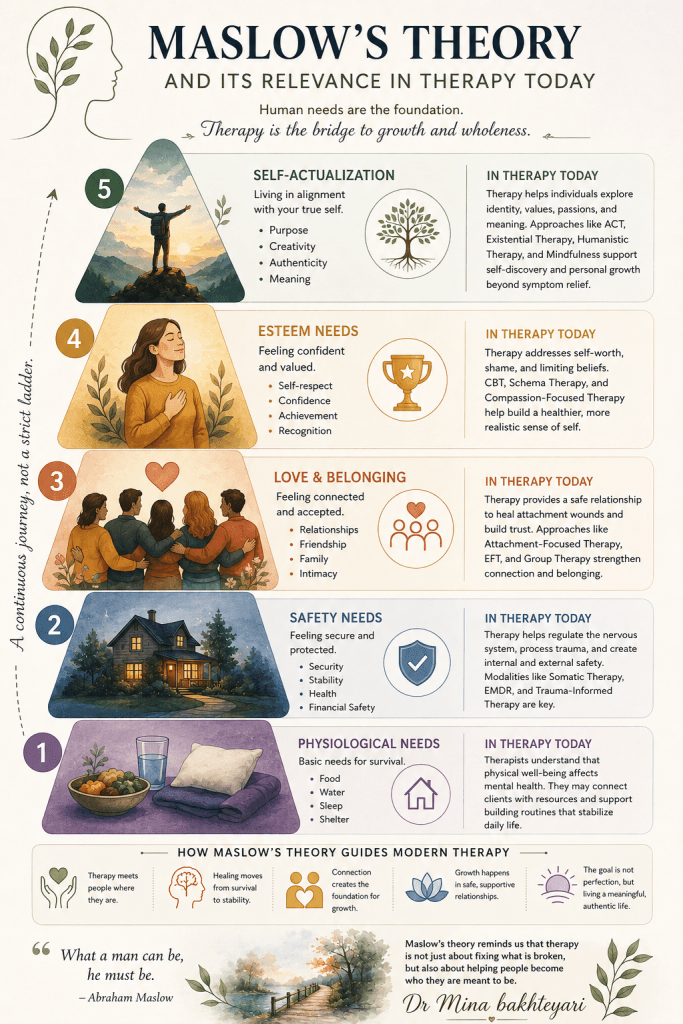
When hearing the name Abraham Maslow, we usually think about the pyramid of needs taught in psychology classes. However, Maslow’s ideas were never only about a diagram. What he was really trying to understand was much more human than that: Why do some people feel emotionally alive and connected to themselves, while others spend years feeling empty, disconnected, or emotionally stuck, even when life looks “fine” from the outside?
At the time Maslow was writing, psychology was largely focused on illness, pathology, and dysfunction. Much of the field was trying to explain what goes wrong in people. Maslow became interested in something different. He also wanted psychology to study healthy emotional development, personal meaning, creativity, emotional fulfillment, and the conditions that allow people to grow rather than simply survive psychologically. That shift still matters in therapy today.
Who Was Abraham Maslow?
Abraham Maslow (1908–1970) was an American psychologist and one of the major figures behind Humanistic Psychology. Unlike many theorists of his era, Maslow did not spend most of his time studying severe pathology alone. He became interested in emotionally healthy individuals, people who seemed psychologically grounded, creative, resilient, purposeful, and internally connected to themselves. He believed psychology had become too focused on what is broken in human beings while paying less attention to what helps people become emotionally whole.
That perspective later influenced many approaches that modern psychotherapy now takes almost for granted.
Today, therapists regularly talk about:
- emotional needs,
- self-worth,
- identity,
- meaning,
- belonging,
- authenticity,
- and psychological growth.
Maslow helped move psychology in that direction long before these conversations became common in clinical work.
Maslow’s Hierarchy of Needs Was Never Just About a Pyramid
Maslow proposed that human beings are motivated by different layers of need that include:
- physical survival,
- safety,
- emotional connection,
- esteem,
- and eventually self-actualization.
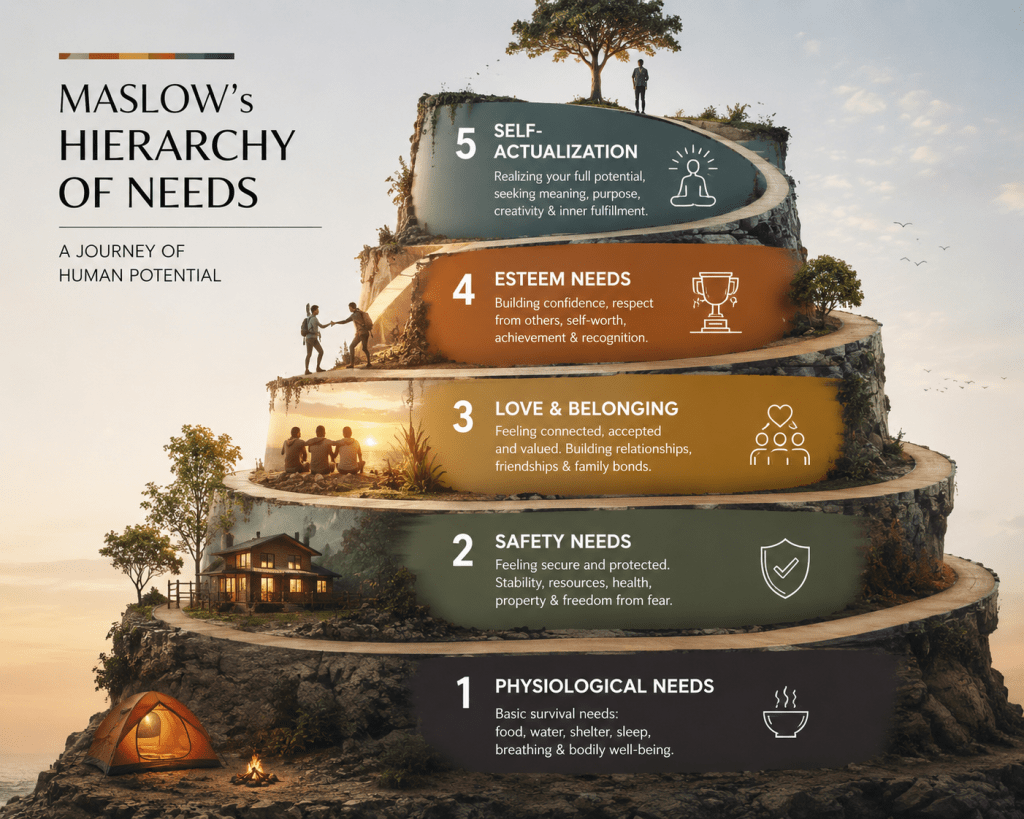
But in real clinical life, people rarely move through these needs in a perfectly organized order. Someone appears successful professionally while feeling emotionally empty, another person deeply craves connection while simultaneously struggling to trust others because of earlier attachment wounds. Some individuals remain emotionally focused on safety for years because their nervous system never fully stops expecting danger. Therapy nowadays often sees these needs overlapping constantly rather than functioning as separate stages. That is one reason Maslow’s work still feels relevant.
Emotional Safety and the Nervous System
One of the most important parts of Maslow’s theory involved safety. Not only physical safety, but also psychological safety. Current trauma research continues showing how difficult emotional growth becomes when a person lives in chronic fear, instability, emotional unpredictability, or long-term stress. When the nervous system stays focused on protection, deeper emotional exploration often becomes difficult. Clinicians see this regularly in therapy. People who grew up around criticism, emotional neglect, chaos, rejection, or unstable caregiving environments often learn to stay emotionally guarded long before they learn how to feel emotionally secure.
In many modern treatments, therapy does not immediately begin with “fixing thoughts.” Often, it begins with helping the person feel safer internally.
This can involve:
- emotional regulation,
- grounding work,
- nervous system stabilization,
- attachment repair,
- emotional validation,
- and developing a more secure therapeutic relationship.
That overlap between Maslow’s ideas and modern trauma-informed work is difficult to ignore.
You can see it today in:
- trauma-focused CBT,
- somatic therapies,
- attachment-focused therapy,
- Internal Family Systems (IFS),
- polyvagal-informed approaches,
- Emotionally Focused Therapy (EFT).
The Need to Belong
Maslow believed that human beings need emotional connection in a very deep way. Modern psychotherapy continues to confirm this repeatedly. Many people enter therapy carrying the effects of:
- chronic loneliness,
- emotional rejection,
- relational inconsistency,
- invalidation,
- abandonment,
- or attachment trauma.
Over time, these experiences shape how people see themselves and others and how they become emotionally distant to avoid disappointment; others become overly dependent on reassurance because emotional security was never fully developed. Therapists today frequently recognize that psychological symptoms do not emerge in isolation. Emotional pain is often connected to relational experiences that shaped a person’s beliefs about trust, safety, worth, and closeness. That is the reason why relationship patterns remain central in many therapies today, including:
- psychodynamic therapy,
- schema therapy,
- attachment-based therapy,
- group therapy,
- family systems therapy,
- and emotionally focused approaches.
Healing often happens inside an emotionally safe connection, not only through insight or technique alone.
Self-Worth, Shame, and Esteem
Maslow also wrote about esteem needs — the need to feel capable, respected, valued, and internally worthy. This remains deeply connected to modern clinical work. Many people struggling with depression, anxiety, perfectionism, trauma, or chronic shame quietly carry beliefs such as:
- “I am not enough,”
- “I always fail,”
- “I am only valuable if I achieve,”
- “People will reject the real version of me.”
Therapy today often involves more than reducing symptoms. It also involves helping people examine the emotional identity they built around those symptoms. This can be seen across:
- CBT,
- Schema Therapy,
- Compassion-Focused Therapy,
- ACT,
- and many integrative approaches.
Modern clinicians increasingly recognize that emotional suffering is not always only about painful events themselves. Sometimes the deepest wounds come from the meaning people gradually attach to themselves because of those experiences.
Self-Actualization in Modern Therapy
Maslow’s most famous idea was self-actualization. Unfortunately, this concept is sometimes misunderstood as becoming “perfect” or endlessly successful. That was not what Maslow meant. He was describing the process of becoming more connected to one’s authentic self — living in a way that feels psychologically real rather than emotionally disconnected or internally divided.
In psychotherapy, many people eventually find a point where therapy becomes less about symptom control alone and more about questions like:
- Who am I underneath survival mode?
- What kind of life actually feels meaningful to me?
- Why do I still feel emotionally empty even when I function well externally?
- What parts of myself have I spent years hiding?
These are deeply human questions. therapies increasingly work with them directly, especially:
- existential therapy,
- humanistic psychotherapy,
- ACT,
- narrative therapy,
- mindfulness-based therapies,
- integrative relational approaches.
Therapists today recognize that a person can appear highly functional while still feeling emotionally disconnected from themselves internally, and begin taking that emotional reality seriously during the therapy sessions.
Clinical Review
Psychology has evolved far beyond Maslow’s original model, and many parts of his theory have been debated, revised, or expanded over time. Moreover, his influence remains everywhere in contemporary psychotherapy, and his work helped shift psychology toward understanding that human beings are not only trying to avoid pain. They are also trying to:
- feel connected,
- feel emotionally safe,
- develop a stable sense of self,
- experience meaning,
- build authentic relationships,
- feel psychologically alive inside their own lives.
From a contemporary clinical perspective, that may be the reason Maslow’s ideas continue to resonate decades later. Because underneath many psychological symptoms, people are often still searching for the same things Maslow was describing all along: safety, connection, worth, meaning, and the freedom to become more fully themselves.
Dr Mina Bakhteyari
 Dr Mina Bakhterari Haftlangi
Leave a comment