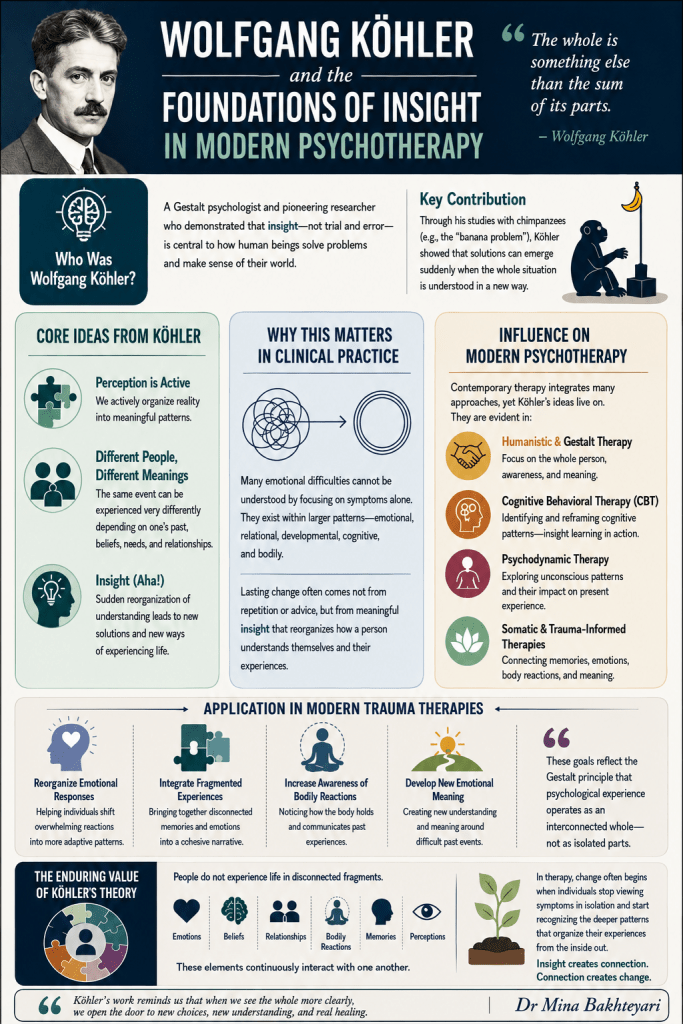
Before psychotherapy became dominated by diagnostic systems, symptom checklists, and structured behavioural protocols, some psychologists were already trying to understand how human beings naturally organize experience, solve problems, and create meaning. Among the most influential of these thinkers was Wolfgang Köhler, one of the central founders of Gestalt Psychology.
Köhler’s work moved psychology away from viewing human behaviour as nothing more than automatic reactions to external events. He believed the mind naturally tries to connect experiences, recognize patterns, and make sense of situations as a whole. Rather than responding to life in separate, disconnected pieces, people tend to organize their experiences into something meaningful and psychologically connected.
Although Köhler did not create a psychotherapy model himself, many modern therapies still reflect ideas that are very close to his work. Approaches that focus on self-awareness, emotional understanding, shifting perception, deeper insight, cognitive patterns, and relationship dynamics often build on the same foundations he helped introduce to psychology.
Who Was Wolfgang Köhler?
Wolfgang Köhler (1887–1967) was a German psychologist best known for helping establish Gestalt psychology alongside Max Wertheimer and Kurt Koffka. Köhler became particularly known for his research on problem-solving and insight learning. During his studies with chimpanzees, he observed that learning did not always occur gradually through trial and error alone. In many situations, the animal suddenly recognized relationships within the environment and discovered a solution through understanding the whole situation differently. This became known as insight learning.
His work challenged strictly mechanistic views of behaviour and introduced the idea that psychological change can occur through reorganization of perception, awareness, and meaning.
Core Concepts in Köhler’s Theory
1. The Whole Is Different from the Sum of Its Parts
One of the main ideas behind Gestalt psychology is that human experience cannot fully make sense if we look at it only in separate, disconnected parts. People do not experience:
- emotions separately from thoughts,
- thoughts separately from relationships,
- or behaviours separately from meaning.
Instead, psychological experience tends to function as an interconnected system. From a modern clinical viewpoint, this idea is still very important. Emotional struggles often cannot be understood by looking only at symptoms without also considering the person’s relationships, past experiences, emotional patterns, development, and ways of thinking that are connected to them.
2. Insight Learning
Köhler believed that learning sometimes occurs through sudden understanding rather than slow repetition. A person may struggle with the same emotional pattern for years and then suddenly recognize:
- a relational dynamic,
- a defensive pattern,
- a trauma response,
- or an unconscious belief that had previously remained outside awareness.
In psychotherapy, these moments are often experienced as:
- emotional realization,
- cognitive shifts,
- increased self-awareness,
- or sudden changes in perspective.
Many therapists notice that bigger psychological change does not happen only through repeated practice or advice. Sometimes real change begins when a person reaches an insight that shifts the way they see themselves, their relationships, or their past experiences.
3. Perception and Meaning-Making
Köhler believed that people do not simply absorb experiences passively. The mind naturally tries to make sense of situations by organizing them into patterns that carry emotional and personal meaning. Because of this, two people can go through the same situation but experience and interpret it in completely different ways depending on:
- past experiences,
- attachment patterns,
- emotional memories,
- beliefs,
- or nervous system responses.
This idea became deeply influential in many modern therapeutic approaches because psychological suffering is often connected not only to external events themselves, but also to the meaning attached to those experiences.
The Relevance of Köhler’s Theory in Modern Psychotherapy
Modern psychotherapy has developed far beyond the early ideas of Gestalt theory by itself. Today, clinicians usually combine different psychological perspectives and treatment approaches, including:
- attachment theory,
- trauma research,
- cognitive neuroscience,
- emotional regulation,
- nervous system functioning,
- behavioural learning,
- and relational psychology.
Even so, many of Köhler’s ideas are still present in modern therapy today, even when therapists may not directly realize where those concepts originally came from.
Cognitive Behavioural Therapy (CBT)
In modern Cognitive Behavioral Therapy, individuals gradually learn to identify patterns connecting:
- thoughts,
- emotions,
- behaviours,
- physical reactions,
- and interpretations.
This way of understanding emotional difficulties is quite similar to Gestalt thinking because emotions are not viewed as separate, isolated symptoms, but as parts of a larger, connected psychological pattern. In CBT, people are also encouraged to notice thinking patterns they may not have been fully aware of before and gradually develop different ways of understanding themselves and their experiences, which is very close to Köhler’s idea of insight learning.
Schema Therapy
Schema Therapy strongly reflects the idea that people organize experiences into larger emotional frameworks or “schemas.” A person may repeatedly interpret relationships through patterns shaped by:
- abandonment,
- shame,
- mistrust,
- emotional deprivation,
- or defectiveness.
Therapeutic change often occurs when the individual begins recognizing these long-standing emotional structures and develops a different understanding of themselves and others. This process closely resembles Köhler’s emphasis on reorganization of perception.
Gestalt Therapy
Although developed later by Fritz Perls, Gestalt Therapy was heavily influenced by Gestalt psychology. Modern Gestalt therapy focuses on:
- awareness,
- present-moment experience,
- emotional integration,
- unfinished emotional experiences,
- and relational contact.
Rather than analyzing isolated symptoms alone, therapists explore how the entire emotional experience is organized in the present moment.
Trauma Therapy and Nervous System Work
Many trauma-focused therapies now recognize that emotional reactions are not always logical or consciously controlled. A person may intellectually understand they are safe while their nervous system continues reacting as if danger is still present. Many modern trauma therapies help people gradually reconnect different parts of their emotional experience. This may include understanding emotional reactions more clearly, processing experiences that once felt disconnected or overwhelming, becoming more aware of bodily responses, and creating a different emotional understanding of painful past events. This way of viewing human functioning closely reflects the Gestalt idea that thoughts, emotions, body reactions, and experiences are deeply connected rather than separate from one another.
Clinical Reflection
From a modern clinical viewpoint, Köhler’s theory is still important not simply because people sometimes solve problems through sudden insight, but because his work pointed to something much deeper about human psychology. In additional, People do not experience life as separate, disconnected pieces; emotions, memories, beliefs, body reactions, relationships, and personal perceptions constantly influence one another. In therapy, real psychological change often starts when a person begins seeing the larger emotional patterns beneath their struggles instead of focusing only on individual symptoms one by one.
Sometimes a single moment of genuine insight can shift an entire emotional framework that had remained unchanged for years. Wolfgang Köhler helped psychology move beyond purely mechanical explanations of behaviour and toward a deeper understanding of perception, meaning, awareness, and insight. Although modern psychotherapy has expanded far beyond early Gestalt psychology, many contemporary therapeutic approaches still reflect Köhler’s central ideas:
- that human beings naturally seek meaning,
- that experiences are interconnected,
- and that psychological change often occurs through new awareness and reorganization of perception.
His work continues to influence how clinicians understand emotional patterns, self-awareness, relational functioning, and the process of psychological transformation itself.
Dr. Mina Bakhteyari
 Dr Mina Bakhterari Haftlangi
Leave a comment