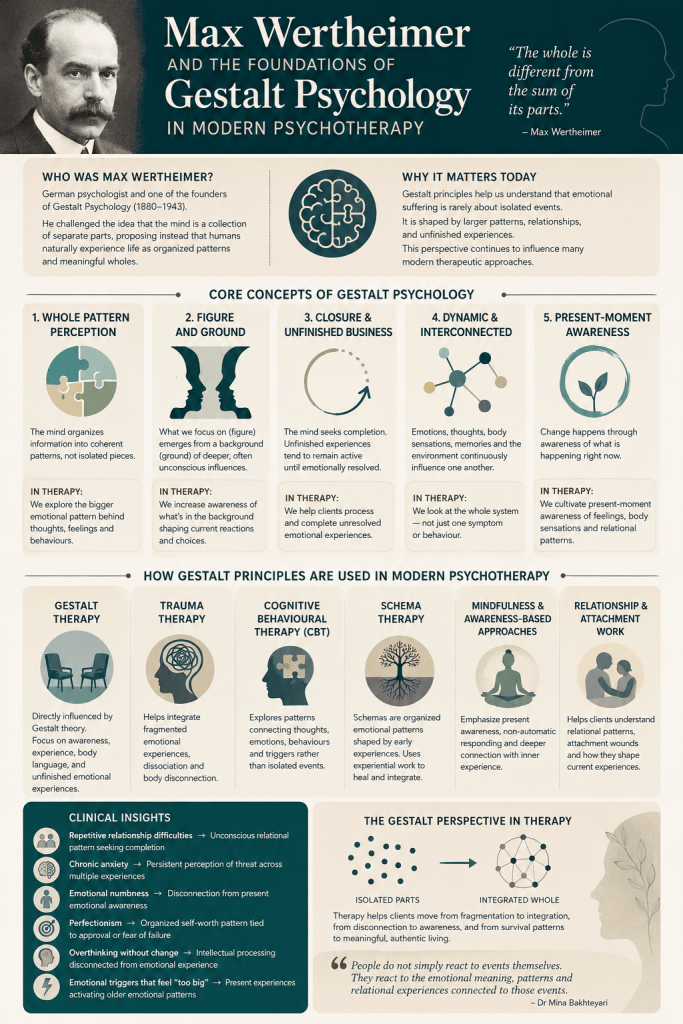
Before psychology became heavily focused on symptoms, diagnoses, and behavioural techniques, Max Wertheimer introduced a different way of understanding human experience. Instead of viewing thoughts, emotions, or behaviours as isolated pieces, he argued that the human mind naturally experiences life as organised patterns and meaningful wholes. This idea later became one of the central foundations of Gestalt Psychology.
Although Wertheimer’s original work was not created as a psychotherapy model itself, his theories deeply influenced many contemporary therapeutic approaches, particularly those that focus on awareness, emotional integration, perception, relational experience, and present-moment processing.
Today, many clinicians still work with concepts closely connected to Gestalt principles, often without fully realising how much modern therapy inherited from Wertheimer’s way of thinking.
Who Was Max Wertheimer?
Max Wertheimer (1880–1943) was a German psychologist and one of the founders of Gestalt Psychology alongside Kurt Koffka and Wolfgang Köhler.
Rather than understanding a person only through isolated symptoms or behaviours, Gestalt thinking encouraged psychologists to examine the larger emotional, cognitive, and relational patterns shaping human experience.
Over time, this perspective became highly influential not only in psychology but also in psychotherapy, neuroscience, learning theory, perception research, communication, and even modern trauma treatment.
Core Concepts of Gestalt Theory
1. The Mind Organises Experience Into Patterns:
At a time when many psychologists attempted to study the mind by breaking experience into smaller parts — sensations, reflexes, or individual thoughts — Wertheimer proposed something radically different: The mind does not naturally experience reality in fragmented pieces. It organises experience into meaningful patterns. This became the core idea behind Gestalt Psychology, which claims the whole is different from the sum of its parts.
Wertheimer stated that human beings automatically organise information into coherent structures. For example, people naturally search for meaning and connect emotional experiences, also completing missing information, detecting patterns, and interpreting situations as unified experiences rather than disconnecting fragments. This perspective helps explain why emotional difficulties feel larger than one isolated event, and a single criticism from a partner unconsciously connects with:
- earlier attachment wounds,
- past rejection,
- childhood shame,
- fear of abandonment,
- or long-standing beliefs about self-worth.
The nervous system rarely reacts only to the present moment. It often reacts to the entire emotional pattern attached to the experience.
2. Figure and Ground
One of Gestalt Psychology’s most important concepts is the relationship between figure and ground. The “figure” represents what is currently in conscious awareness. The “ground” represents the emotional background influencing perception outside immediate awareness. In therapy, this becomes highly relevant. A client may consciously focus on:
- anger,
- conflict,
- anxiety,
- perfectionism,
- or relationship problems,
while deeper emotional experiences remain in the background:
- fear of rejection,
- shame,
- grief,
- loneliness,
- emotional deprivation,
- unresolved attachment pain.
Modern psychotherapy often involves helping individuals recognise the emotional “background” shaping their reactions.
3. Human Experience Is Dynamic, Not Static:
Gestalt theory viewed human experience as fluid and constantly changing. In other words, thoughts, emotions, bodily sensations, memories, and environmental experiences continuously interact with one another. This idea strongly resembles contemporary approaches that examine the nervous system regulation, emotional processing, body-based awareness, interpersonal dynamics, and trauma responses.
According to the this days, clinicians increasingly recognise that emotional suffering cannot always be understood through isolated symptoms alone. Emotional experiences often emerge through interconnected systems involving cognition, physiology, attachment history, and relational experiences.
4. The Importance of Present-Moment Awareness
Although later Gestalt Therapy was developed more fully by Fritz Perls, many of its foundations originated from Wertheimer’s ideas about perception and awareness. Modern Gestalt-oriented work often encourages clients to notice:
- what they are feeling right now,
- how emotions appear in the body,
- repetitive interactional patterns,
- emotional avoidance,
- or unfinished emotional experiences.
In many cases, individuals spend years analysing their problems intellectually while remaining emotionally disconnected from their present experience.
Contemporary therapy increasingly recognises that insight alone does not always create emotional change. Awareness, emotional processing, nervous system experience, and relational safety are often equally important.
How Gestalt Principles Influence Modern Psychotherapy
Gestalt Therapy
The most direct influence of Wertheimer’s work appears in Gestalt Therapy.
Gestalt therapists often focus on:
- present awareness,
- emotional expression,
- body language,
- unfinished emotional experiences,
- relational dynamics,
- and experiential processing.
Rather than analysing clients only intellectually, therapy may involve helping individuals directly experience emotions that were previously avoided or disconnected.
Trauma Therapy:
Modern trauma treatments frequently work with fragmented emotional experiences. Trauma survivors may experience: emotional, disconnection, dissociation, bodily numbness, fragmented memories and internal conflict.
Gestalt principles helped psychology recognise the importance of emotional integration. Many trauma-focused approaches today attempt to reconnect fragmented emotional experiences into a more coherent sense of self.
This can be seen in:
- somatic therapies,
- attachment-focused trauma work,
- EMDR conceptualisation,
- parts work and
- experiential therapies.
Cognitive Behavioural Therapy (CBT)
Although CBT is usually viewed as very different from Gestalt approaches, some important overlaps exist. CBT often helps clients identify broader patterns connecting, such as thoughts, emotions, behaviours, bodily reactions, and environmental triggers. Rather than viewing symptoms as isolated events, therapy explores the larger cognitive-emotional system maintaining distress.
Schema Therapy
Schema Therapy strongly reflects Gestalt influences in several ways. Many schemas develop as organised emotional patterns shaped through repeated relational experiences.
For example:
- abandonment schemas,
- defectiveness schemas,
- emotional deprivation,
- mistrust schemas
often influence how individuals perceive entire situations, relationships, and emotional experiences. Experiential techniques in Schema Therapy, including chair work and imagery rescripting, also resemble Gestalt-based methods that focus on emotional processing in the present moment.
Mindfulness and Emotional Awareness Approaches:
Modern therapies increasingly emphasise present awareness, emotional observation, bodily experience and non-automatic responding, which are the principles that align closely with Gestalt ideas about conscious awareness and perception. Additionally, even therapies such as DBT, ACT, mindfulness-based CBT, and compassion-focused approaches often encourage individuals to become more aware of how emotional experiences unfold moment by moment.
Clinical Reflection
From a contemporary clinical perspective, Wertheimer’s contribution remains important in addition to psychological difficulties, which cannot be reduced to visual perception theories alone; his work helped psychology recognise that human beings experience life through interconnected emotional and cognitive patterns.
In therapy, people rarely struggle with one isolated thought or one isolated memory. In addition, emotional suffering is shaped by larger relational themes, unfinished emotional experiences, nervous system learning, attachment wounds, and deeply organised internal patterns that influence how individuals interpret themselves and the world around them. Gestalt principles continue to influence modern psychotherapy because they encourage clinicians to look beyond isolated symptoms and understand the broader emotional organisation of human experience.
Clinical Insight
Emotional Pattern: Possible Gestalt-Oriented Understanding Repetitive, unhealthy relationships, unconscious relational patterns seeking completion.
Chronic anxiety: Persistent perception of threat across multiple experiences. Emotional numbness Disconnection from present emotional awarenessn Perfectionism Organised self-worth pattern tied to approval or fear of failure.
Overthinking without emotional change, Intellectual processing disconnected from emotional experience. Emotional triggers that feel “larger than the situation” Present experiences activating older emotional patterns
Closing Reflection
Max Wertheimer’s ideas continue to shape modern psychotherapy in subtle but powerful ways. His work helped psychology move beyond viewing the mind as a collection of disconnected symptoms and toward understanding human experience as organised, relational, and deeply interconnected.
Today, many contemporary therapies still reflect this central Gestalt principle: people do not simply react to isolated events. They react to the meaning, emotional patterns, and lived experiences connected to them.
Dr Mina Bakhteyari
 Dr Mina Bakhterari Haftlangi
Leave a comment