Before psychology became deeply focused on cognition, trauma, attachment, or emotional regulation, early behavioural theorists were already trying to answer an important clinical question: Why do human beings continue certain behaviours even when those behaviours create distress, exhaustion, or emotional suffering?
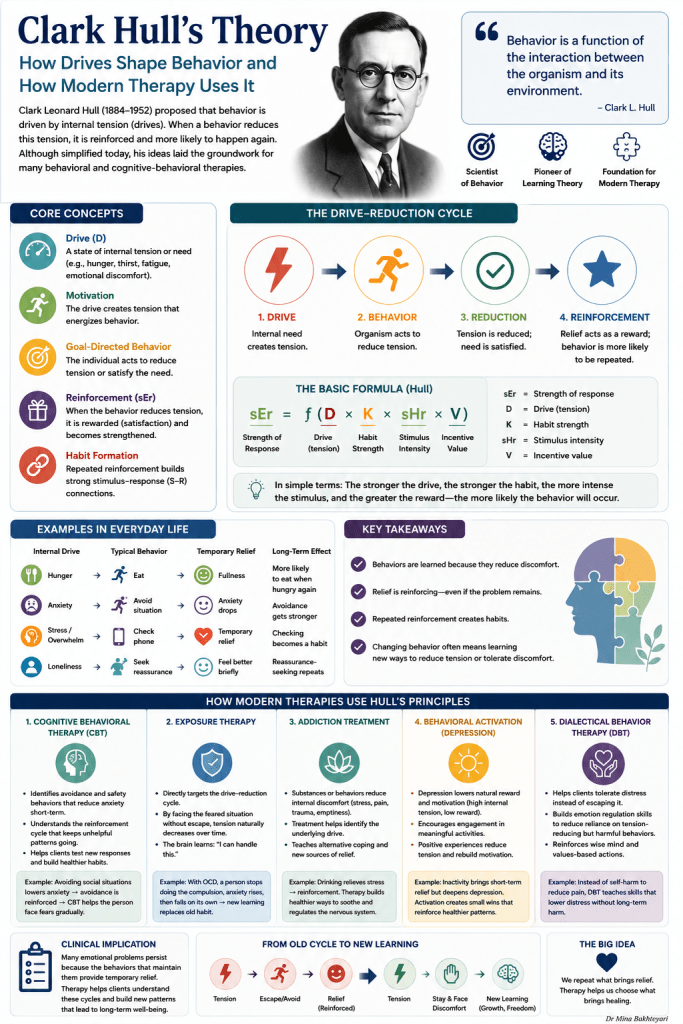
Clark Hull was one of the psychologists who attempted to explain behaviour through the relationship between internal tension, motivation, learning, and reinforcement.
Although many aspects of his original theory are no longer used in their strict classical form, his work helped shape some of the early foundations of behavioural learning theory, habit formation, motivational psychology, and reinforcement-based treatment approaches that continue influencing psychotherapy today.
Who Was Clark Hull?
Clark Leonard Hull (1884–1952) was an American psychologist best known for developing what became known as Drive Reduction Theory. His work emerged during a period when psychology was attempting to become more scientific, measurable, and experimentally structured. Unlike theorists who focused mainly on introspection or unconscious symbolism, Hull tried to explain behaviour through observable principles involving:
- biological needs,
- internal tension,
- motivation,
- reinforcement,
- habit formation,
- Moreover, learning through repeated behavioural outcomes.
He believed that much human behaviour is driven by attempts to reduce uncomfortable internal states.
From Hull’s perspective, behaviours that successfully reduce tension are more likely to become repeated over time.
Understanding Drive Reduction Theory
At the centre of Hull’s theory was the concept of a drive. A drive refers to an internal state of tension or discomfort that pushes the organism toward action.
For example:
- hunger creates tension that motivates eating,
- thirst motivates drinking,
- exhaustion motivates rest,
- emotional discomfort may motivate avoidance, reassurance-seeking, or emotional escape behaviours.
Hull proposed that when a behaviour reduces this uncomfortable internal state, the brain gradually strengthens the connection between the behaviour and the relief that follows. Over time, the behaviour can become habitual.
In simple terms:
Internal discomfort → behaviour → temporary relief → stronger behavioural pattern
Even though modern psychology recognises that human beings are far more emotionally complex than Hull originally proposed, this basic behavioural cycle still appears in many emotional and psychological difficulties seen in clinical work today.
Why Hull’s Theory Still Matters Clinically
Modern psychotherapy no longer views human behaviour only through biological drives or simple behavioural equations.
People are influenced by:
- attachment experiences,
- trauma,
- emotional learning,
- cognition,
- nervous system regulation,
- interpersonal dynamics,
- identity,
- and unconscious emotional processes.
However, Hull’s work remains clinically relevant because it highlighted some concepts that therapists still observe regularly: Behaviours that reduce emotional discomfort tend to become reinforced, even when they create long-term psychological problems.
This pattern can appear in many forms:
- chronic reassurance-seeking,
- emotional avoidance,
- compulsive checking,
- people-pleasing,
- addictive behaviours,
- emotional eating,
- avoidance of vulnerability,
- perfectionism,
- procrastination,
- or excessive emotional withdrawal.
In many cases, the behaviour is not repeated because it is healthy, but because it provides temporary relief from emotional tension.
Hull’s Influence on Modern Behavioural Treatments
Many current interventions indirectly reflect principles connected to Hull’s observations about reinforcement and tension reduction, although contemporary therapies have evolved far beyond early behaviourism.
Cognitive Behavioural Therapy (CBT)
In CBT, therapists often explore how avoidance behaviours become reinforced. For example: A person with social anxiety avoids social situations → anxiety temporarily decreases → avoidance becomes strengthened.
After a while, the mind and body can get used to avoiding things because avoidance brings temporary relief; the fear may still stay underneath, but the person feels calmer for the moment, so the pattern keeps repeating itself. This is very similar to what Hull described about reinforcement. In modern CBT, the goal is often to help people stay with difficult emotions little by little instead of automatically trying to get away from them.
Exposure Therapy
Exposure-based approaches are strongly connected to behavioural learning theories.
Individuals struggling with:
- panic disorder,
- OCD,
- phobias,
- trauma-related anxiety,
- or health anxiety
Often engage in behaviours that temporarily reduce fear, examples include:
- checking,
- reassurance-seeking,
- avoidance,
- compulsive rituals,
- or emotional escape behaviours.
While these behaviours reduce anxiety briefly, they unintentionally strengthen the fear cycle long-term.
Exposure therapy helps retrain the nervous system by reducing reliance on tension-reducing safety behaviours.
Addiction and Compulsive Behaviour
Hull’s concepts also helped influence later understanding of addiction and reinforcement. According to his perspective, many addictive or compulsive behaviours initially function as attempts to reduce internal discomfort, such as stress, emotional pain, loneliness, shame, emptiness, or psychological overwhelm. The temporary relief reinforces the behaviour neurologically and emotionally.
Modern addiction treatment now integrates:
- behavioural interventions,
- trauma-informed therapy,
- emotional regulation work,
- attachment-focused treatment,
- relapse prevention,
- and nervous system regulation.
However, the reinforcement cycle itself remains highly relevant.
Behavioural Activation in Depression
Behavioural Activation, often used in depression treatment, also indirectly reflects behavioural learning principles. Moreover, when individuals become emotionally exhausted or depressed, withdrawal and inactivity can temporarily reduce pressure or emotional strain.
However, long-term withdrawal often deepens hopelessness, isolation, and emotional numbness. Behavioural Activation gradually helps individuals reconnect with meaningful activity, structure, movement, and reward experiences even before motivation naturally returns.
Clinical Reflection
Hull’s theory remains valuable because he stated that human beings can be reduced to mechanical drive systems, and his work highlighted how strongly relief-based learning can shape behavioural patterns over time.
In therapy, many individuals intellectually understand that certain habits are harming them, yet their nervous system continues repeating those behaviours automatically because the behaviours once provided emotional relief, safety, predictability, or temporary escape from distress. This is one reason emotional patterns are often far more difficult to change than simple logical insight alone.
Clinical Insight
| Behaviour Pattern | Possible Emotional Function |
|---|---|
| Reassurance-seeking | Temporary reduction of anxiety or uncertainty |
| Emotional avoidance | Escape from overwhelm or vulnerability |
| Perfectionism | Attempt to reduce fear of criticism or failure |
| People-pleasing | Reducing fear of rejection or conflict |
| Compulsive checking | Short-term relief from uncertainty |
| Emotional withdrawal | Protection from disappointment or emotional pain |
| Addictive behaviours | Temporary escape from distress or emptiness |
Closing Reflection
Clark Hull’s work belong to an earlier era of psychology, and some of his core observations continue to echo throughout modern psychotherapy.
Contemporary clinicians increasingly recognise that many emotional struggles are maintained not simply by conscious choice, but by repeated patterns of emotional relief, reinforcement, and nervous system learning developed over time.
Integrating behavioural understanding with modern approaches such as CBT, trauma-informed therapy, attachment-focused work, Schema Therapy, and emotional regulation models allows therapists to understand better why certain patterns feel so difficult to change — even when the individual genuinely wants change. Rather than asking only “Why does this person continue this behaviour?” modern psychotherapy often asks a deeper question: “What emotional tension, fear, or unmet need might this behaviour temporarily be helping them manage?”
Dr Mina Bakhteyari
 Dr Mina Bakhterari Haftlangi
Leave a comment