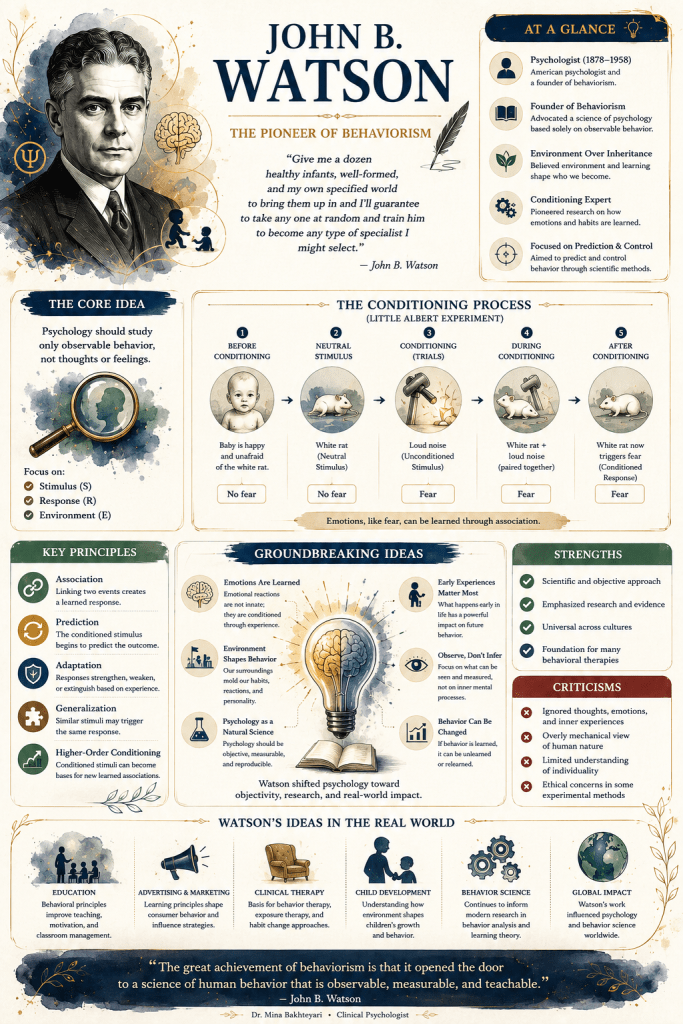
John B. Watson remains one of the most controversial and influential figures in the history of psychology. As the founder of Behaviorism, Watson radically changed the direction of psychological science and argued that psychology should focus on observable behaviour rather than unconscious processes, subjective experiences, or introspection.
Psychology relied heavily on analysing internal mental states, while Watson believed this approach lacked scientific reliability, and in his view, psychology could only become a true science if it studied measurable behaviour that could be observed, tested, and replicated objectively.
Although some early Behaviourist ideas are now viewed as overly simplistic, Watson’s work still had a major influence on the development of modern psychotherapy, behavioural medicine, learning theory, exposure-based treatments, and current understandings of conditioning and emotional learning.
Watson’s Core Theory: Behaviour Is Learned
Watson believed that human behaviour develops mainly through life experiences and environmental influences rather than being driven mostly by inborn personality traits or unconscious psychological forces.
He believed that:
- emotions can be conditioned,
- behaviours can be learned,
- reactions can be reinforced,
- behavioural patterns can be modified through environmental influence.
One of his most famous and ethically criticised experiments was the “Little Albert” study, conducted with Rosalie Rayner. In this experiment, a young child was conditioned to fear a previously neutral object after it became associated with a frightening stimulus.
Although the experiment would never meet modern ethical standards, it demonstrated an important psychological principle: Emotional reactions can become learned through repeated associations. This idea later became one of the foundations of classical conditioning models used in behavioural psychology and psychotherapy.
Classical Conditioning and Emotional Learning
Watson expanded upon earlier work by Ivan Pavlov and argued that emotional responses themselves could become conditioned. From a modern perspective, this concept remains highly relevant. In therapy, emotional reactions are not deliberate or fully conscious; they reflect automatic patterns within the nervous system that have developed gradually through repeated emotional experiences.
Some examples are stated below.
- A person repeatedly criticised during childhood automatically associates mistakes with shame.
- someone exposed to chronic unpredictability becomes highly sensitive to signs of rejection.
- traumatic experiences condition the body to react defensively even in objectively safe environments.
Over time, the nervous system may begin responding automatically before conscious reasoning has time to intervene, and it is one reason emotional suffering is not always resolved through logic alone.
Watson’s Influence on Modern Behavioural Therapy
Even though psychotherapy has changed considerably since Watson’s time, many modern evidence-based approaches still draw from behavioural principles that emerged from early Behaviourism.
Watson’s work helped create the groundwork for:
- Behavioural therapy,
- Exposure Therapy,
- Systematic Desensitisation,
- Behaviour Modification,
- Cognitive Behavioural Therapy (CBT),
- and parts of trauma-focused interventions.
Modern clinicians no longer view human beings as simple stimulus-response systems. However, behavioural learning principles continue to play an essential role in understanding anxiety, fear conditioning, avoidance behaviours, addiction patterns, emotional reinforcement, and habit formation.
Behaviourism and Anxiety Treatment
One of the clearest modern applications of Watson’s theoretical influence can be seen in the treatment of anxiety disorders. In clinical practice, many anxiety responses operate through conditioned fear learning.
Some examples:
- panic attacks may become associated with certain places or bodily sensations,
- social humiliation experiences may condition social avoidance,
- traumatic experiences may create automatic fear responses to reminders linked with past events.
Behavioural and CBT-oriented therapies often aim to reshape these gradually learned emotional responses over time. This can include:
- exposure-based interventions,
- response prevention strategies,
- behavioural exercises,
- nervous system regulation techniques,
- Moreover, helping individuals reduce avoidance habits that may unintentionally maintain fear and anxiety.
From a behavioural perspective, avoidance temporarily reduces anxiety, but over time it teaches the brain that the feared situation is dangerous. This can strengthen the anxiety cycle. Modern therapy, therefore, often focuses not only on insight, but also on corrective emotional experiences and behavioural change.
Watson’s Legacy in Trauma and Nervous System Research
Although Watson did not have access to the neuroscientific knowledge available today, some of his ideas foreshadowed later developments in trauma psychology and research on emotional conditioning.
Modern trauma-informed approaches now recognise that repeated experiences can gradually shape automatic emotional and physiological reactions within the nervous system.
Today we understand that:
- the nervous system learns patterns of safety and danger,
- emotional reactions can become deeply conditioned,
- and survival responses may continue long after the original threat has passed.
In many clients, emotional reactions are not simply “irrational thoughts.” They are learned protective responses shaped through experience. For this reason, many contemporary therapies combine behavioural techniques with:
- emotional processing,
- nervous system regulation,
- attachment-focused work,
- and cognitive restructuring as part of treatment.
Behaviourism and Modern CBT
Contemporary Cognitive Behavioural Therapy evolved from behavioural traditions. In other words, early Behaviourism focused primarily on observable behaviour. Later cognitive theorists expanded these ideas by exploring how thoughts, interpretations, beliefs, and emotional meaning influence behaviour.
However, many core CBT strategies still reflect behavioural principles:
- reinforcement,
- habit learning,
- exposure,
- behavioural activation,
- and stimulus-response patterns.
For example, behavioural activation used in depression treatment is strongly connected to behavioural theory. Clients are encouraged to gradually re-engage with meaningful activities because behaviour itself can influence emotional state. Moreover, exposure therapy for OCD and anxiety disorders relies on principles connected to conditioned fear reduction.
Clinical Reflection
From a modern clinical perspective, Watson’s theory remains valuable not because human beings can be viewed as conditioned systems, but because his work highlighted how deeply experiences can influence emotional and behavioural reactions over time.
In therapy, many people logically understand that they are safe, competent, or accepted, yet their nervous system may still respond with fear, shame, rejection sensitivity, or emotional defensiveness. Behavioural theory helped psychology recognise that many emotional patterns develop gradually through repeated experiences and learned emotional associations.
Modern psychotherapy has moved far beyond early Behaviourism alone. However, many evidence-based interventions still rely on principles connected to emotional learning, conditioning, reinforcement, and behavioural change. Rather than viewing symptoms simply as “bad behaviours,” contemporary clinicians increasingly understand them as adaptive patterns that were learned, reinforced, and emotionally encoded over time.This shift allows therapy to move beyond judgment and toward understanding, regulation, flexibility, and meaningful psychological change.
Dr. Mina Bakhteyari
 Dr Mina Bakhterari Haftlangi
Leave a comment