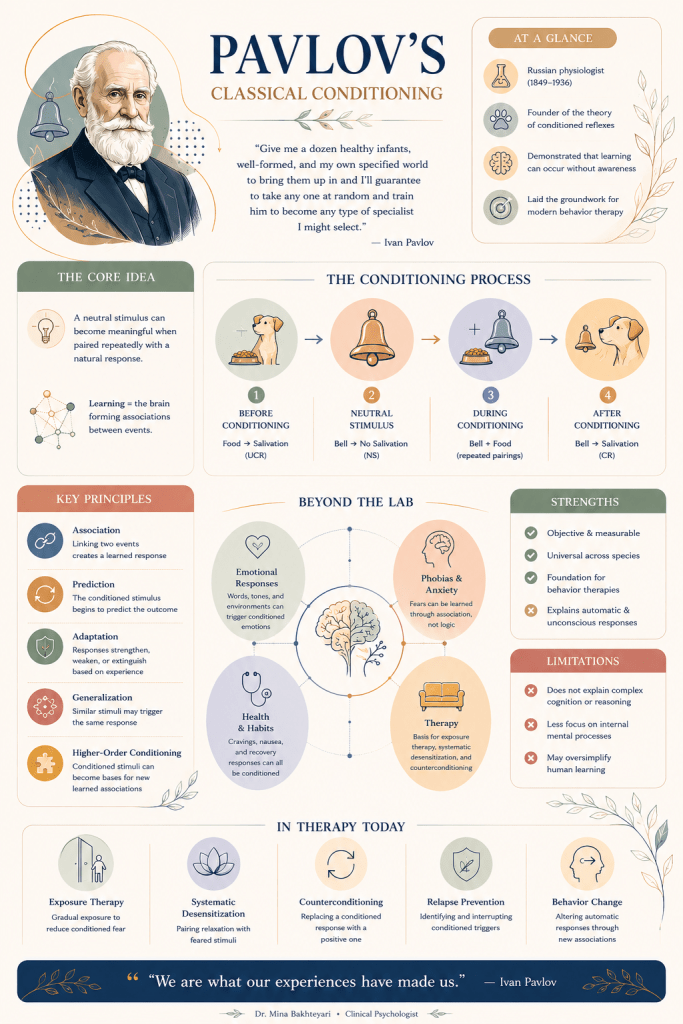
When people hear the name Ivan Pavlov, they often immediately think about “dogs salivating at the sound of a bell.”
Although this experiment became one of the most recognised psychological demonstrations in history, Pavlov’s work was far more significant than a simple laboratory observation. His research fundamentally changed how psychology understood learning, emotional reactions, behaviour, and the connection between environmental experiences and human responses.
Even today, many modern psychological treatments, especially behavioural and cognitive-behavioural approaches, still indirectly rely on principles that originated from Pavlov’s discoveries.
Who Was Ivan Pavlov?
Ivan Pavlov was a Russian physiologist born in 1849, and unlike many figures associated with early psychology, his background was rooted more in biology and medical science than in psychotherapy or psychoanalysis. In addition, more of his early research explored the digestive system and the functioning of the nervous system. His work on digestion later earned him the Nobel Prize in Physiology or Medicine.
During his experiments, he noticed something unexpected, which dogs were beginning to salivate not only when food was presented, but also when they heard the footsteps of the assistant bringing the food, saw laboratory equipment, or noticed signals associated with feeding. This observation eventually led to one of the most influential concepts in psychology:
Classical conditioning that refers to a learning process in which a previously neutral stimulus becomes associated with a meaningful stimulus and eventually produces a learned response. Pavlov demonstrated that behaviour and physiological reactions could be shaped through repeated associations.
In simplified form:
- Food naturally causes salivation.
- A bell initially caused no salivation.
- After repeatedly pairing the bell with food, the bell alone began triggering salivation.
The dog had started reacting automatically, both emotionally and physically, after linking the sound with food over time. Even though Pavlov’s experiment mainly examined observable reactions, it later became important for understanding human emotions and psychological responses as well.
Why Pavlov’s Theory Became So Important
Before Pavlov, many emotional and behavioural reactions were viewed as mysterious, instinctive, or purely unconscious. Pavlov’s findings suggested that emotional responses could also be learned through experience. This idea later became foundational in understanding:
- fears,
- emotional triggers,
- trauma responses,
- habits,
- avoidance patterns,
- addictions,
- emotional associations,
- and automatic behavioural reactions.
Modern psychology eventually recognised that many emotional responses are not random. They are often shaped through repeated experiences and learned associations accumulated over time.
Conditioning and Emotional Life
In clinical settings, conditioning processes are often much more subtle than laboratory experiments. A person may not consciously realise that their emotional reactions have become linked to certain experiences, environments, or interpersonal patterns.
For example, A child repeatedly criticised in school later feels anxiety whenever evaluated by authority figures.
Another example, someone who experienced betrayal in relationships may develop automatic fear when emotional intimacy increases.
One more example, a person exposed to chronic conflict during childhood may become physiologically tense even in relatively safe situations.
final example, a panic attack experienced in a crowded place may later condition fear toward shopping centres, public transportation, or social spaces.
Sometimes people go through stress for so long that their body stays tense even when everything is actually okay. They may understand in their mind that they are safe, but their body still reacts with anxiety, fear, or discomfort. This is one reason emotional reactions are not always easy to control just by “thinking differently.”
Pavlov’s Influence on Behavioural Therapy
Pavlov’s work later became one of the foundations of Behaviourism and Behavioural Therapy. Psychologists such as John B. Watson and B. F. Skinner expanded learning theories further, eventually contributing to the development of modern behavioural interventions and many evidence-based therapies still use principles connected to conditioning theory.
How Pavlov’s Theory Influences Modern Treatments
Exposure Therapy
One of the clearest modern applications is Exposure Therapy.
Individuals struggling with:
- phobias,
- panic disorder,
- obsessive fears,
- health anxiety,
- social anxiety,
- or trauma-related avoidance
often develop conditioned fear responses.
For example, A person who once experienced intense panic while driving may eventually associate driving itself with danger. Even when no real danger exists, the nervous system continues reacting automatically. Exposure-based interventions gradually help the brain relearn safety by weakening conditioned fear associations. Rather than avoiding triggers, clients slowly experience them in controlled and supportive ways until the nervous system begins responding differently.
This process is strongly connected to Pavlovian learning principles.
Trauma-Informed Therapy
Modern trauma research also reflects conditioning concepts. Trauma is not only remembered cognitively; it is often stored physiologically and emotionally.
Sounds, smells, environments, tones of voice, facial expressions, or interpersonal dynamics may become associated with past distress.
In therapy, individuals sometimes react intensely to situations that objectively appear minor because their nervous system has learned emotional associations linked to earlier experiences.
Many trauma-focused approaches attempt to modify these conditioned emotional responses through gradually:
- emotional processing,
- nervous system regulation,
- corrective emotional experiences,
- grounding techniques,
- and safe relational experiences.
Cognitive Behavioural Therapy (CBT)
Although Cognitive Behavioral Therapy later integrated cognition, beliefs, and thought patterns, behavioural learning theories remain part of its foundation.
CBT often explores:
- automatic reactions,
- avoidance cycles,
- reinforcement patterns,
- emotional triggers,
- and learned behavioural habits.
Many behavioural interventions within CBT indirectly trace back to conditioning principles established by Pavlov and later behavioural theorists.
Addiction and Habit Formation
From a conditioning perspective, addiction is not only about the substance or behaviour itself. Over time, the mind can begin connecting certain emotions, routines, environments, or relationships with the experience of using. Eventually, even small reminders of those situations may bring up strong urges or cravings before any actual behaviour takes place. Modern addiction treatment frequently works on:
- recognising triggers,
- interrupting conditioned patterns,
- creating alternative responses,
- and reducing automatic cue-based reactions.
Health Psychology and Psychophysiology
Pavlov’s influence extends into modern health psychology and psychophysiology, and researchers recognise that emotional conditioning can affect:
- stress responses,
- sleep,
- chronic tension,
- autonomic nervous system activation,
- and even some psychosomatic symptoms.
Through repeated emotional experiences, the body can gradually become used to reacting in certain ways. In therapy, many people with long-term anxiety describe constantly feeling tense or watchful, even when nothing dangerous is happening around them. Often, the nervous system has spent so much time adapting to stress, uncertainty, or emotional instability that remaining “on guard” starts to feel automatic.
Clinical Reflection
From a contemporary clinical perspective, Pavlov’s theory still holds value, not because human beings can be reduced to simple conditioned responses, but because his work helped demonstrate how deeply repeated experiences can influence emotional and physical reactions over time. Many individuals entering therapy are not consciously choosing their reactions. Often, their nervous systems have learned emotional associations through repeated experiences over many years.
This is especially visible in:
- chronic anxiety,
- relationship avoidance,
- panic reactions,
- trauma responses,
- emotional hypervigilance,
- and persistent behavioural habits.
Understanding conditioning helps therapists approach symptoms with greater compassion rather than viewing them simply as irrational or intentional. In many modern therapies, healing partly involves helping the brain and nervous system form new emotional associations — especially experiences of safety, regulation, trust, emotional expression, and psychological flexibility.
Although psychology has evolved significantly since Pavlov’s early experiments, his work continues to influence modern psychotherapy, behavioural science, neuroscience, trauma treatment, and emotional learning theory. His research helped establish one of the most important psychological insights still recognised today: Human emotional reactions are often learned through experience, and because they are learned, they can also gradually be changed.
Dr. Mina Bakhteyari
 Dr Mina Bakhterari Haftlangi
Leave a comment