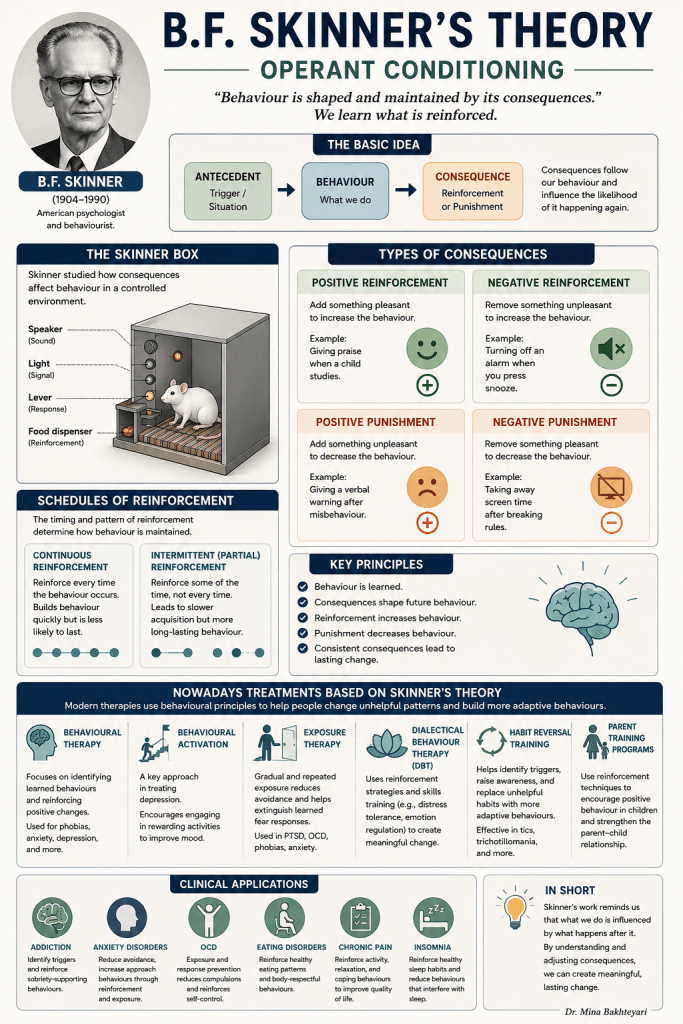
B. F. Skinner was one of the most influential psychologists of the twentieth century and a central figure in the development of Behaviourism after John B. Watson. While Watson helped establish Behaviourism as a scientific movement focused on observable behaviour, Skinner expanded these ideas into a far more detailed theory of learning, behaviour modification, and reinforcement.
Skinner believed that human behaviour is strongly shaped by its consequences. According to his theory, behaviours that are reinforced are more likely to continue, while behaviours that are ignored or punished are less likely to be repeated.
Although modern psychology recognises that human experience is far more complex than behaviour alone, Skinner’s work continues to influence contemporary psychotherapy, behavioural medicine, educational psychology, addiction treatment, trauma-informed care, and evidence-based interventions used in clinical settings today.
From Watson to Skinner: The Evolution of Behaviourism
Watson argued that psychology focuses on observable behaviour rather than internal mental states. Skinner agreed with this scientific direction but believed Watson’s model did not fully explain how behaviours are maintained over time.
Skinner introduced the concept of Operant Conditioning, which focused not only on stimuli that trigger behaviour, but also on the consequences that strengthen or weaken behaviour afterward.
This became one of the most influential learning theories in modern psychology.
According to Skinner:
- behaviours followed by rewarding outcomes are likely to be repeated,
- behaviours followed by unpleasant consequences decrease,
- patterns of reinforcement gradually shape behaviour across time.
Rather than seeing behaviour as random, Skinner viewed human actions as patterns shaped continuously through interaction with the environment.
Operant Conditioning and Reinforcement
Skinner’s theory is centred around reinforcement. He proposed that behaviour is strongly influenced by what happens immediately after an action occurs.
Positive Reinforcement
A rewarding experience increases the likelihood of repeating a behaviour. for example:
- praise after achievement,
- emotional validation,
- attention from others,
- social approval,
- or relief after avoidance.
Negative Reinforcement
A behaviour increases because it removes discomfort or distress. Some examples are mentioned below:
- avoiding social situations may temporarily reduce anxiety,
- compulsive behaviours may reduce internal tension,
- emotional withdrawal may reduce fear of conflict.
From a modern clinical perspective, this concept became extremely important because many psychological symptoms are unintentionally reinforced over time.
Skinner’s Theory and the Development of Modern Behavioural Therapy
Skinner’s work directly influenced the development of:
- Behavioural therapy,
- Cognitive Behavioural Therapy (CBT),
- Behaviour Modification,
- Exposure-Based Treatments,
- Behavioural Activation,
- addiction treatment models,
- and parts of Dialectical Behaviour Therapy (DBT).
Modern therapists no longer reduce human beings to reinforcement systems alone. However, Skinner’s principles continue helping clinicians understand:
- habit formation,
- emotional avoidance,
- compulsive patterns,
- addiction cycles,
- self-destructive coping behaviours,
- and long-term maintenance of anxiety disorders.
Reinforcement and Anxiety Disorders
One of the most clinically relevant contributions of Skinner’s theory involves understanding how anxiety becomes maintained over time. In many anxiety disorders, avoidance behaviours become negatively reinforced. As examples, avoiding social situations temporarily reduces anxiety, reassurance-seeking briefly reduces uncertainty, compulsive checking lowers tension for a short period, and emotional avoidance reduces immediate discomfort.
However, the anxiety cycle becomes stronger, but these behaviours create temporary relief, and the brain learns to repeat them. In other words, it is why many evidence-based therapies work not only by discussing emotions intellectually, but by gradually changing behavioural responses and reducing reinforcement patterns connected to fear and avoidance.
Skinner’s Influence on Depression Treatment
Skinner’s ideas also influenced modern approaches to depression, particularly Behavioural Activation and many individuals experiencing depression gradually withdraw from:
- social interaction,
- meaningful activity,
- pleasurable experiences,
- or emotionally rewarding routines.
As reinforcement decreases, emotional numbness, hopelessness, and passivity may deepen further. Behavioural Activation works partly by helping individuals reconnect with behaviours associated with:
- mastery,
- emotional reward,
- structure,
- movement,
- and meaningful engagement.
From a behavioural perspective, emotional improvement is not always something that happens before action. Sometimes emotional change begins through gradual behavioural engagement itself.
Behaviourism, Addiction, and Emotional Coping
Skinner’s theory also remains highly relevant when trying to understand addiction and unhealthy coping patterns. Many behaviours continue not because they truly help the person in the long term, but because they provide temporary emotional relief in the moment.
Furthermore, substance use, compulsive behaviours, emotional avoidance, constant reassurance-seeking, or chronic people-pleasing often do not develop randomly. In many cases, these patterns slowly become ways of coping with anxiety, emotional pain, shame, loneliness, stress, or internal discomfort.
Even when the behaviour eventually becomes harmful, part of the person still experiences it as emotionally protective because, at some stage in life, it helped them feel calmer, safer, less rejected, or more emotionally in control. In therapy, exploring reinforcement patterns can help clinicians understand:
- what emotional need the behaviour is trying to meet,
- what feelings or experiences the person may be trying to avoid,
- why certain patterns continue even when the individual is fully aware of their negative long-term effects.
This perspective shifts therapy away from moral judgment and toward behavioural understanding.
Modern Psychotherapy Beyond Classical Behaviourism
Modern psychotherapy has moved far beyond the early behavioural models that focused only on observable actions. Today, clinicians also work with attachment dynamics, trauma histories, unconscious emotional patterns, identity struggles, relational experiences, and the way the nervous system responds to stress and emotional threat.
At the same time, behavioural principles remain an important part of many contemporary treatments. Most modern therapies no longer rely on a single approach alone. Instead, they often combine behavioural strategies with emotional processing, cognitive work, mindfulness-based techniques, attachment-focused interventions, and nervous system regulation.
Even therapies that are not usually described as “behavioural” still use behavioural learning principles in different ways. This can be seen in approaches such as gradual exposure during trauma treatment, behavioural activation for depression, distress tolerance skills in DBT, habit reversal training, or reinforcement-based interventions used in parenting and child therapy.
Clinical Reflection
From a modern clinical perspective, Skinner’s theory continues to hold value not because human behaviour can simply be explained through rewards and punishments, but because his work helped psychology recognise how emotional and behavioural patterns can become strengthened over time through repeated experiences.
In therapy, many individuals continue behaviours they consciously dislike because those behaviours still serve an emotional function.
- Avoidance may reduce fear temporarily.
- Emotional withdrawal may reduce vulnerability.
- Perfectionism may reduce feelings of inadequacy.
- Compulsive reassurance-seeking may briefly reduce uncertainty.
- The nervous system learns these patterns automatically.
Skinner’s work helped psychology recognise that many emotional and behavioural difficulties are maintained not simply by conscious choice, but by reinforcement cycles that gradually become deeply ingrained. Modern psychotherapy has expanded far beyond classical Behaviourism alone. However, behavioural learning principles still remain central to many evidence-based treatments used today.
Rather than viewing symptoms only as irrational or self-destructive behaviours, contemporary clinicians increasingly understand them as adaptive strategies that once helped the individual regulate distress, regain control, or psychologically survive difficult emotional experiences.
Dr. Mina Bakhteyari
 Dr Mina Bakhterari Haftlangi
Leave a comment