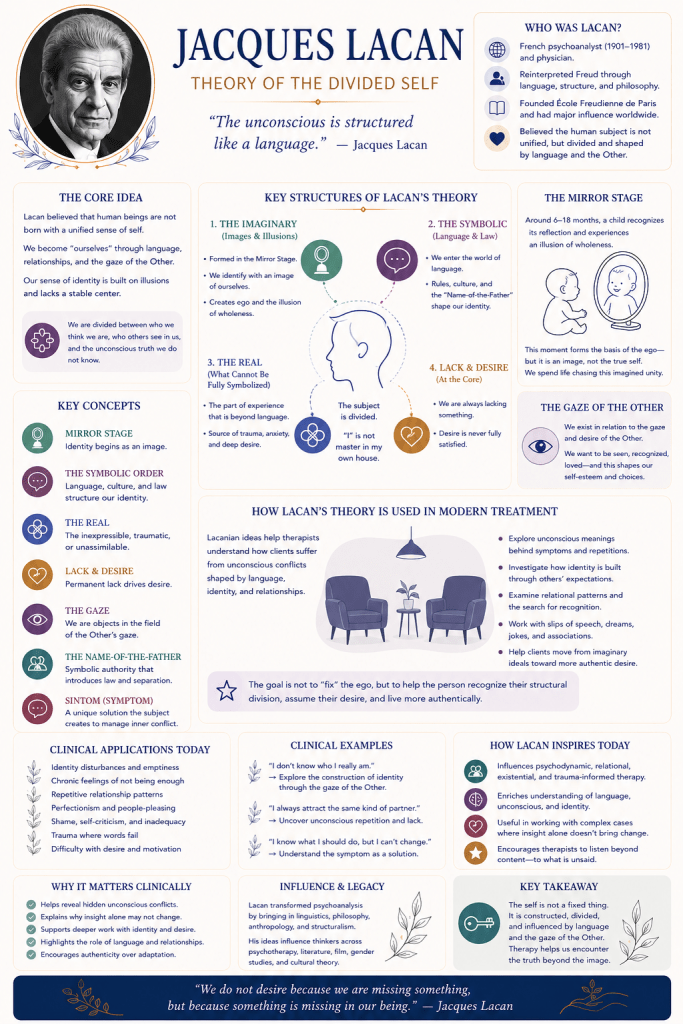
Among major psychoanalytic thinkers, Jacques Lacan is often considered one of the most intellectually complex. His ideas are sometimes described as difficult, abstract, or even confusing. However, underneath the dense terminology, Lacan was attempting to answer a very human question, such as:
- Why do people so often feel emotionally divided within themselves?
- Why does someone appear successful yet feel empty?
- Why does someone desire intimacy yet fear closeness?
- Why does someone understand their patterns intellectually but still repeat them emotionally?
- Why does someone constantly search for validation without ever fully feeling “enough”?
Lacan believed that human beings are not as psychologically unified as they appear. According to his theory, much of emotional suffering emerges from the gap between who we think we are and who we believe others want us to be. Moreover, the parts of ourselves that we cannot fully understand or express.
Although Lacanian theory originated within psychoanalysis, many of its themes remain highly relevant in modern psychotherapy, especially in work involving: identity confusion, chronic emptiness, unstable relationships, emotional disconnection, perfectionism, shame, attachment trauma, and repetitive relational patterns.
The Mirror Stage: How Identity Begins
One of Lacan’s most famous ideas is the Mirror Stage. He proposed that, early in life, infants gradually begin to recognise themselves as separate individuals. When a child first identifies their reflection, they experience an illusion of wholeness, a sense that: “This is me.”
However, internally, the child’s emotional experience is still fragmented, dependent, vulnerable, and disorganised. According to Lacan, from this point onward, human beings continue building identities partly through external images, roles, and recognition from others. In modern terms, this idea remains psychologically relevant.
Many people unconsciously build their self-worth through achievement, appearance, productivity, relationships, academic success, social approval or external validation. However, they feel uncertain, emotionally fragmented, or internally disconnected.
Clinical Reflection
Some people appear very put-together from the outside. They manage responsibilities, work, and relationships well, yet internally they may constantly question themselves, struggle with their sense of identity, or feel as though they are never truly enough.
Lacan’s work helps explain how a person can spend years constructing a stable external identity while internally feeling emotionally divided or psychologically unanchored.
The “Other”: Why Human Beings Need Recognition
A central idea in Lacanian theory is the concept of the Other. Lacan believed that human identity develops through relationships and language. In many ways, we learn who we are through how others respond to us.
Children slowly learn which behaviours are accepted, rewarded, or valued around them. Many grow up feeling they should stay strong, avoid disappointing others, achieve highly, or meet expectations to feel valued or loved.
These repeated experiences can become deeply internalized psychological standards rather than simply external expectations. In additional, as adults, many people continue unconsciously searching for approval, validation, or emotional confirmation from others because part of their identity still depends on being recognised. This does not mean all human connection is unhealthy; rather, he highlighted how easily self-worth can become overly dependent on external recognition.
Clinical Reflection
In contemporary psychotherapy, this dynamic is visible in individuals who:
- struggle with people-pleasing,
- fear rejection intensely,
- overadapt to others,
- lose connection with their authentic needs,
- Alternatively, feel emotionally destabilised when approval is withdrawn.
Many intellectually understand that their worth should not depend entirely on others, yet emotionally, they continue to feel driven by relational validation.
Desire and the Feeling That Something Is Missing
Lacan believed that human desire is never completely satisfied.
According to his theory, people often imagine:
- Once I achieve this, I will finally feel complete.
- Once I find the right relationship, everything will feel better.
- Once I become successful enough, confident enough, attractive enough and productive enough.
However, after achieving one goal, another feeling of incompleteness often emerges. Lacan argued that this emotional “lack” is part of the human condition itself. Modern psychology may frame this differently, but clinically, the idea remains recognisable. Many individuals spend years chasing:
- perfection,
- success,
- validation,
- ideal relationships,
- or impossible standards,
- while still feeling emotionally unsatisfied internally.
Clinical Reflection
In therapy, it is not uncommon to see people who appear successful, productive, and emotionally stable on the outside while internally feeling emotionally unsettled, disconnected, or unable to feel fully satisfied with life. Therapy sometimes becomes less about “fixing” the self and more about helping individuals develop a more realistic, compassionate, and emotionally integrated relationship with themselves.
Language, Symptoms, and the Unconscious
Lacan claimed that the unconscious is structured like a language, and the idea carries important therapeutic meaning. People often reveal emotional conflicts indirectly through:
- repeated phrases,
- jokes,
- avoidance,
- slips of speech,
- contradictions,
- emotional reactions,
- recurring relationship patterns,
- or symbolic behaviours.
Modern therapists may not interpret these experiences exactly as classical psychoanalysis once did, yet many contemporary approaches still pay close attention to:
- emotional narratives,
- relational patterns,
- symbolic meaning,
- internal dialogue,
- and unconscious emotional themes.
Clinical Reflection
In therapy, individuals repeat the same emotional story in different forms for years, such as:
- pursuing emotionally unavailable partners,
- fearing abandonment while avoiding intimacy,
- overfunctioning to gain worth,
- Alternatively, intellectualising emotions while remaining emotionally disconnected.
Lacan’s work reminds clinicians that symptoms are not always random problems to eliminate immediately. Sometimes, they are attempts by the psyche to communicate unresolved emotional conflicts.
Lacan and Modern Psychotherapy
Although few therapists today practice “pure” Lacanian psychoanalysis, many of Lacan’s ideas continue to influence modern clinical thinking indirectly.
His ideas continue to influence several contemporary therapeutic approaches, including psychodynamic therapy, relational psychoanalysis, attachment-oriented work, trauma-informed treatment, and existential psychotherapy. Elements of his thinking can also be recognised in some schema-based formulations, particularly those related to identity, self-worth, and recurring relational dynamics.
His theory still influences different modern therapeutic approaches, such as psychodynamic, relational, attachment-based, trauma-informed, and existential therapies. Furthermore, some schema-focused approaches also reflect similar ideas when working with identity difficulties, emotional patterns, and relationship dynamics.
In contemporary practice, therapists usually do not use Lacanian concepts in a strict theoretical sense. Instead, parts of his thinking are often applied in more emotionally understandable and clinically practical ways, such as helping people understand repeated relationship patterns, an unstable self-image, shame, a dependency on external validation, or a feeling of losing connection to their more authentic emotional experience.
A Contemporary View of Lacan
Lacan’s theory writing style itself is often considered intentionally difficult, and parts of his works remain controversial and theoretical. However, many clinicians continue to find value in his broader observations about identity, desire, emotional fragmentation, and relational dependency.
From a contemporary perspective, Lacan’s lasting relevance may not lie in interpreting every symbol literally, but in recognising something psychologically familiar:
Many people spend years trying to become the version of themselves they believe will finally feel complete — while quietly losing connection with the parts of themselves that already exist underneath those expectations.
Closing Reflection
Drawing on Lacanian perspectives in contemporary psychotherapy can offer a richer understanding of identity struggles, emotional conflict, attachment dynamics, and the ongoing human search for meaning and recognition. Rather than seeing symptoms only as behaviours or problems that need to be eliminated, Lacanian thinking encourages clinicians to explore what emotional reality or unmet psychological need may be expressed through those patterns.
Dr Mina Bakhteyari
 Dr Mina Bakhterari Haftlangi
Leave a comment