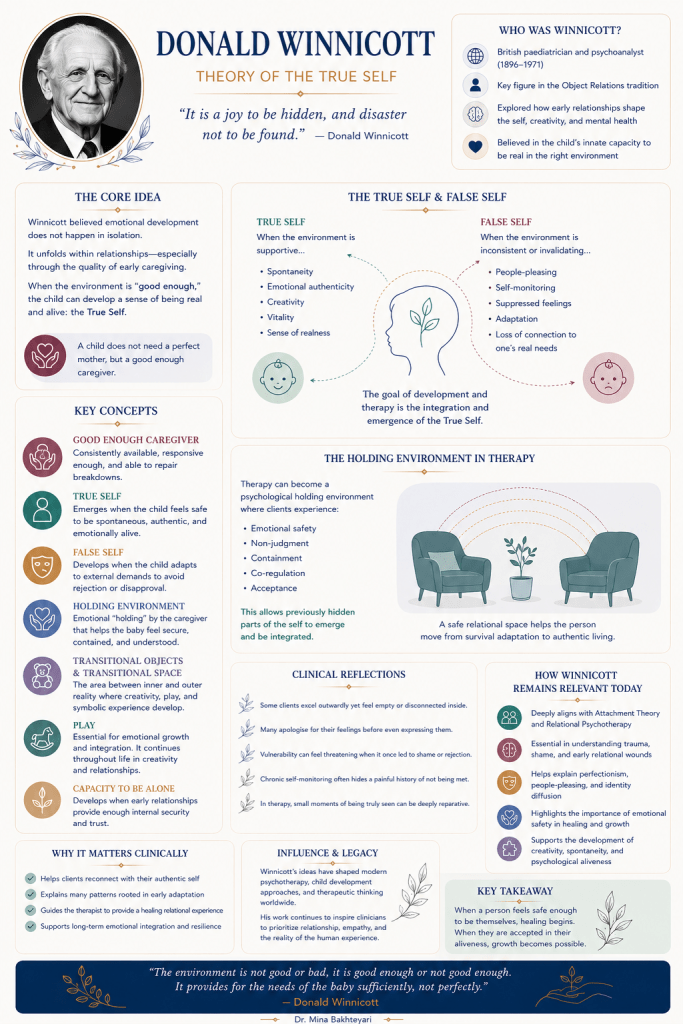
Donald Winnicott remains one of the most influential figures in contemporary relational psychotherapy, not because every aspect of his theory is interpreted literally today, but because many of his observations about emotional development continue to inform clinical practice.
Winnicott explained how emotional safety, attunement, and early relational experiences shape the development of identity, emotional regulation, and the ability to feel psychologically real. He asked a deeper psychological question, rather than focusing only on symptoms or pathology:
What happens when a person learns that maintaining connection is safer than expressing authenticity?
This question remains highly relevant in modern psychotherapy.
Emotional Development Begins Inside Relationships
Winnicott believed that the self develops gradually through emotional interactions with caregivers.
A child comes to understand themselves not only through words, but through thousands of repeated emotional experiences:
- being soothed,
- emotionally recognised,
- responded to,
- tolerated,
- Moreover, emotionally held during distress.
When these experiences occur consistently enough, the child slowly develops an internal sense of safety, such as: My feelings can exist; My needs are not dangerous; I do not have to hide parts of myself to remain emotionally connected. Moreover, emotional regulation, self-worth, and relational security are understood as deeply connected to early caregiving environments, a view supported by modern attachment theory.
Clinical Reflection
In therapy, emotional adaptation is often far more visible than emotional authenticity. Some individuals speak about painful experiences while smiling apologetically throughout the session. Others minimise emotional pain almost automatically before anyone else has the chance to dismiss it. Over time, emotional self-protection may become so habitual that the person no longer recognises how frequently they monitor themselves in relationships.
The “Good Enough” Caregiver
Winnicott introduced the idea of the “good enough” caregiver to challenge the belief that children need perfect parenting in order to develop healthily. He believed that emotional development does not come from a caregiver getting everything right all the time. Children do not need constant perfection, endless patience, or flawless emotional responses every moment of the day.
Instead, what matters more is whether the caregiver is generally emotionally present, reliable, and able to respond to the child often enough for the child to feel safe and emotionally held. Winnicott believed that ordinary mistakes, moments of frustration, emotional misunderstandings, or temporary disconnection are a natural part of human relationships.
From this perspective, small emotional ruptures are not necessarily damaging in themselves. In fact, when a caregiver reconnects after those moments, children slowly learn that relationships can survive disappointment, distance, frustration, and imperfection. This becomes an important part of emotional growth, helping the child develop a more stable and realistic sense of self and others.
What they require is something far more human:
- emotional reliability,
- sufficient responsiveness,
- emotional repair after ruptures,
- Moreover, an environment where emotional needs are not consistently ignored, criticised, or shamed.
Small frustrations are psychologically normal and even necessary. Through manageable disappointment, children gradually develop resilience and the ability to tolerate reality. However, when emotional misattunement becomes chronic, children may begin organising themselves around adaptation rather than authenticity.
Micro Clinical Observation
Some adults enter therapy carrying a deep fear of becoming “too much” for others emotionally. They may repeatedly say:
- “It’s okay.”
- “It’s not a big deal.”
- “I don’t want to bother anyone.”
However, beneath this emotional minimisation, there is often a long history of learning that expressing needs too openly risked disapproval, emotional withdrawal, criticism, or relational tension.
The True Self and Emotional Authenticity
Winnicott’s theory of the true self remains one of the most clinically meaningful concepts in relational psychotherapy. Further, the true self develops when individuals feel psychologically safe enough to experience spontaneity, vulnerability, curiosity, emotional expression, and genuine emotional presence without excessive fear of rejection or shame.
The true self is not perfection.
It is the experience of feeling emotionally alive and internally connected. Individuals who remain connected to their true selves often experience:
- emotional flexibility.
- creativity.
- psychological vitality.
- self-trust.
- and greater emotional congruence between their internal and external world.
The False Self as Emotional Survival
Winnicott’s concept of the false self is frequently misunderstood as simple inauthenticity. In reality, it represents a highly adaptive relational survival strategy.
When children repeatedly sense that certain emotions threaten connection, they may gradually begin organising themselves around external expectations.
Instead of asking:
- “What do I feel?”
- they learn to ask:
- “What is safest to feel here?”
- “What version of myself will maintain connection?”
- “Which emotions create less tension for others?”
Over time, emotional adaptation may become so automatic that the individual struggles to identify their own emotional needs, preferences, or boundaries.
Clinical Reflection
In therapy, some clients appear to be handling life very well at first glance. They keep up with responsibilities, function well in work or university, respond calmly in conversations, and rarely appear emotionally overwhelmed in front of others. People around them often see them as dependable, self-sufficient, or emotionally strong.
A lot of them eventually describe feeling very different on the inside compared to how they seem to other people. Even though they continue doing what needs to be done every day, many quietly feel emotionally exhausted, disconnected from themselves, or as if they are simply moving through life on autopilot instead of actually feeling emotionally present in it.
However, after spending more time with them, another side usually emerges; beneath that organised exterior, there is often a quieter emotional struggle that other people rarely see. Some describe feeling emotionally disconnected, constantly tired inside, or unable to remember the last time they genuinely felt calm, present, or emotionally close to themselves.
Some describe feeling emotionally tired all the time without fully understanding why. Others say they feel disconnected from themselves, as if they are moving through life automatically. A few explain it as “I’m doing everything I’m supposed to do, but I don’t really feel inside it.” There can be a quiet sense of emptiness, numbness, or loneliness even when life outwardly seems organised and successful.
I also notice that some clients are extremely good at understanding themselves intellectually. They can explain their emotions clearly, recognise their behavioural patterns, and speak insightfully about childhood experiences or relationships. However, actually feeling those emotions in a direct, personal way can be much harder for them. Instead of emotionally sitting with an experience, they often move quickly into analysing, explaining, or interpreting it. Sometimes it feels as though they are describing their emotions from a distance rather than truly experiencing them in the moment.
The Holding Environment and Corrective Emotional Experience
Winnicott introduced the concept of the holding environment, originally describing the emotional containment provided by caregivers through:
- soothing,
- consistency,
- emotional regulation,
- responsiveness,
- and psychological safety.
Contemporary psychotherapy later expanded this concept considerably.
Today, many relational and attachment-based therapies view the therapeutic relationship itself as a form of emotional holding environment where individuals gradually experience:
- emotional safety,
- non-shaming connection,
- co-regulation,
- emotional validation,
- Moreover, secure relational presence.
This process can become especially important for individuals with histories of:
- emotional neglect,
- chronic invalidation,
- relational trauma,
- attachment insecurity,
- or developmental emotional loneliness.
Micro Clinical Observation
Some clients become visibly uncomfortable immediately after expressing vulnerability in therapy.
They may laugh suddenly, change the subject, intellectualise, or begin reassuring the therapist that they are “fine.”
These moments are often psychologically meaningful. In many cases, vulnerability itself once carried emotional risk.
Play, Creativity, and Psychological Aliveness
In Winnicott’s perspective, play was not psychologically trivial; but it was represented of the space where individuals safely explore:
- emotion,
- imagination,
- identity,
- spontaneity,
- curiosity,
- and symbolic meaning.
Importantly, Winnicott believed adults continue engaging in psychological “play” throughout life through:
- creativity,
- humour,
- intimacy,
- storytelling,
- imagination,
- artistic expression,
- and an emotionally meaningful connection.
When emotional environments become excessively critical, emotionally rigid, or psychologically unsafe, spontaneity often becomes restricted.
Clinical Reflection
Some adults function very well in life and still feel emotionally unwell inside. The difficulty is often not a lack of intelligence, competence, or motivation. For many people, years of focusing mainly on responsibilities, pressure, achievement, or simply “getting through life” can slowly create distance from the parts of themselves that once felt more natural, emotionally alive, playful, relaxed, or genuinely enjoyable. Many learned to prioritise emotional control long before they learned how to feel emotionally safe.
The Capacity to Be Alone
Winnicott proposed something psychologically paradoxical:
The ability to tolerate solitude develops through secure emotional connection.
Children who experience consistent emotional holding gradually internalise the feeling that a supportive connection continues to exist psychologically, even when another person is physically absent.
As a result, healthy solitude later comes to be associated with reflection, emotional regulation, creativity, and internal stability. In addition, without this foundation, aloneness may instead feel emotionally overwhelming, empty, or psychologically unsafe.
In some micro clinical observations, some individuals remain constantly mentally occupied, scrolling, working, overcommunicating, seek the reassurance or avoiding silence altogether. At times, the difficulty is not solitude itself, but what emerges emotionally when distraction disappears.
Winnicott’s Relevance in Contemporary Psychotherapy
Winnicott emerged from psychoanalytic theory, but many of his ideas anticipated contemporary relational and trauma-informed psychotherapy. That means, his work remains highly relevant for understanding: chronic people-pleasing, emotional masking, perfectionistic adaptation, insecure attachment, emotional disconnection, shame-based identity patterns, emotional overcontrol and relational self-monitoring.
Modern clinicians increasingly recognise that many psychological symptoms are not simply “disorders” in isolation, but long-term adaptations developed within emotionally unsafe relational environments.
Final Reflection
Donald Winnicott’s theories continue to resonate because he addressed one of the emotional dilemmas: What happens when authenticity feels less secure than conformity? His perspective has been applied many times in modern therapy in this context, and from a contemporary clinical perspective, emotional recovery often involves more than just symptom reduction. This may involve gradually helping people reconnect with spontaneity, emotional authenticity, vulnerability, creativity, and a more integrated experience of themselves.
Winnicott’s work remains profoundly valuable because it helps explain how individuals may lose connection with their authentic emotional experience — and how that connection can slowly begin to re-emerge within psychologically safe relationships.
Clinical Integration — Dr Mina Bakhteyari
- False self-adaptation → chronic emotional self-monitoring
- Emotional invalidation → shame surrounding vulnerability and needs
- Relational overadaptation → people-pleasing and emotional exhaustion
- Restricted spontaneity → diminished emotional vitality and creativity
- Therapeutic holding environment → corrective emotional experience and secure relational repair
In my opinion, attending to the client’s character and integrating theories such as Winnicottian theory with Attachment Theory, Schema Therapy, relational psychotherapy, and trauma-informed clinical approaches provides a powerful framework for treatment. In other words, these integration help to understanding bertter how emotional identity develops, how adaptive self-protection emerges, and how authentic emotional connection can gradually be restored within therapy.
 Dr Mina Bakhterari Haftlangi
Leave a comment