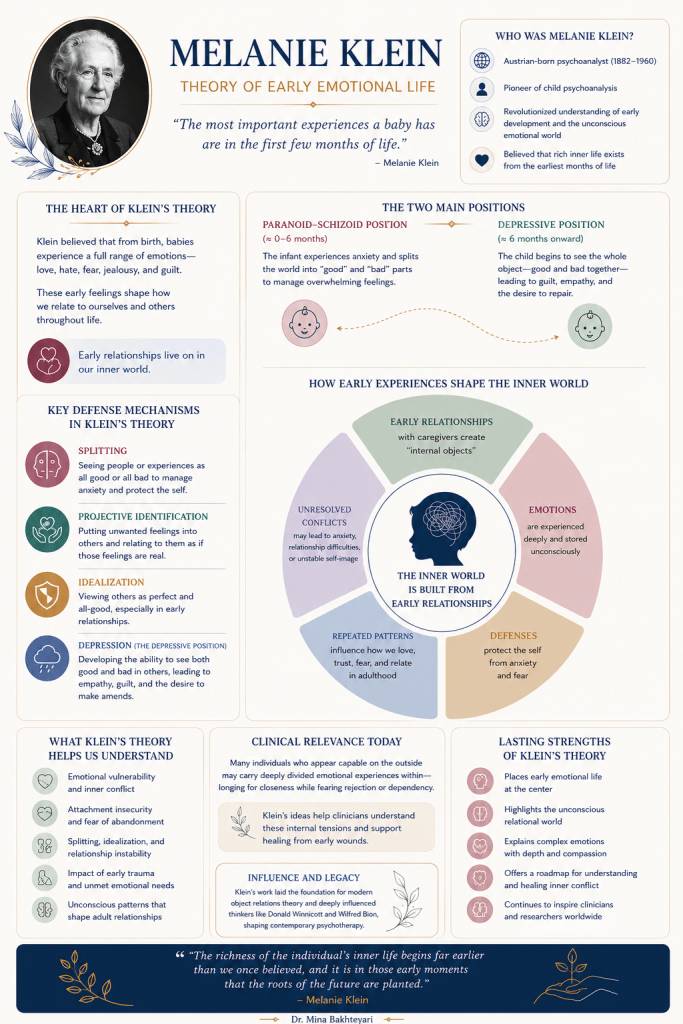
Melanie Klein was one of the most influential figures in psychoanalytic psychology and one of the earliest theorists to focus deeply on children’s emotional world.
Rather than focusing mainly on adult experiences and unconscious conflicts, as classical psychoanalysis traditionally did, Klein placed much greater emphasis on the child’s inner emotional life and the very early relationships that begin shaping the mind from infancy.
Her work became foundational for what later developed into Object Relations Theory, a perspective suggesting that human beings are shaped not only by instincts or behaviour, but also by the emotional meanings they attach to important relationships.
Although some of her concepts may initially sound highly theoretical, many of Klein’s ideas remain surprisingly visible in everyday emotional life, attachment patterns, relationships, anxiety, and psychotherapy today.
The Importance of Early Emotional Experience
Klein believed that emotional development begins much earlier than many psychologists of her time had assumed. According to her theory, infants are already emotionally active from birth. Even before language develops, the child is forming emotional impressions about safety, frustration, comfort, love, and fear.
From Klein’s perspective, the infant does not initially experience caregivers as fully integrated people; instead, experiences are emotionally organised into “good” and “bad” depending on whether needs are satisfied or frustrated.
For example:
- Comfort, feeding, warmth, and emotional soothing become associated with a “good” experience.
- Frustration, absence, tension, or emotional unavailability may become associated with a “bad” experience.
Over time, psychological development involves gradually integrating these experiences into a more realistic understanding that the same person can be both loving and frustrating at the same time.
In clinical work, individuals who struggle with emotional splitting often experience others as entirely supportive or entirely rejecting, with little emotional middle ground.
Object Relations Theory
One of Klein’s major contributions was the idea that relationships become psychologically internalized. In other words, important emotional experiences with caregivers are not simply remembered consciously; they become part of the person’s inner psychological structure.
These “internal objects” continue influencing emotional life long after childhood, such as:
- A consistently emotionally responsive environment contributes to feelings of safety and trust.
- Unpredictable or emotionally frightening experiences contribute to chronic insecurity, fear of abandonment, or emotional instability.
According to Klein, people do not relate only to others externally; they also relate internally to emotional representations of others formed very early in life.
Clinically, this can sometimes be observed when individuals react to current relationships through emotional expectations shaped in childhood rather than by the current situation itself.
The Paranoid–Schizoid Position
One of Klein’s best-known concepts is the Paranoid–Schizoid Position. Despite the intimidating name, this concept does not mean schizophrenia in the modern psychiatric sense.
Klein used the term to describe an early developmental state in which the infant manages overwhelming emotions through psychological splitting.
In this stage:
- Experiences feel either completely good or completely bad.
- Anxiety is often related to fears of danger, loss, frustration, or emotional annihilation.
- The mind attempts to protect itself by separating positive and negative emotional experiences.
This process is considered a normal part of early development. However, remnants of this emotional style continue into adulthood. In adult life, these include: 1. Extreme idealisation followed by sudden devaluation; 2. All-or-nothing thinking in relationships; 3.Difficulty tolerating emotional ambiguity; 4. Viewing people as either entirely safe or entirely threatening.
In psychotherapy, these patterns often become especially visible during periods of emotional stress, attachment insecurity, or fear of rejection.
The Depressive Position
As emotional development progresses, Klein believed individuals gradually move toward what she called the Depressive Position. This stage reflects a more mature emotional capacity:
- Recognising that loved people can disappoint us while still being loved.
- Tolerating emotional complexity.
- Developing empathy and concern for others.
- Experiencing guilt in a healthy and reparative way.
The term “depressive” here does not refer to clinical depression. Instead, it refers to the emotional sadness and responsibility that arise when individuals realise they harbour angry or destructive feelings toward people they also love. This developmental shift is psychologically important because it allows to having Emotional integration; Stable attachment; Greater empathy; More realistic relationships.
In clinical settings, difficulty tolerating mixed emotions often contributes to unstable relationships, chronic anger, emotional withdrawal, or cycles of idealization and disappointment.
Splitting as a Defence Mechanism
Klein’s theory is closely connected to the defence mechanism known as splitting, which occurs when conflicting emotional experiences are psychologically separated because holding both simultaneously feels emotionally overwhelming. As an example:
- A person may view themselves as either completely successful or completely worthless.
- A partner may be experienced as perfect one day and deeply disappointing the next.
- Emotional reactions shift rapidly between idealisation and rejection.
Although splitting may temporarily protect the person from Anxiety or emotional overwhelm, depending on it too heavily over time often leads to unstable emotions and difficulties in relationships.
In clinical practice, splitting is commonly seen in individuals with attachment-related trauma, difficulties regulating emotions, or a fragile and unstable sense of self.
Melanie Klein’s Influence on Modern Psychotherapy
Although Klein’s writings were deeply psychoanalytic, many of her ideas continue to influence modern therapeutic approaches today, including:
- Psychodynamic psychotherapy
- Attachment-based therapy
- Schema Therapy
- Mentalization-Based Therapy (MBT)
- Contemporary relational psychotherapy
Many contemporary clinicians still work with ideas that are closely connected to Klein’s contributions, particularly difficulties involving emotional regulation, attachment insecurity, fear of abandonment, splitting and idealisation, internalised relationship patterns, and the long-term impact of early developmental trauma.
Klein’s work also had a major influence on later object relations theorists, including Donald Winnicott and Wilfred Bion.
Why Klein’s Theory Still Matters Today
One reason Klein’s work remains psychologically relevant is that it attempts to explain emotional experiences that many people recognize internally but struggle to describe.
- Why do some individuals fear abandonment even in stable relationships?
- Why can love and anger toward the same person feel difficult to tolerate?
- Why do some people emotionally “split” others into all-good or all-bad categories?
- Why do early attachment experiences continue affecting adult emotional life?
Klein’s theory suggests that many of these struggles are connected to how the mind learned to manage anxiety, attachment, and emotional safety very early in development. Rather than viewing emotional conflict as weakness, her work highlights how many psychological defences originally developed as attempts to cope with overwhelming emotional experiences.
Clinical Reflection
Not every part of Melanie Klein’s theory is viewed in the same way today, but many of her ideas still feel very real when working with people in therapy. Her work focused deeply on early emotional experiences, especially the fear of losing love, feelings of emotional safety, and struggles with closeness in relationships.
In therapy, some people look completely fine from the outside. They work, study, care for others, and appear emotionally in control. However, beneath the surface, they may constantly worry about being rejected, abandoned, disappointed, or emotionally hurt. Many deeply want closeness, but at the same time feel afraid of depending on others too much. These inner emotional conflicts are part of what made Klein’s work so influential, and they are still visible in many therapeutic settings today.
Integrating Kleinian concepts with modern approaches such as attachment theory, CBT, and Schema Therapy can provide a deeper understanding of how early emotional experiences continue shaping adult relationships, self-perception, and emotional regulation across the lifespan.
Dr Mina Bakhteyari Haftlangi
 Dr Mina Bakhterari Haftlangi
Leave a comment