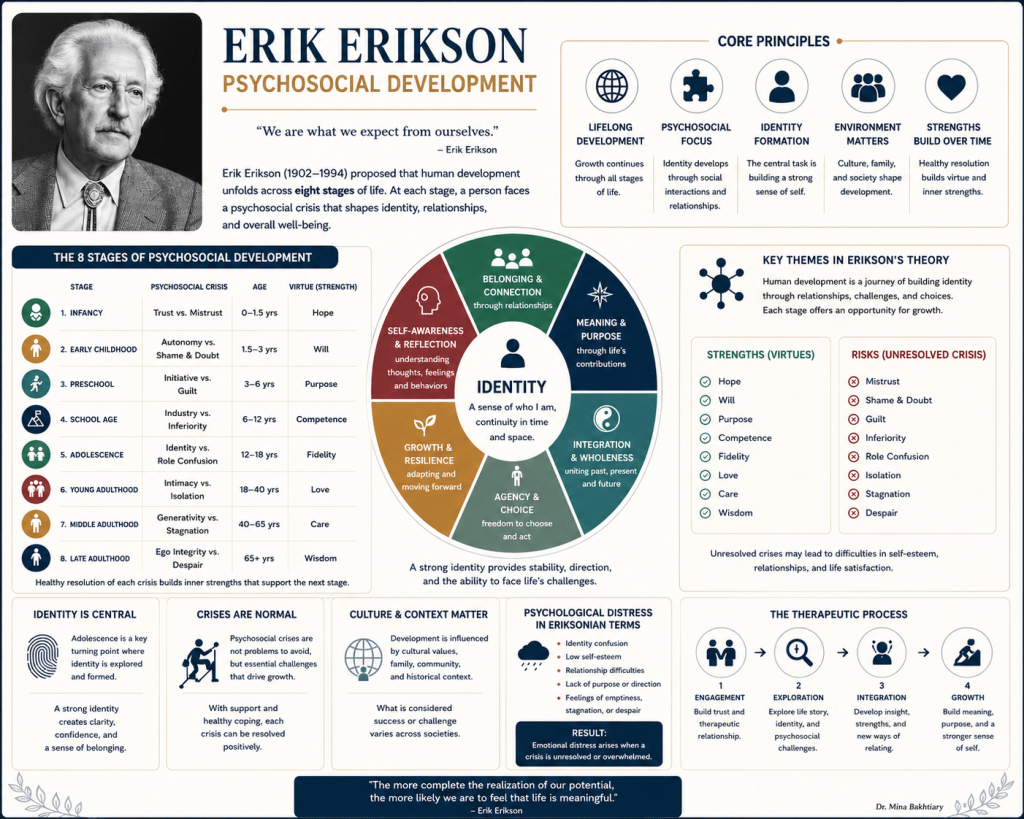
Erik Erikson believed something that still feels deeply true in clinical work today: people do not simply “finish” developing after childhood. Even as adults, many individuals continue struggling with trust, identity, belonging, shame, emotional closeness, or the feeling that they are somehow not enough.
His psychosocial theory was not only about child development. It was about the emotional themes that quietly follow people throughout life.
Some people become highly independent because trusting others once felt unsafe. Others spend years trying to prove their worth without fully understanding why achievement never feels emotionally satisfying. Many adults who appear functional externally still carry unresolved emotional conflicts connected to earlier developmental experiences.
This is one reason Erikson’s theory continues to feel psychologically relevant decades later.
The Emotional Stages of Development
1. Learning Whether the World Feels Safe
Trust vs. Mistrust
In the earliest years of life, children begin forming a basic emotional impression of the world. Not through logic or language, but through repeated emotional experiences.
When caregivers are emotionally available and relatively consistent, children slowly develop a sense that closeness is safe. Their nervous system begins learning that distress can be soothed.
But when caregiving feels unpredictable, emotionally cold, rejecting, or frightening, children may adapt differently. Some become emotionally guarded very early. Others later in life become highly sensitive to abandonment or rejection without fully understanding why.
In therapy, these patterns often appear subtly. A person may say they “do not need anyone,” while simultaneously feeling distressed whenever emotional distance appears in relationships.
2. The Beginning of Independence
Autonomy vs. Shame and Doubt
As children grow, they naturally begin testing independence. They want to choose, explore, refuse, touch, move, and do things alone.
Healthy support during this stage helps children develop confidence in themselves. Not perfection — confidence.
However, when children are repeatedly criticised, shamed, overcontrolled, or made to feel incapable, they may begin doubting themselves early in life.
Some adults continue carrying this emotional atmosphere internally for years. They hesitate before making decisions. They overthink simple mistakes. They become harsh toward themselves in ways they would never be toward others.
Clinically, chronic self-criticism is often less about “low confidence” and more about an internalised emotional environment formed very early.
3. Learning Whether It Is Safe to Express Yourself
Initiative vs. Guilt
Children are naturally imaginative, expressive, emotional, and curious. They ask questions constantly. They experiment with identity long before adolescence.
When this exploration is encouraged, children usually develop a healthier relationship with self-expression and emotional spontaneity.
Some children grow up feeling that their emotions, opinions, needs, or even their excitement make other people uncomfortable. Little by little, they learn to hide parts of themselves in order to keep peace, stay connected, or feel accepted.
Later in life, this may appear as people-pleasing, difficulty saying no, or feeling guilty for having emotional needs at all. Many people who seem very “easygoing” on the outside are, in reality, deeply used to adjusting themselves to avoid rejection, conflict, or disapproval.
4. The Need to Feel Capable
Industry vs. Inferiority
For many children, the school years are when comparison starts becoming much more noticeable. They begin paying attention to who gets praised, who seems naturally successful, who struggles socially, and who feels different or left behind.
Some children gradually develop competence and confidence. Others quietly begin believing they are inadequate.
Not all inferiority feelings are obvious. In fact, some highly successful adults continue functioning from an internal fear of not being enough. Achievement becomes emotionally tied to worth.
In clinical settings, feelings of inferiority rarely disappear simply because someone becomes objectively successful.
5. Searching for Identity
Identity vs. Role Confusion
Adolescence is often described as the stage of identity formation, although many adults continue revisiting this process throughout life.
People begin asking:
- Who am I without other people’s expectations?
- What kind of life feels meaningful to me?
- Where do I actually belong?
Identity is not built overnight. It develops gradually through relationships, emotional experiences, cultural influences, values, losses, and personal choices.
Some individuals develop a relatively stable sense of self. Others continue adapting themselves depending on the environment they are in.
Clinically, identity confusion does not always appear dramatic. Sometimes it appears as emotional emptiness, chronic comparison, unstable direction, or difficulty knowing what someone genuinely wants for themselves.
Major life transitions migration, divorce, loss, career change, trauma often reactivate identity-related conflicts even later in adulthood.
6. Emotional Closeness and Fear of Vulnerability
Intimacy vs. Isolation
Once people begin forming a stronger sense of identity, the next challenge often becomes intimacy.
Real intimacy involves emotional exposure. It requires individuals to tolerate dependency, vulnerability, uncertainty, and emotional closeness.
For some people, closeness feels deeply comforting. For others, it feels psychologically dangerous.
Individuals who learned early that emotional needs lead to disappointment appear distant, overly self-sufficient, or emotionally unavailable in relationships.
At times, isolation is not caused by lack of desire for connection, but by fear of what connection emotionally requires. This distinction becomes very important in psychotherapy.
7. The Desire to Contribute Something Meaningful
Generativity vs. Stagnation
At some point in adulthood, many people begin reflecting on meaning more seriously.
They may ask:
- Does my life feel emotionally meaningful?
- Am I building something valuable?
- Have I only been surviving?
For some, generativity appears through parenting, mentorship, creativity, helping others, teaching, or contribution to society.
Others begin experiencing emotional stagnation a sense of disconnection from purpose despite maintaining daily responsibilities.
At this point in life, success and staying productive often stop feeling emotionally satisfying on their own. In other words, people begin questioning whether their life feels meaningful, emotionally connected, or genuinely fulfilling.
In therapy, what people describe as a “midlife crisis” is often less about age and more about an internal feeling that something important has been missing for a long time, whether that is identity, emotional connection, personal meaning, or the sense of truly living as themselves
8. Looking Back at Life
Integrity vs. Despair
Adulthood often brings reflection, and people naturally revisit memories, relationships, regrets, choices, losses, and unresolved emotional experiences.
Some individuals gradually reach a sense of acceptance. Not because life was perfect, but because they can emotionally integrate both pain and meaning into their story.
Others remain overwhelmed by regret, bitterness, guilt, or the feeling that life moved past them too quickly.
One of the most emotionally difficult experiences for many individuals is not failure itself, but the belief that they never truly lived as themselves.
Why Erikson’s Theory Still Feels Relevant
Part of what makes Erikson’s work enduring is that most people can recognise pieces of themselves within these stages.
A person struggling with emotional dependency may also carry unresolved trust wounds. Someone with chronic perfectionism may still be trying to escape feelings of inferiority formed years earlier. Identity struggles, fear of vulnerability, shame, and emotional isolation are rarely random experiences; they often have developmental histories.
Even though psychotherapy has changed a lot since Erikson first introduced his theory, many of his ideas still naturally appear in today’s clinical work, especially in attachment theory, schema therapy, developmental psychology, and trauma-focused approaches.
His theory reminds us that emotional development is not linear. Human beings continue evolving psychologically throughout life, often revisiting earlier emotional conflicts in new forms.
Clinical Reflection
Many emotional difficulties in adulthood are not only responses to what is happening now. In many cases, they began as protective emotional patterns developed earlier in life — ways of coping that once helped the person feel safe, understood, or emotionally survive, even though those same patterns may later become painful or limiting.
Dr Mina Bakhteyari Haftlangi
 Dr Mina Bakhterari Haftlangi
Leave a comment