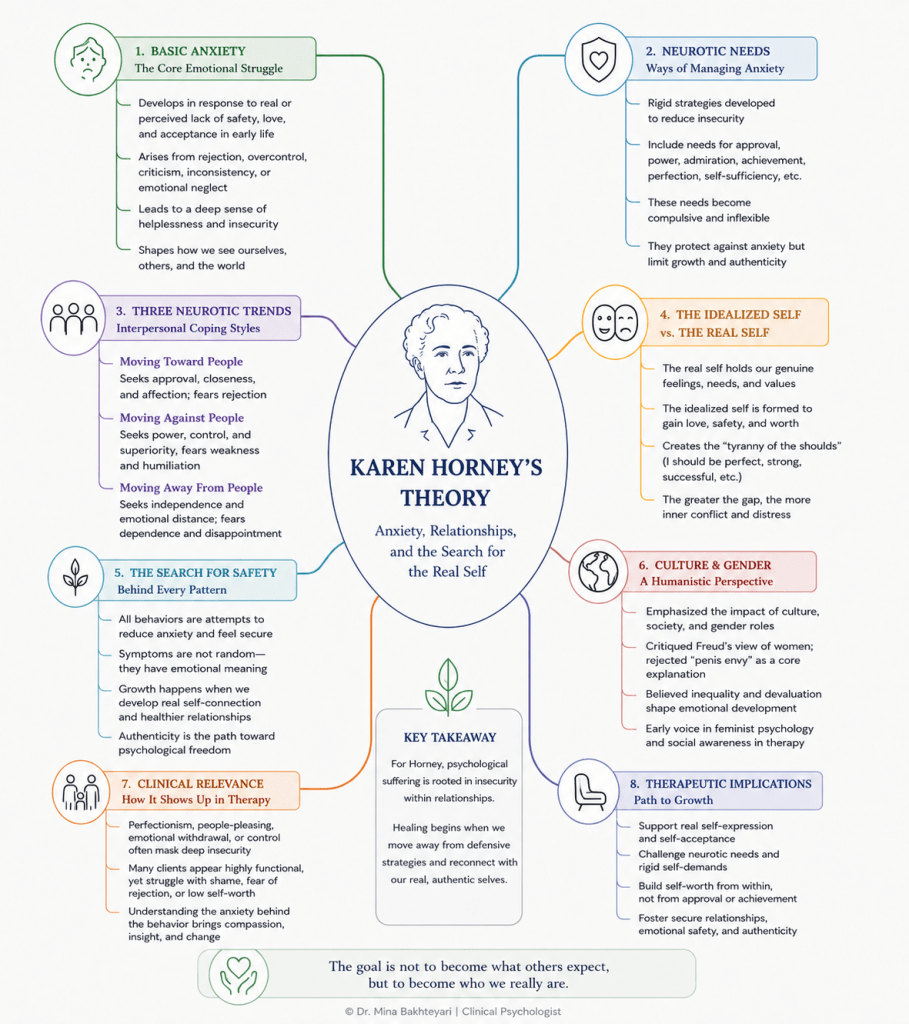
Karen Horney is one of the theorists who expanded psychoanalytic thought beyond classical Freudian ideas, and her theories are still used today as a leading figure in psychology.
While Freud’s theory focused on unconscious drives and psychosexual development, Horney focused on emotional security, self-esteem, relational experiences, and how individuals psychologically cope when they do not feel truly accepted or secure. In other words, Horney presented a different understanding of emotional suffering. She viewed emotional suffering not simply as an instinctual conflict, but as a response to chronic insecurity in early relationships and environments.
Horney’s theory seems contemporary and modern, and many of the emotional patterns she described decades ago resemble issues clinicians still encounter regularly in therapy: perfectionism, chronic shame, approval-seeking, emotional withdrawal, unstable self-esteem, fear of rejection, and difficulties maintaining an authentic sense of self.
What Horney understood particularly well was that many psychological symptoms are not random. They often represent attempts to survive environments that once felt emotionally and psychologically unsafe.
Basic Anxiety
When children experience the world as emotionally unreliable, rejecting, unpredictable, or psychologically unsafe, a deep and persistent sense of insecurity develops, and Horney called this basic anxiety a foundation concept in her theory.
Furthermore, children need emotional warmth, stability, harmony, and a sense of worth independent of performance or obedience, in addition to their care and discipline. When their emotional needs are repeatedly unmet, they may gradually come to see themselves as vulnerable, inadequate, or fundamentally insecure in relationships.
In addition, Horney did not believe psychological conflict develops only in severely traumatic environments. In many cases, the emotional atmosphere itself becomes the source of distress. Some children grow up in homes where practical needs are adequately met, yet emotional security remains inconsistent. The child learns to monitor relationships carefully, suppress vulnerability, or become psychologically over-adaptive to maintain a connection.
In clinical practice, Many clients do not initially recognise these patterns as Anxiety because they experience them as part of their personality rather than as defensive adaptations. These individuals often appear highly functional externally while struggling internally with chronic inadequacy, shame, or fear of rejection.
The manifestation of basic anxiety can be through:
- excessive reassurance seeking,
- hypersensitivity to criticism,
- emotional dependency,
- chronic self-monitoring,
- perfectionistic striving,
- fear of abandonment,
- Alternatively, difficulties trusting others emotionally.
One reason Horney’s theory continues to feel clinically meaningful is that she focused less on symptoms in isolation and more on the emotional logic underlying behaviour.
Neurotic Needs
Horney proposed that individuals develop certain coping strategies in an attempt to manage basic anxiety. She referred to these patterns as neurotic needs.
These needs are not pathological merely because they exist. Most people seek approval, achievement, affection, or independence at times. However, in neurotic functioning, these needs become rigid, compulsive, and psychologically tied to self-worth or emotional survival.
In this stage, approval is no longer a preference but an emotional protection; achievement no longer reflects healthy ambition but an attempt to escape feelings of inadequacy. Likewise, emotional independence may appear mature externally while actually serving as protection against disappointment, vulnerability, or rejection.
Horney described several neurotic needs, including:
- the need for approval and affection
- the need for admiration,
- the need for power,
- the need for perfection,
- the need for achievement,
- and the need for complete self-sufficiency.
Clinically, her patterns are often easier to understand when viewed defensively rather than morally. The perfectionistic client is not simply “high-achieving.” The emotionally detached client is not necessarily emotionally cold. Beneath the surface, there is frequently significant anxiety related to shame, rejection, helplessness, or fear of emotional exposure.
In therapy, many clients gradually recognise that the traits they considered strengths were originally developed as protective strategies.
The Three Interpersonal Patterns
As Horney’s theory evolved, she observed that individuals tend to cope with insecurity through relatively consistent interpersonal styles. She organised these responses into three broader patterns: moving toward people, moving against people, and moving away from people.
Moving Toward People
Individuals manage anxiety by seeking closeness, approval, attachment, and reassurance from others, and their emotional safety is linked to acceptance and relational stability.
These individuals are highly accommodating and sensitive to interpersonal tension; nd they suppress anger, avoid conflict, or prioritise others’ needs to maintain connection.
Such underlying beliefs include things like:
- If people reject me, I will not be okay.
- I need a connection to feel safe.
- Conflict threatens attachment.
In clinical work, these individuals frequently present as caring, relational, and emotionally available. However, underneath this presentation, there is often considerable fear surrounding abandonment, criticism, or emotional disapproval.
Many clients with this pattern struggle to distinguish genuine kindness from fear-based self-sacrifice.
Moving Against People
Other individuals cope with insecurity through control, dominance, competitiveness, or emotional hardness. Rather than seeking safety through closeness, they attempt to protect themselves through strength and psychological superiority.
These individuals may appear highly confident, assertive, productive, or emotionally controlled. However, the external confidence often masks underlying vulnerability.
What Horney recognised particularly well is that superiority can sometimes function defensively rather than reflect genuine self-esteem.
Underlying assumptions are included some maladaptive beliefs such as:
- “Only strong people are safe.”
- “Vulnerability leads to humiliation.”
- “If I lose control, I will be hurt.”
In clinical settings, these individuals may appear highly successful professionally while remaining deeply intolerant of failure, criticism, dependency, or emotional exposure. Their self-worth is frequently conditional and achievement-based, even when this is not consciously recognised.
This defensive structure often overlaps with perfectionistic overcompensation, narcissistic defences, hostility, or chronic competitiveness.
Moving Away From People
A third group manages Anxiety through emotional distance and psychological withdrawal.
These individuals place strong value on independence, privacy, self-control, and emotional self-sufficiency. Closeness may feel intrusive, risky, or emotionally exhausting.
Rather than fighting for approval or dominance, they psychologically retreat from dependency altogether.
Common underlying assumptions are:
- “People eventually disappoint you.”
- “Needing others creates vulnerability.”
- “I am safer emotionally alone.”
In therapy, these individuals are often thoughtful, insightful, and highly self-observant. At the same time, they may struggle with emotional access, vulnerability, or sustained relational closeness.
Clinically, emotional detachment is misunderstood as a lack of need, while many emotionally withdrawn individuals continue to experience strong attachment needs but have learned to suppress them to avoid disappointment or emotional pain.
The Idealised Self and the “Tyranny of the Shoulds”
One of Horney’s most psychologically sophisticated ideas was her distinction between the real self and the idealised self.
The real self refers to the authentic emotional core of the individual — including genuine feelings, wishes, vulnerabilities, limitations, and capacities.
However, when children grow up feeling chronically criticised, emotionally unsafe, or conditionally valued, they may gradually disconnect from this authentic self and construct an idealised version of themselves instead.
This idealised self often becomes perfectionistic and unrealistic.
The individual may begin living according to rigid internal demands such as:
- “I should never fail.”
- “I should always be emotionally strong.”
- “I should never need help.”
- “I should always achieve more.”
- “I should never disappoint anyone.”
Horney referred to this internal pressure as the “tyranny of the shoulds.”
Clinically, this concept remains highly relevant because many clients struggling with perfectionism or chronic shame are not merely pursuing success; they are attempting to escape feelings of defectiveness, inadequacy, or emotional unworthiness.
In therapy, these individuals often experience exhaustion from continuously trying to maintain an idealised identity that feels impossible to sustain.
Horney’s Critique of Freud
Horney also became well known for challenging Freud’s views regarding female psychology. She argued that many psychological differences between men and women are shaped more by culture and social experience than by biology alone. She criticised Freud’s concept of “penis envy,” and suggested that women’s emotional struggles often emerge from social inequality, restricted opportunities, and cultural devaluation rather than innate inferiority.
Her responses to Freud were controversial during her time, yet they later contributed significantly to feminist and relational perspectives within psychology.
More broadly, Horney helped psychoanalytic theory move toward a more interpersonal and culturally informed understanding of personality development.
Contemporary Clinical Relevance
Many of Horney’s ideas integrate naturally with contemporary psychotherapy approaches, while she wrote within the psychoanalytic tradition.
Her work overlaps significantly with:
- attachment theory,
- schema therapy,
- relational psychodynamic approaches,
- interpersonal psychotherapy,
- and emotion-focused models.
Clinicians today still encounter the same defensive patterns Horney described:
- individuals who overfunction in order to gain approval,
- individuals who pursue achievement compulsively to maintain self-worth,
- Moreover, individuals who emotionally withdraw to protect themselves from disappointment or vulnerability.
Perhaps one of Horney’s most enduring contributions is her view of symptoms, grounded in psychological depth and compassion. Rather than reducing behaviour to pathology alone, she explored how individuals adapt to emotional environments that once felt unsafe.
That perspective continues to hold substantial value in modern psychotherapy.
Conclusion
Karen Horney expanded psychodynamic theory by placing emotional insecurity, relationships, self-worth, and cultural experience at the centre of personality development. Rather than understanding symptoms purely in terms of instinctual conflict, she explored how individuals psychologically adapt to environments characterised by insecurity, criticism, inconsistency, or emotional disconnection.
Her concepts of basic Anxiety, neurotic coping patterns, and the conflict between the real self and the idealised self remain highly relevant in understanding perfectionism, shame, relational difficulties, emotional withdrawal, and chronic insecurity.
Even decades later, Horney’s theory continues to resonate because it speaks directly to a deeply human struggle: the desire to feel emotionally safe while also remaining authentically oneself.
Dr Mina Bakhteyari Haftlangi
 Dr Mina Bakhterari Haftlangi
Leave a comment