Introduction
Alfred Adler (1870–1937) developed a holistic, goal-oriented framework for understanding human behaviour and called it Individual Psychology.
Freud’s model focused mainly on drives, but Adler approached it more purposefully. He believed people are motivated by meaning and by wanting to feel important within their social environment, which is why his ideas are still used in many therapeutic approaches today.
Clinical note: In practice, Adlerian concepts are especially useful when working with clients whose difficulties stem from identity, self-worth, and interpersonal disconnection.
1. Core Assumptions of Individual Psychology
Adler’s theory’s foundational principles are:
- Holism: The individual is an integrated whole; thoughts, emotions, and behaviours are interconnected.
- Teleology: Behaviour is goal-directed and oriented toward future aims rather than past causes alone.
- Subjective Reality: Individuals act based on their personal interpretations of experiences.
- Social Embeddedness: Psychological health depends on one’s ability to connect and contribute to others.
Clinical note: Clinically, this means that symptom reduction alone is insufficient; therapy must also address the client’s life goals and subjective meaning-making.
2. Inferiority and Compensation
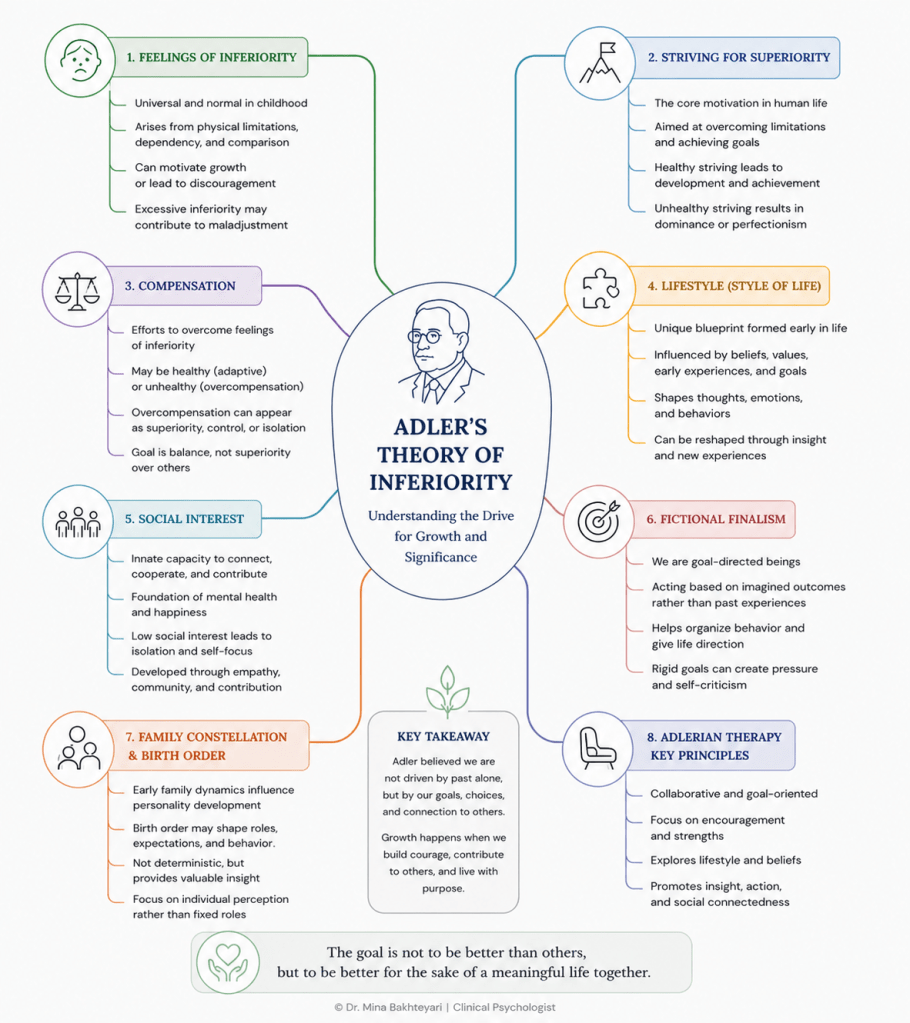
Adler believed that feeling “not enough” is something everyone experiences at some point, especially in childhood, when we are more dependent and aware of what we cannot yet do.
He described this as primary inferiority, which is normal. Problems tend to arise when these feelings are not resolved and instead grow stronger over time, a phenomenon he called secondary inferiority.
People naturally try to deal with this. Sometimes they do it in helpful ways, like developing skills or becoming more resilient. However, in other cases, it turns into overcompensation—perfectionism, control, or an attempt to appear superior.
Clinical note: In therapy, this often appears as defectiveness schemas, chronic self-doubt, or perfectionism used as a way to cope.
3. Lifestyle (Style of Life)
The lifestyle represents an individual’s unique psychological blueprint, formed early in life:
- Core beliefs about self, others, and the world
- Emotional and behavioural patterns
- Strategies for achieving significance
This pattern becomes relatively stable and guides how individuals interpret and respond to life.
Clinical note: In practice, lifestyle assessment often overlaps with schema assessment, since both are essentially looking for the same thing—repeating patterns that keep the person stuck in distress.
4. Social Interest (Gemeinschaftsgefühl)
Adler placed great importance on what he called social interest—the ability to care about others, work with them, and feel part of a larger community.
- When this is strong, people tend to function better psychologically. When it is weaker, it often leads to feelings of isolation and adjustment problems.
Adler viewed social connectedness as a core indicator of well-being.
Clinical note: Clients with low social interest often present with interpersonal avoidance, relational Anxiety, or difficulties forming secure attachments.
5. Birth Order and Family Constellation
Adler also paid attention to family dynamics, especially how people experience their place in the family. Birth order can shape expectations, but not in a fixed or predictable way.
For example, first-born children are often given more responsibility early on, so they may grow into more structured or leadership roles. Second-borns tend to grow up in comparison, which can make them more competitive. The youngest child is sometimes more dependent, but in other cases, becomes quite driven. Only children often feel more comfortable around adults, though social adjustment with peers can sometimes be more challenging.
These are not rules; they are tendencies. What really matters is how the person experienced their role in the family, not the label itself.
Clinical note: In practice, it is more useful to explore how the client understood their position in the family rather than trying to fit them into a category.
6. Fictional Finalism
Another important idea in Adler’s work is that people are guided by certain personal “end goals”—not necessarily real ones, but beliefs they carry about who they need to be.
These can sound like:
“I need to be perfect to be accepted,” or
“I can’t afford to fail.”
Even if these beliefs are not realistic, they still influence how a person makes decisions and how they feel about themselves.
Clinical note: In therapy, these often show up as core beliefs. Once they become visible, they can be worked with using cognitive and schema-based approaches.
7. Psychopathology in Adlerian Theory
From this perspective, psychological distress does not just appear randomly—it usually develops over time when certain patterns become too rigid.
This can happen when feelings of inferiority become too strong, when a person’s coping mechanisms become inflexible, or when there is a lack of connection with others.
For instance, depression may reflect a deeper sense of not being able to achieve significance, while Anxiety often involves avoiding situations because of underlying feelings of inadequacy.
Clinical note: Rather than seeing symptoms as purely pathological, Adlerian work tends to view them as meaningful—often as ways the person has tried to cope, even if those ways are no longer helpful.
8. Adlerian Therapy
Adlerian therapy is collaborative, encouraging, and insight-oriented.
Key phases:
- Engagement: Building a respectful, equal therapeutic relationship
- Assessment: Exploring lifestyle, early memories, and family context
- Insight: Identifying beliefs, goals, and behavioural patterns
- Reorientation: Encouraging new ways of thinking and acting
Techniques include:
- Encouragement
- Cognitive reframing
- Behavioural experiments
- “Acting as if” strategies
Clinical note: Encouragement is a central mechanism of change, particularly for clients with chronic feelings of inadequacy.
Clinical Insight (Dr Mina Bakhteyari)
- Inferiority → Defectiveness / Failure schema
- Compensation → Overcompensation coping mode
- Low social interest → Interpersonal avoidance patterns
- Fictional goals → Rigid core beliefs (CBT perspective)
Conclusion
Adler’s Individual Psychology offers a powerful and clinically relevant framework for understanding human behaviour as purposeful, socially embedded, and meaning-driven. By integrating Adlerian concepts with modern approaches such as CBT and Schema Therapy, clinicians can develop a deeper and more effective understanding of psychological difficulties.
Integrating Adlerian theory with CBT and Schema Therapy provides a powerful framework for understanding not only why individuals struggle, but how meaningful change can occur.
Dr Mina Bakhteyari
 Dr Mina Bakhterari Haftlangi
Leave a comment