A Different Starting Point
While classical psychoanalysis (e.g., Sigmund Freud) conceptualised the mind primarily as a system of conflict and repression, Jung reframed the psyche as a self-organising, meaning-generating system.
In Jung’s model, the mind is not merely something to be fixed, but rather something that is trying to evolve.
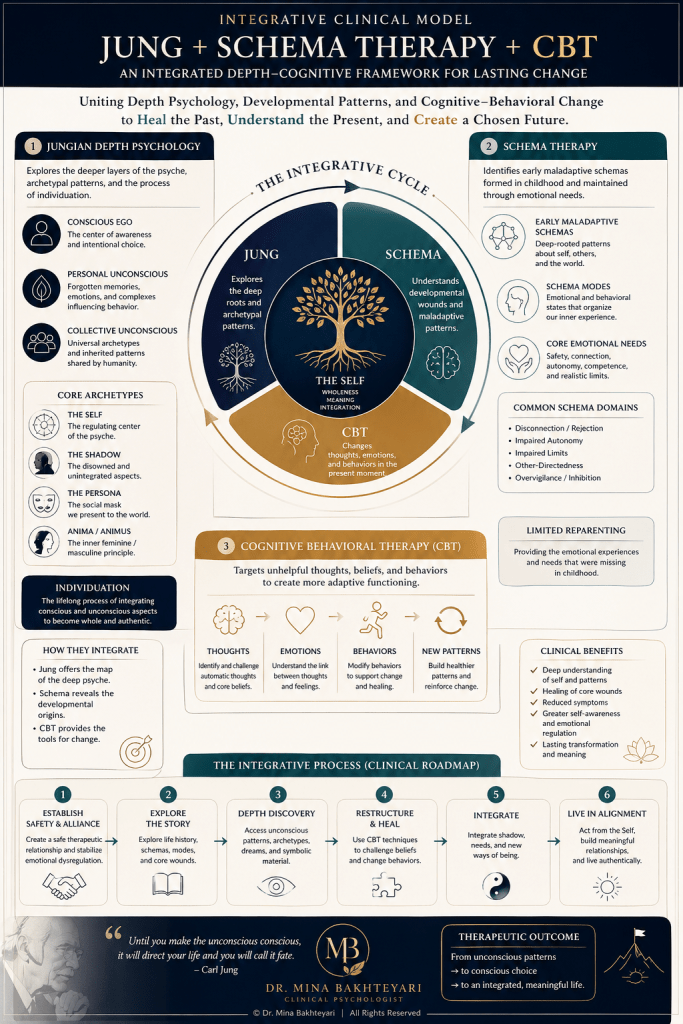
The central premise in Jung theory is that the psyche is inherently oriented toward balance, integration, and wholeness. In other words, the psyche is known as a Multi-Layered System that Jung proposed as a stratified model, where conscious awareness represents only a small fraction of total psychological reality.
Concepts of Jung’s theory
1. The Ego (Centre of Consciousness)
The Ego is not the whole personality. In other words, the Ego is not in control of the psyche, but it is only one component within a much larger system. The Ego is only:
- the organiser of conscious experience
- The narrator of identity
- The structure responsible for continuity
2. The Personal Unconscious (The Forgotten Self)
- This layer includes its core building blocks, which are complexes autonomous emotional networks that shape perception, behaviour, and relationships without conscious awareness. That means the Personal Unconscious is composed of emotionally charged memories, repressed experiences and unresolved relational patterns.
For example, a mother complex may distort how authority, care, or dependency are experienced unconsciously across adulthood.
3. The Collective Unconscious (The Inherited Mind)
Jung’s most radical contribution the collective unconscious is universal, inherited (not learned), and structurally identical across humanity. It contains psychological blueprints rather than memories. These blueprints are called archetypes.
Archetypes: The Deep Grammar of Human Experience
Archetypes are patterns that organise human experience into symbolic form, not images themselves. That means, they manifest through dreams, myths, religious imagery, narratives and storytelling.
A. The Persona (The Social Interface), the adaptive mask, is used to function in society, is necessary for social integration, and becomes pathological when mistaken for the true self. Clinical risk is that identity diffusion through over-identification with roles.
B. The Shadow (The Disowned Self):
The part which contains rejected, feared, or morally unacceptable aspects and is not inherently bad; it is merely unintegrated. The shadow often appears in projections. In other words, what an individual cannot accept in themselves, sees in others. Moreover, from a therapeutic perspective, shadow integration reduces reactivity, shame, and interpersonal distortion.
C. Anima / Animus (The Inner Other)
The feminine psychological principle in men is called Anima, and the masculine psychological principle in women is called Animus.
These structures:
- influence attraction and relationships
- shape emotional depth and symbolic life
When unconscious, they lead to idealisation, projection, and relational instability.
The Self (The Regulating Centre of the Psyche)
The self is the totality of the psyche (conscious + unconscious), the organising principle of psychological development. Unlike the Ego, the self operates as a guiding system toward integration.
Individuation: The Central Developmental Process
Individuation is not self-improvement, even though it is a structural transformation of the psyche. Furthermore, it involves:
- confronting the shadow
- differentiating from the persona
- integrating unconscious material
- establishing alignment with the self
Individuation is the process of becoming psychologically whole, not socially perfect.
Dreams (Not Wish Fulfilment, but Regulation):
Jung rejected the reduction of dreams to disguised wishes. Instead, dreams are:
- compensatory mechanisms
- symbolic communications
- regulatory feedback from the unconscious
Function: They correct one-sided conscious attitudes.
For example, an overly rational individual may dream in emotional or chaotic imagery to restore balance.
Symbol Formation: The Language of the Unconscious
The unconscious does not communicate in logic—it communicates in symbols.
Symbols:
- bridge conscious and unconscious processes
- carry multiple layers of meaning
- cannot be reduced to a single interpretation
This is why Jungian work emphasises amplification rather than simplification.
Psychological Types:
The structure of Individual Differences in Jung’s typology introduced two fundamental orientations:
- Attitude cloud a. Introversion → energy directed inward. b. Extraversion → energy directed outward
Furthermore, this framework later shaped instruments such as the MBTI, although Jung’s original model is more dynamic and less categorical.
A. Thinking (rational evaluation).
B. Feeling (value-based judgment).
C. Sensing (objective perception).
D. Intuition (pattern recognition).
Clinical Relevance:
A Depth-Oriented Therapeutic Model
Jungian therapy focuses on:
Increasing symbolic awareness
Analysing dreams and imagery
Identifying projections
Integrating discrete aspects of the self
The goal is not symptom removal alone, but:
restructuring the relationship between conscious and unconscious systems.
Strengths of Jung’s model:
Provides a semantic framework for psychopathology and integrates psychology with culture, mythology, and narrative. Provides profound explanatory power for identity and existential crises.
Limitations: Difficult to operationalise empirically; relies heavily on symbolic interpretation; requires high clinician skill to avoid overinterpretation.
The Final Combination
Carl Jung fundamentally changed psychology from a pathological model to a developmental model.
In his view:
Symptoms are not simply a dysfunction.
They are signs of imbalance.
Moreover, they are often invitations to integration.
The psyche is not broken – it is incomplete.
 Dr Mina Bakhterari Haftlangi
Leave a comment