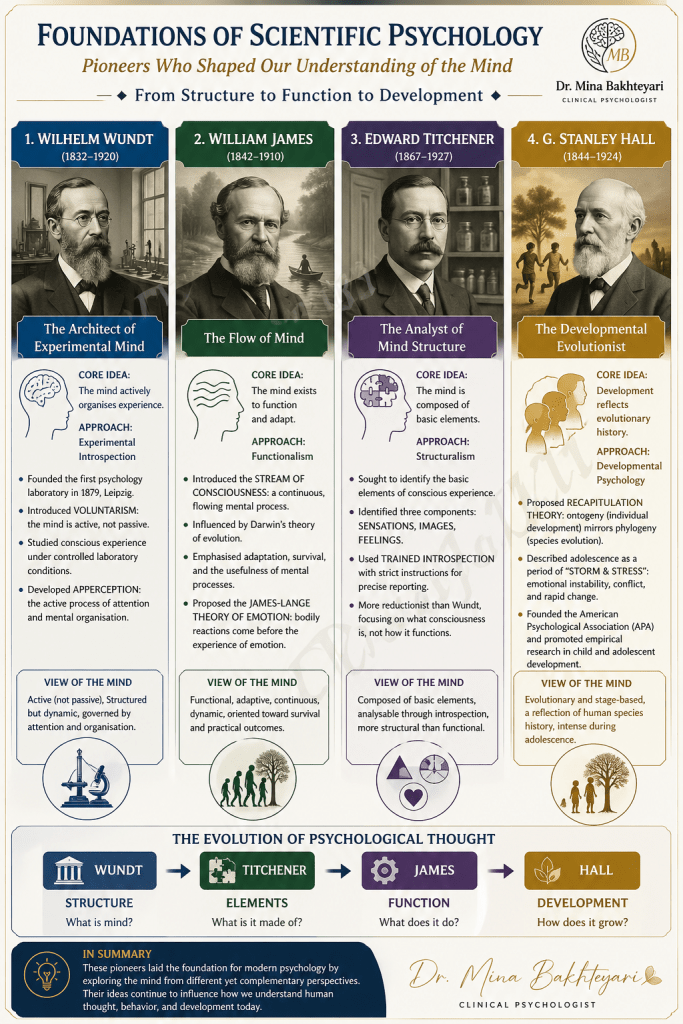
🧠 Wilhelm Wundt (Experimental Introspection)
Wilhelm Wundt (1879) is a pioneer of scientific psychology, and he marked a turning point in the distinction between psychology and philosophy by founding the first dedicated psychology laboratory in Leipzig.
His theoretical framework, termed voluntarism, emphasised the systematic study of conscious experience using controlled introspection. Wundt’s theory, known as voluntarism, emphasises that the mind is not passive but actively organises experiences. He aimed to study the structure of conscious experience by breaking it down into basic elements such as sensations and feelings.
His approach was experimental introspection, meaning that trained participants reported their immediate conscious experiences under controlled laboratory conditions. It is worthly to note that the rigorous procedures to ensure reliability distinguished this approach from philosophical introspection.
Apperception is a central concept in Wundt’s theory, and it refers to the active process of attention and mental organisation. According to Wundt, individuals selectively attend to certain stimuli and integrate them into meaningful wholes.
In summary, Wundt viewed the mind as an Active (not passive), Structured but dynamic and governed by attention and organisation processes.
🧠 William James (Functionalism)
William James is the founder of Functionalism, a perspective that focuses on the functions of the mind and behaviour rather than their structure. s
His proposed of the question of What is the purpose of consciousness? is that consciousness is a continuous, flowing process, which is called the stream of consciousness. According to James, thoughts are not separate units but part of an ongoing, dynamic flow.
Influenced by Charles Darwin, James emphasised that mental processes help individuals adapt to their environment. Moreover, he noted that behaviours and thoughts are useful because they increase survival and effectiveness in real-life situations.
He also introduced a pragmatic approach, suggesting that the value of an idea lies in its practical consequences. In addition, James contributed to the study of emotion, proposing (with Lange) that bodily reactions come before emotional experience (James-Lange theory).
In summary, James viewed the mind as a Functional, adaptive, continuous, dynamic, oriented toward survival and practical outcomes.
🧠 Edward Titchener (Structuralism)
Edward Titchener, a student of Wilhelm Wundt, developed Structuralism in a more systematic and reductionist way. His main goal was to identify the basic elements of conscious experience and understand how they combine to form complex mental processes.
Furthermore, he stated that the mind can be broken down into three primary components:
- Sensations (perceptions from the external world)
- Images (mental representations)
- Feelings (emotional components)
According to his theory, that was trained introspection, where participants were carefully instructed to describe their immediate experiences without interpretation. He emphasised precise, analytic reporting of mental content.
Unlike Wundt, Titchener viewed the mind more as a passive structure, focusing on what consciousness is rather than how it functions. His approach was criticised for being too subjective and lacking scientific reliability, which eventually led to the decline of Structuralism.
- In summary, Titchener viewed the mind as a Composed of basic elements, Analyzable through introspection and More structural than functional.
🧠 G. Stanley Hall (Developmental Perspective)
G. Stanley Hall is considered a pioneer of Developmental Psychology in the United States. He was strongly influenced by Charles Darwin and applied evolutionary ideas to human development.
His most well-known concept is the Recapitulation Theory, which suggests that an individual’s development (ontogeny) mirrors the evolutionary development of the human species (phylogeny). In other words, as children grow, they pass through stages that reflect earlier forms of human evolution.
Hall emphasised adolescence, describing it as a period of storm and stress, characterised by emotional instability, conflict, and rapid change. He believed this stage is critical for identity formation and psychological development.
In addition to theory, Hall contributed significantly to the institutionalisation of psychology, founding the American Psychological Association and promoting empirical research in child and adolescent development.
In summary, Hall viewed development as an evolutionary and stage-based, a reflection of human species history, and particularly intense during adolescence.
Dr Mina Bkhterari Hftlangi
 Dr Mina Bakhterari Haftlangi
Leave a comment