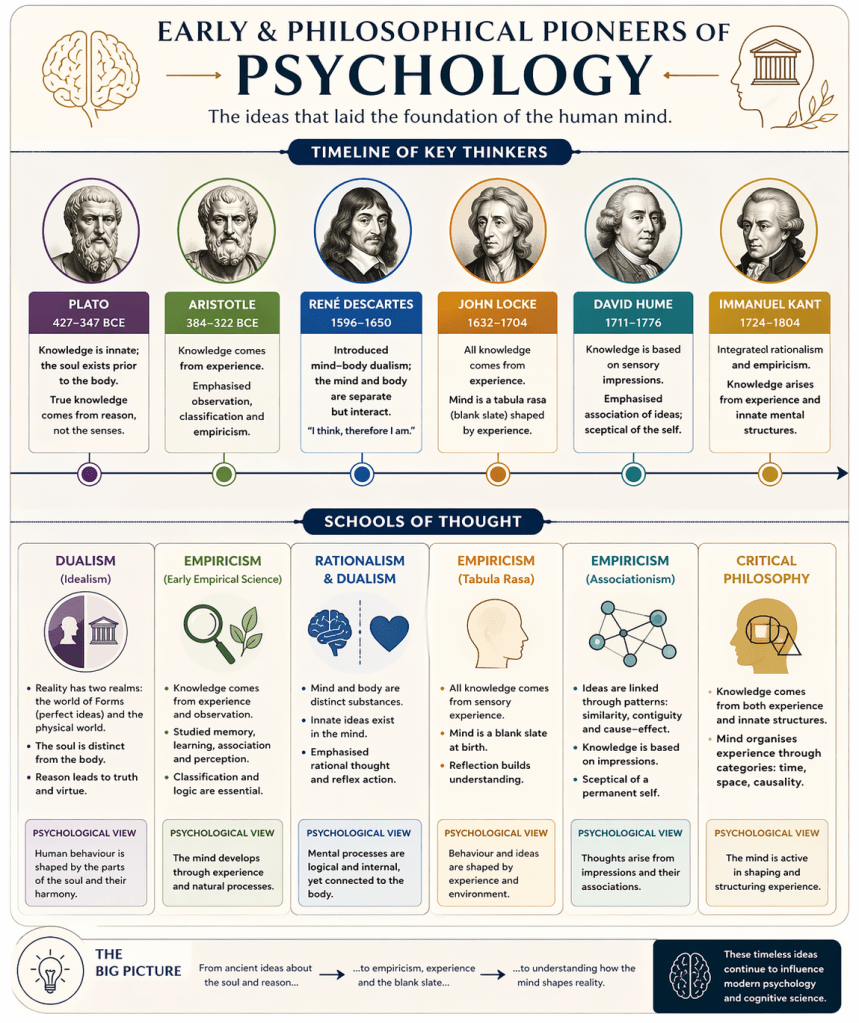
🏛️ Plato:
Plato is the first name that is known for his proposed that knowledge is innate and that the soul exists prior to the body. He introduced a dualist view, separating the world of ideas (Forms) from the physical world. According to Plato, true knowledge comes from reason, not sensory experience. He conceptualised the human soul as comprising three interrelated components that shape behaviour and psychological functioning.
These three parts are included: 1. The rational part that is responsible for reasoning, truth-seeking, and decision-making, and guiding the individual toward wisdom. 2. The spirited part is associated with emotions such as courage, anger, and the drive for honour, acting as a motivating force that supports or resists the rational mind. 3. The appetitive part reflects basic desires and impulses, including hunger, pleasure, and material cravings.
According to his theory, psychological balance and ethical living depend on harmony among these three elements. In other words, with the rational part ideally governing the other two parts to maintain order within the individual.
🏛️ Aristotle:
believed that knowledge comes from experience, that the mind begins as a blank slate or tabula rasa, and he rejected Plato’s nativism. He claimed that. Aristotle emphasised empiricism, observation, and classification. He also studied memory, learning, and association, laying the groundwork for later behavioural theories.
🧠 René Descartes
Descartes introduced the concept of mind–body dualism. In his approach, the mind and body are separate but interact. He believed in innate ideas and emphasised rational thought (I think, therefore I am). He also proposed early ideas about reflexes and physiological processes, bridging philosophy and biology.
🧠 John Locke:
He developed the perspective of empiricism, that all knowledge comes from experience. He developed the concept of the mind as a tabula rasa, shaped by sensory input and reflection. His ideas influenced learning theories and later behaviourism.
🧠 David Hume
Hume expanded empiricism and argued that knowledge is based on sensory impressions. He emphasised association of ideas, suggesting that thoughts are linked through patterns such as similarity and cause-and-effect. He was sceptical about the concept of a stable self.
🧠 Immanuel Kant:
He integrated rationalism and empiricism, and that knowledge arises from both sensory experience and innate mental structures. According to Kant, the mind actively organises experience through categories such as time, space, and causality.
 Dr Mina Bakhterari Haftlangi
Leave a comment