Introduction
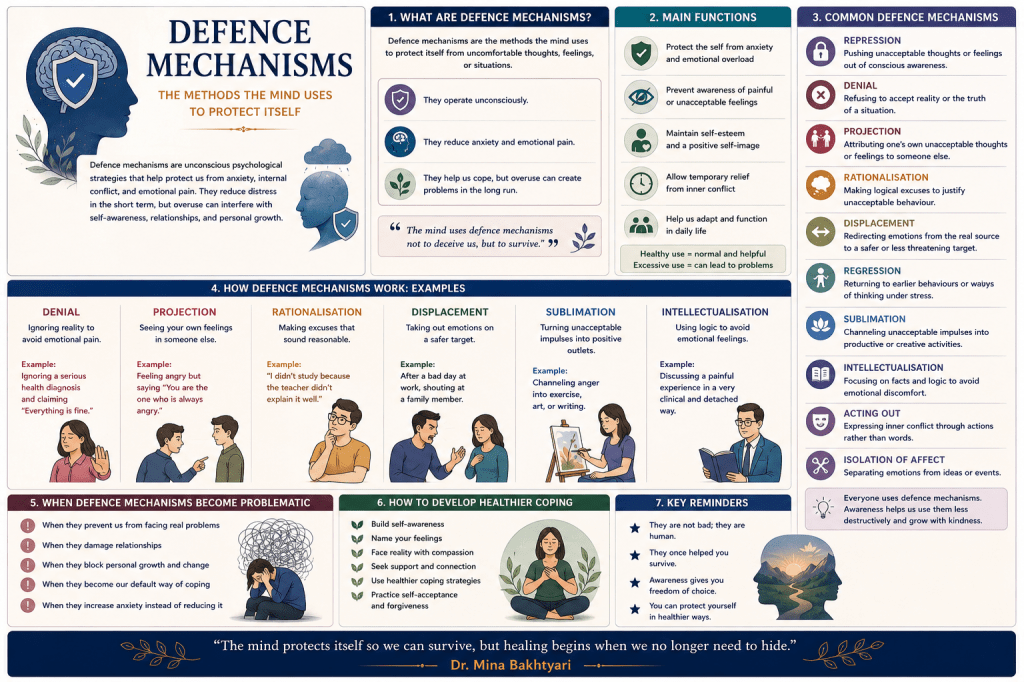
In clinical practice, one of the most consistent observations is that individuals rarely respond to psychological distress in a direct, conscious manner. Instead, the mind employs defence mechanisms, automatic psychological strategies designed to protect the individual from anxiety, internal conflict, and emotional overload.
Originally conceptualized by Sigmund Freud and later elaborated by Anna Freud, defence mechanisms are now understood as essential components of everyday psychological functioning, not merely pathological processes. Rather than viewing them as problems, modern clinical psychology considers them part of a continuum of adaptation, ranging from immature to highly sophisticated coping styles.
It can be defined in a simpler phrase that the Defence Mechanisms are largely unconscious processes that modify how we perceive reality, regulate emotions, and maintain psychological equilibrium.
They operate when:
- Internal conflicts (e.g., desire vs morality) become overwhelming
- External stressors threaten self-concept
- Emotional experiences exceed current coping capacity
At their core, they serve one function: To reduce psychological distress while preserving a sense of self-coherence.
The Structural Logic Behind Defences
From a psychodynamic perspective, defence mechanisms emerge from tension between:
- Id (instinctual drives)
- Ego (reality-oriented mediator)
- Superego (internalized moral standards)
When this system becomes imbalanced, the ego deploys defences to prevent Anxiety from reaching conscious awareness.
A Clinical Hierarchy of Defence Mechanisms
1. Immature Defences (Primitive Level)
These are often observed in early development, personality disorders, or high-stress states. They tend to distort reality more significantly.
Examples:
- Denial: Refusal to accept reality (This is not happening)
- Projection: Attributing one’s own feelings to others
- Splitting: Viewing people as all good or all bad
- Acting Out: Expressing unconscious conflict through behaviour
- Somatisation: Emotional distress appearing as physical symptoms
Clinical insight: Persistent use may indicate poor emotional integration and difficulties with identity stability.
2. Neurotic Defences (Intermediate Level)
These mechanisms are common in the general population and often seen in anxiety and mood disorders.
Examples:
- Repression: Unconscious blocking of distressing thoughts
- Displacement: Redirecting emotions to safer targets
- Intellectualisation: Over-reliance on logic to avoid feelings
- Dissociation: Temporary disconnection from reality or self
- Rationalization: Justifying behaviour with seemingly logical explanations
Clinical insight: They allow functioning but often maintain underlying unresolved conflict.
3. Mature Defences (Adaptive Level)
These represent the most psychologically healthy ways of managing internal tension.
Examples:
- Sublimation: Channelling impulses into constructive activities
- Humour: Expressing distress in a socially acceptable way
- Altruism: Helping others to regulate internal emotions
- Suppression: Consciously postponing emotional processing
- Anticipation: Preparing for future stress realistically
Clinical insight: Associated with resilience, emotional intelligence, and long-term well-being
Beyond Freud: Contemporary Extensions
Modern clinical frameworks expand defence mechanisms beyond classical psychoanalysis:
- Projective Identification: Interpersonal enactment of projected feelings
- Identification with the Aggressor: Adopting traits of a threatening figure
- Idealisation & Devaluation: Common in relational instability
- Compensation: Overdeveloping one domain to mask vulnerability
- Conversion: Psychological conflict expressed neurologically
These mechanisms are particularly relevant in:
- Trauma-related disorders
- Personality pathology
- Complex relational dynamics
Why Defence Mechanisms Matter in Therapy
Understanding defence mechanisms is not about removing them; it is about Increasing awareness,
Enhancing emotional processing,
Replacing rigid defences with flexible coping.
In therapy, clients often move from Automatic, unconscious defences to Conscious, adaptive regulation strategies. This transition is a key marker of psychological growth.
A Practical Clinical Example
A client experiencing anger toward a parent may:
- Displace anger onto colleagues
- Rationalize the parents’ behaviour
- Somatize stress into headaches
Through therapy, this may evolve into:
- Recognition of underlying emotion
- Direct emotional expression
- Use of mature defences (e.g., humour, insight)
In summary, Defence mechanisms are not signs of weakness—they are evidence of the mind’s attempt to survive emotional complexity.
The goal is not elimination, but refinement from rigid protection → to flexible adaptation. In this way, defence mechanisms become not barriers, but pathways to self-understanding and psychological integration.
Dr Mina Bakhteyari Haftlangi Contact Information
 Dr Mina Bakhterari Haftlangi
Leave a comment