Introduction
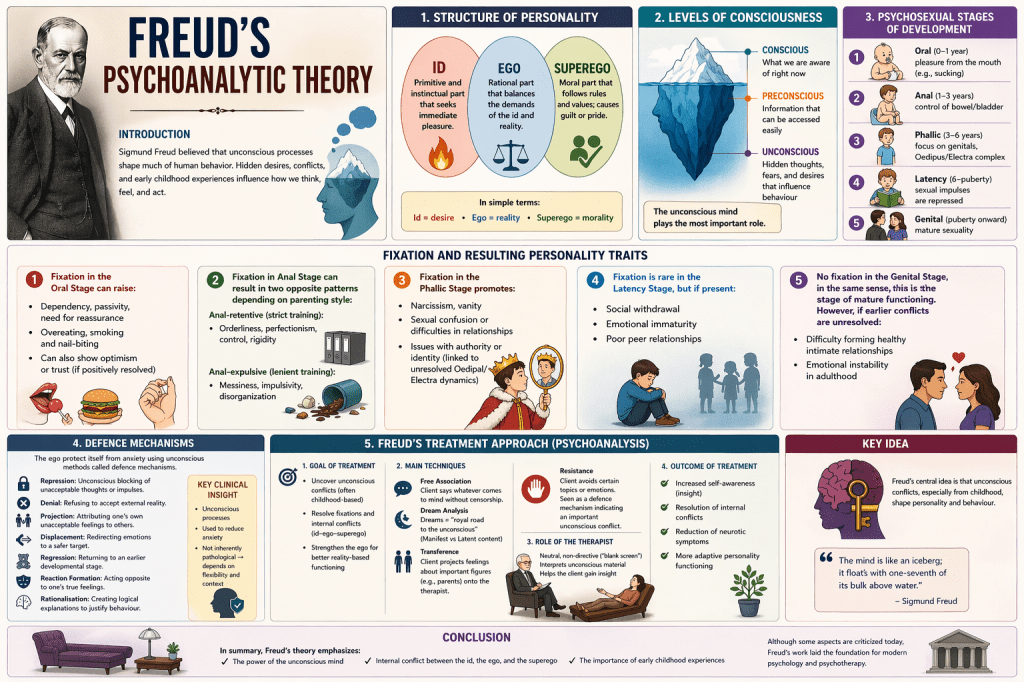
Sigmund Freud, the founder of psychoanalysis, proposed that unconscious processes largely influence human behaviour. According to Freud, much of what we think, feel, and do is driven by hidden desires, conflicts, and early childhood experiences.
1. Structure of Personality
Freud divided personality into three parts:
- Id: The primitive and instinctual part of the mind that operates on the pleasure principle and seeks immediate gratification (e.g., hunger, sex, aggression).
- Ego: The rational part that operates on the reality principle. It balances the demands of the id and the constraints of reality.
- Superego: The moral component represents internalized societal rules and values. It creates feelings of guilt or pride.
👉 In simple terms:
Id = desire, Ego = reality, Superego = morality
2. Levels of Consciousness
Freud described the mind as having three levels:
- Conscious: What we are aware of right now
- Preconscious: Information that can be accessed easily
- Unconscious: Hidden thoughts, fears, and desires that influence behaviour
👉 The unconscious mind plays the most important role.
3. Psychosexual Stages of Development
Freud believed personality develops through five stages:
- Oral (0–1 year) – pleasure from the mouth (e.g., sucking)
- Anal (1–3 years) – control of bowel/bladder
- Phallic (3–6 years) – focus on genitals, Oedipus/Electra complex
- Latency (6–puberty) – sexual impulses are repressed
- Genital (puberty onward) – mature sexuality
👉 Fixation and Resulting Personality Traits
1. Fixation in the oral personality can raise:
- Dependency, passivity, need for reassurance
- Overeating, smoking and nail-biting
- Can also show optimism or trust (if positively resolved)
2. Fixation in Anal stage can result in two opposite patterns depending on parenting style:
- Anal-retentive (strict toilet training):
- Orderliness, perfectionism, control, rigidity
- Anal-expulsive (lenient training):
- Messiness, impulsivity, disorganization.
3. Fixation in the Phallic Stage promotes:
- Narcissism, vanity
- Sexual confusion or difficulties in relationships
- Issues with authority or identity (linked to unresolved Oedipal/Electra dynamics)
4. Fixation is rare in the Latency Stage, but if present:
- Social withdrawal
- Emotional immaturity
- Poor peer relationships
5. No fixation in the Genital Stage, in the same sense, this is the stage of mature functioning. However, if earlier conflicts are unresolved
- Difficulty forming healthy intimate relationships
- Emotional instability in adulthood
4. Defence Mechanisms
Freud claimed that the Ego protect themselves when they face a challenging situation with some methods that he called Defence Mechanisms for reducing Anxiety.
These operate unconsciously to protect the individual. Below is a comprehensive, clinically structured list of Freud’s defence mechanisms (including classical Freudian and later ego-psychology extensions by Anna Freud):
- Repression: Unconscious blocking of unacceptable thoughts or impulses.
- Denial: Refusing to accept external reality.
- Projection: Attributing one’s own unacceptable feelings to others.
- Displacement: Redirecting emotions to a safer target.
- Regression: Returning to an earlier developmental stage.
- Reaction Formation: Acting opposite to one’s true feelings.
- Rationalisation: Creating logical explanations to justify behaviour.
Key Clinical Insight about the Defence mechanisms is:
- Unconscious processes
- Used to reduce Anxiety
- Not inherently pathological → depends on flexibility and context
5. Key Idea:
Freud’s central idea is that Unconscious conflicts, especially from childhood, shape personality and behaviour.
Freud’s Treatment Approach (Psychoanalysis)
1. Goal of Treatment
- Uncover unconscious conflicts (often childhood-based)
- Resolve fixations and internal conflicts (id–ego–superego)
- Strengthen the ego for better reality-based functioning
2. Main Techniques
Free Association
- Client says whatever comes to mind without censorship
- Reveals unconscious material through patterns, slips and themes
Dream Analysis
- Dreams = “royal road to the unconscious”
- Manifest content (what is remembered) vs latent content (hidden meaning)
Transference
- Client projects feelings about important figures (e.g., parents) onto the therapist
- Therapist analyzes this to uncover relational patterns
Resistance
- Client avoids certain topics or emotions
- Seen as a defence mechanism indicating an important unconscious conflict
3. Role of the Therapist
- Neutral, non-directive (“blank screen”)
- Interprets unconscious material
- Helps the client gain insight
4. Outcome of Treatment
- Increased self-awareness (insight)
- Resolution of internal conflicts
- Reduction of neurotic symptoms
- More adaptive personality functioning
Conclusion
In summary, Freud’s theory emphasizes:
- The power of the unconscious mind
- Internal conflict between the id, the ego, and the superego
- The importance of early childhood experiences
Although some aspects are criticised today, Freud’s work laid the foundation for modern psychology and psychotherapy.
 Dr Mina Bakhterari Haftlangi
Leave a comment