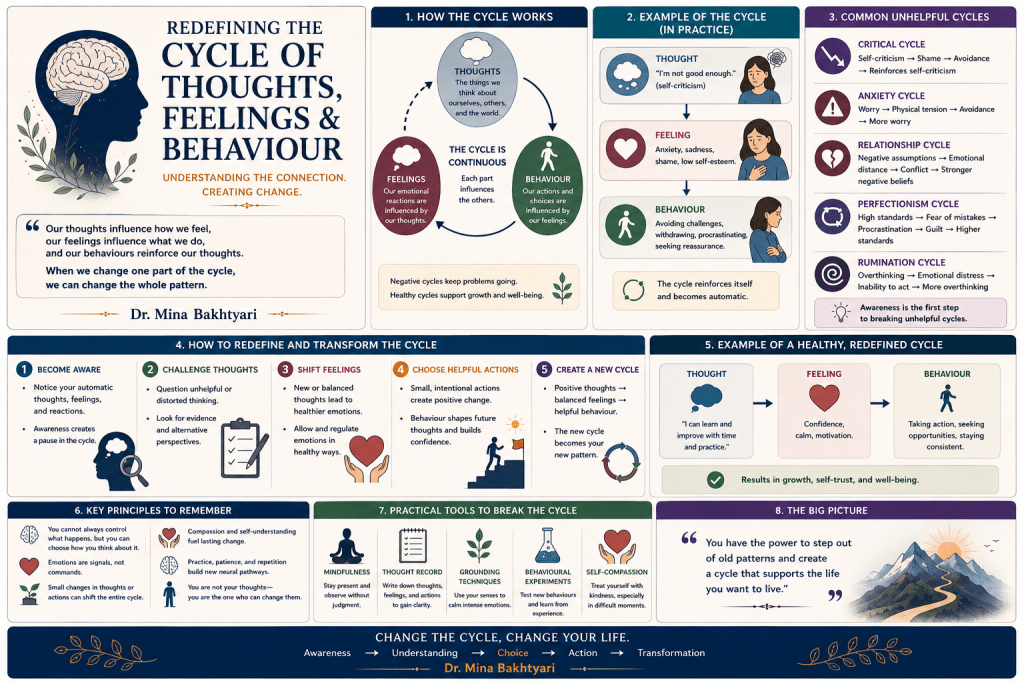
One of the most common patterns observed in therapy is the repetition of the same emotional responses, behaviours, and outcomes. Many individuals find themselves feeling stuck, as if they are caught in a cycle they cannot fully understand or control.
This is not random; rather, it is a pattern that reflects a structured psychological process through which the mind interprets experiences and generates responses.
The Psychological Cycle
At its core, this process can be understood as a cycle:
Stimulus → Thoughts → Emotions → Behaviour
A situation (stimulus) does not directly create emotions. Instead, it is your interpretation of that situation that shapes how you feel and how you act.
The Missing Layer: How Past Experiences Shape the Cycle
To fully understand this cycle, we must go one level deeper.
Your past experiences, especially early relationships and emotionally significant events, form underlying cognitive structures known as:
- Core Beliefs (e.g., I am not enough, or I am good and others are not)
- Schemas (e.g., abandonment, rejection, defectiveness)
These exist before any situation occurs and act as a psychological filter.
This means:
You are not reacting to reality directly.
You are reacting to the meaning your mind assigns to reality.
How the Cycle Works in Practice
1. Stimulus (Trigger)
A stimulus can be:
- A conversation
- A message
- A stressful situation
- A memory
At this stage, nothing has emotional meaning yet.
2. Thoughts (Interpretation)
Your mind automatically interprets the situation.
These thoughts are:
- Fast
- Often unconscious
- Strongly influenced by past experiences
Examples:
- They do not like me
- Something will go wrong
- I am not good enough
This is the key point where past experiences enter the cycle.
3. Emotions
Your interpretation generates emotional responses:
- Anxiety
- Sadness
- Anger
- Shame
The same situation can produce completely different emotions depending on how it is interpreted.
4. Behaviour
Your emotions influence how you respond:
- Avoidance
- Withdrawal
- Overreaction
- Seeking reassurance
🔹 Why This Becomes a Cycle
Over time, behaviours reinforce the original thoughts.
For example:
- You avoid a situation
- You feel temporary relief
- Your brain learns “avoidance = safety”
- Anxiety increases in the long term
This creates a self-perpetuating loop.
🔹 The Deeper Model (CBT + Schema Integration)
To understand this more precisely:
Past Experiences → Core Beliefs / Schemas → Thoughts → Emotions → Behaviour → Reinforcement of Beliefs
This explains why the same patterns repeat—even when situations change.
The point is that You Can Intervene It. How?
Although this cycle feels automatic, there are specific points where change is possible.
1. Thoughts (Most Effective Entry Point)
You can begin to:
- Notice automatic thoughts
- Question their accuracy
- Replace them with more balanced interpretations
This directly influences emotions and behaviour.
2. Behaviour (Fastest Change Mechanism)
Even if thoughts remain the same, changing behaviour patterns helps to:
- Create new experiences
- Disconfirm old beliefs
- Reduce avoidance patterns
3. Core Beliefs / Schemas (Deep Work)
At a deeper level, therapy can address long-standing patterns using approaches such as:
- Schema Therapy
- Experiential techniques
- Emotional processing
This leads to more lasting structural change.
How to Begin Breaking the Cycle
- Increase awareness of your thoughts
- Pause before reacting emotionally
- Aware and understanding emotions before action
- Choose more adaptive behavioural responses
Even small changes can interrupt the cycle and gradually reshape your psychological patterns.
🔹 Clinical Perspective
In Cognitive Behavioural Therapy (CBT), the focus is on identifying and modifying unhelpful thoughts and behaviours. What maintains emotional difficulties is not the situation itself, but:
The meaning assigned to it is shaped by past experiences and reinforced by behaviour.
🔹 Final Note
If you notice that you are repeatedly experiencing the same emotional patterns, this is not a sign of weakness; it is a sign of an underlying structure that can be understood and changed.
With the right guidance, these cycles can be interrupted, reshaped, and ultimately transformed.
Contact me or book a session to begin your process of change.
 Dr Mina Bakhterari Haftlangi
Leave a comment